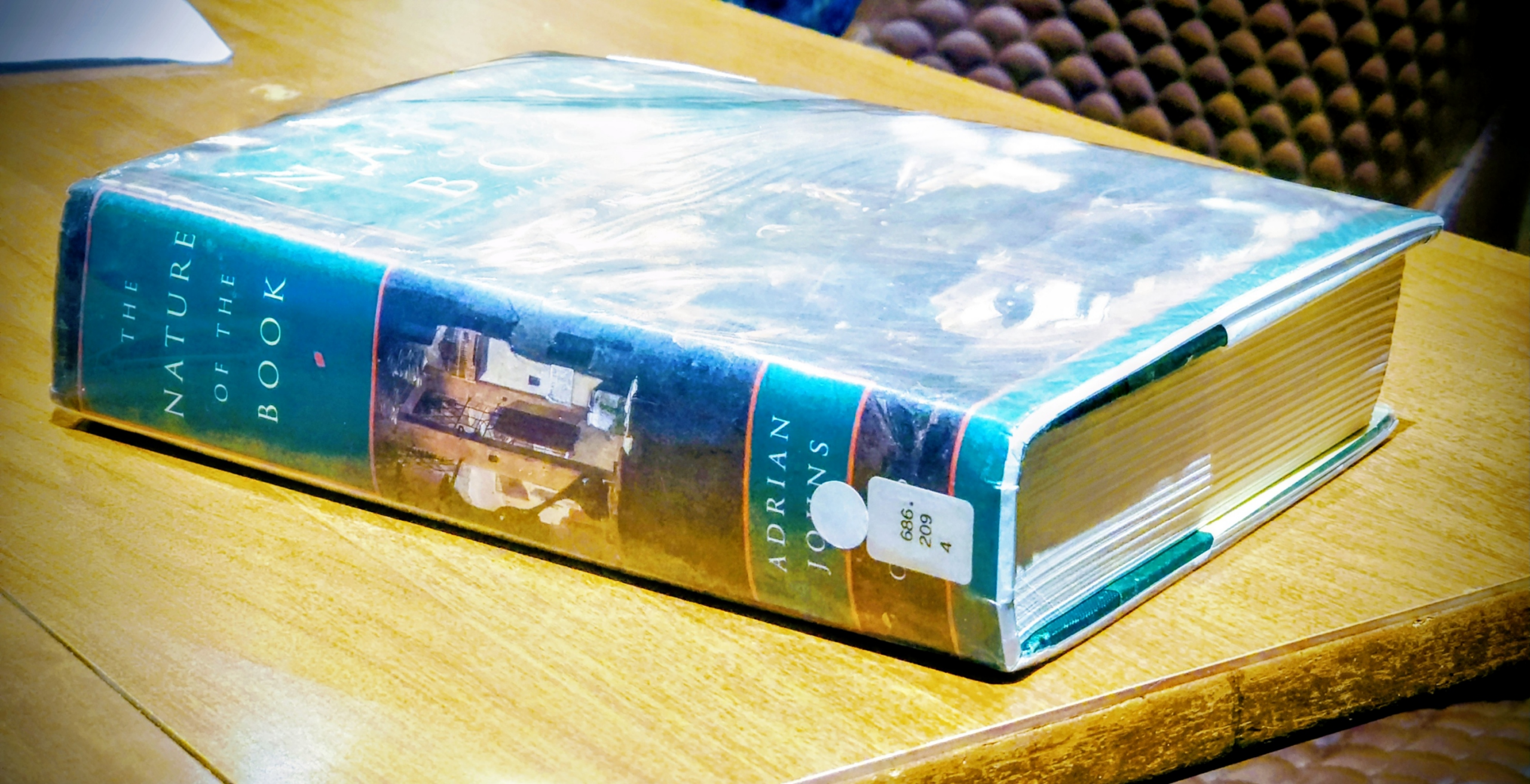

A book review of Adrian Johns’ 1998 publication, by University of Chicago Press
In this series of posts, I’ll be reviewing different academic texts to discover other tools for use in discussing literary texts.
Something that struck me as of paramount importance when designing these lessons was to open with some discussion of ‘what literature is’, The small ‘l’ denoting the common, concrete noun of the object-in-hand, as opposed to capital ‘L’ denoting the proper, abstract noun of the course; Literature. How we define this object as literary, and an object distinct from others is not well grasped by students and I wonder how much of a limitation this is to student responses. If one cannot define the object-in-hand, not acknowledge the distinction from the field of study and its methodologies, will this constitute a limitation in one’s analysis? Does this limitation impart a feel in our expression?
I think so. Sophisticated readers have a sophisticated grasp of the material, and this should not be assumed to be some innate skill or sense that the sophisticated reader has, from which other students are effectively ‘deficient’. It is a matter of culture, cultivation, nurture or more explicitly; instruction.
The Nature Of The Book by Adrian Johns opens his text begging this very same question;
Pick up a book. What sort of object is it? There are certain features about it of which you can be reasonably confident. Begin to use this object. It should immediately become clear that there are things about its proper utilization of which a reader like you can be equally confident (p1).
The teaching of Literature relies upon some first principles, what constitutes a literary text and what function is perform by the text. One of this website’s early lessons imparts the idea of fiction and non fiction, intending to cultivate the idea that literature is not well defined as merely works of make-believe. There is more reality contained within literature than there is the imaginary. For me, they are a sort of para-reality. That is, they exist parallel to our own and are so similar, that only very small deviations from our reality could give us that of the literary text. So close is the non-fiction within the text, that it serves the purpose of demonstrating the reality we do live in.
For Johns, the very nature of the book itself is one that has to be made (p2). His work attempts to portray print culture in the making. Recovering the processes from which today’s literary texts are derived impact how we think of the object-in-hand right now; questions of where it had come from, who had made it, whether or not its putative author acknowledge its content (p3) in order that we may use it properly.
Johns recognises that there is another question to be answered here: how it is then put to use, by whom, in what circumstances and to what effect are all equally complex issues (p3) needing resolved for a literary text to be put to proper use.
So, texts have a form and a function, though function has two modes; the function intended by the author and the function given to it by its audience. The function of a literary text differs from place to place, and its nature changes over time. The historical timeline of literature is a journey of changing functional deployment, whilst Johns refers to centuries, we here break the function into eras of ‘modernity’, largely grouping the function of the text into one that meets the needs of those in power. Literature is generally either a container for the narratives of power, or it is subversive. But power is permissive of literary production; power controls the legislation, the printing press and possibly even the costs too through taxation. Therefore, subversive texts really exist only as permitted within the ideological narrative. How subversive can literature be, when the very ideology promotes subversion? Today’s challenging texts are not exactly underground productions being passed around in smokey basements whilst henchmen sentry the cellar-door. This knowledge of Literature is positioned within the lessons of eras, and intends to establish some understanding that literary texts are part of political structures, they are not a-part from them.
If we accept that the eras and the ideological frameworks of each are a driving motivator of the narrative within literary works, we accept that literature reflects the eras, and we can learn about those eras through the text. Or conversely, we can better understand the text through a knowledge of the era preceding the reading:
Here, then is one way in which a social history of print can prove not just interesting, but consequential. A reappraisal of print in the making can contribute to our historical understanding of knowledge itself. The central concern of this book is the relation between print and knowledge. It proposes a new account of how early modern Europeans put printing to use to create and maintain knowledge (p6).
Johns work attempts to explore how knowledge, as sustained through literature might be catagorized into, for instance; scriptural knowledge, astronomy, experiment, alchemy, to political ideologies and representations of gender. The lessons of this website attempt to capture the basics of this very premise, that Literature is a study through which the cultural world along with its ideologies, it representations, its dramatic performance and even the very nature of people can be better understood. It is this sustaining of knowledge that creates culture. The mechanism of sustenance then is of paramount importance; enter the printing press, and its output; physical literature.
The printing press gave a much higher standard for permanence, and the cultural effects of the Renaissance and Reformation “were rendered permeant by the very permanence of their canonical texts, that nationalism developed thanks to the stabilization of laws and languages.” The printed text, literature, is how culture is maintained and the printing press is the machinery of this process. Meaning is fixed because for hundreds, or thousands of copies, it is assumed contained exact replicas of the original meaning. The author, publisher, printer, date and other credits are assumed ‘fixed’. Any item can be held anywhere in the world, and be studied equally because it is one of the few man-made objects that suffers neither decay nor adaptation – not at least without the consent of those credit within. This, argues Johns, is one of the tenants of Elizabeth Eisenstein’s Printing Press (which has been a key source texts for the lessons, before even the website was conceived), and permanence is a concept that he opposes.
Johns suggest that by holding printed works in too high esteem, we run the risk of feeling that printed texts have some innate, inherent quality that we call print culture, but that this cannot necessarily be determined nor analysed. Eisenstein might argue that print culture has about it a ‘fixity’, the culture is for wider dissemination, that print preserves and accumulates knowledge. Johns argues that this culture is not inherent with print; it would not have this same culture should printing spontaneously manifest in another place and time. The print culture we have is formed within the social and historical sphere. Stability of print is not automatic, faith in the author and publication is fragile, ‘authority’ is contested. These facets are easily swayed by the social and the historical contexts around the reader.
This distinction is important for Johns because to accept Eisenstein’s premise of the intrinsic and predestined nature of print culture, discourages us from investigating how printers work, what to trust, the legal and commercial pressures. Some of these pressures are evident in the lessons here provided – by exploring the political, ideological and often religious pressure on print culture we can see how meanings are instable, authority changes and fixity is fragility.
Fixity is fragile; by example for this, Johns gives Salman Rushdie’s Satanic Verses, a text suffering plagiarism and altered even before the work was published. These unauthorised versions were disseminated in India and Pakistan long before the authorised publication, culminating in Khomeini’s Fatwa – print culture might even accelerate unauthorised narratives by obtaining and subverting existing material. Print has never guaranteed control authority and integrity.
The difference between Johns and Eisenstein comes down to one of stability and permanence afforded to culture through print, in which Johns presents the fragility of print culture and opposes some notional inherent fixity. Print cannot be assumed to prohibit change in meanings across time and place.
—
How does this knowledge change the way we teach Literature? It potentially adds to our toolbox of terms, and the way we conceive of the analysis of literary texts.
- Print Culture – the idea books, being printed, contain some innate intrinsic culture that was not imbued upon them by time nor place, but by technology.
- Permanence – the degree to which the meanings within a book are unchanging
- Fixity – that meanings in books are fixed by the process of printing, that literal print is uneditable and neither too are meanings.
- Fragility – that meanings in books are suspect to change and adaptation, especially when plagiarism is concerned.
- Integrity – the difficulty in changing the meanings within a book. Integrity could be increased when the author, publishing house and printer are reliable, or decrease then they are unreliable.
- Permanence – the degree to which the meanings within a book are unchanging
How then might this new set of tools be used? A non Literary example:
Permanence is like translating a text into English and coming across a word with no direct translation. Different translators might resolve the deficit in different ways, but all the alternatives will convey something slightly different. This difference cannot be controlled by the author, and so the author cannot rely on some print culture, that its meanings are fixed.
A literary example:
Macbeth writes in a manner in which stage direction is encoded into the very printed text – iambic pentameter and the way speeches end and subsequently start can be used to imply degrees of power, fluidity or even staging. But different publications present the lines differently upon the page, sometimes indented, sometimes aligned, and where multiple lines coalesce but never form the full meter, placement on the page becomes highly divergent across different publications. The intervention by the printer / editor to deviate from a standard presentation of indenting shows the fragility of meanings. The meanings encoded within the original author’s copy does not have a permanence across future editions. Changes to the layout impact the way a line is read, how an actor represents a character, and how the character interacts with the narrative. Print theoretically could have the power to fix meanings, but authors are not in control of many of the subsequent process that change the printed work, and so there is no intrinsic print culture for fixity that can be relied upon.
Leave a Reply