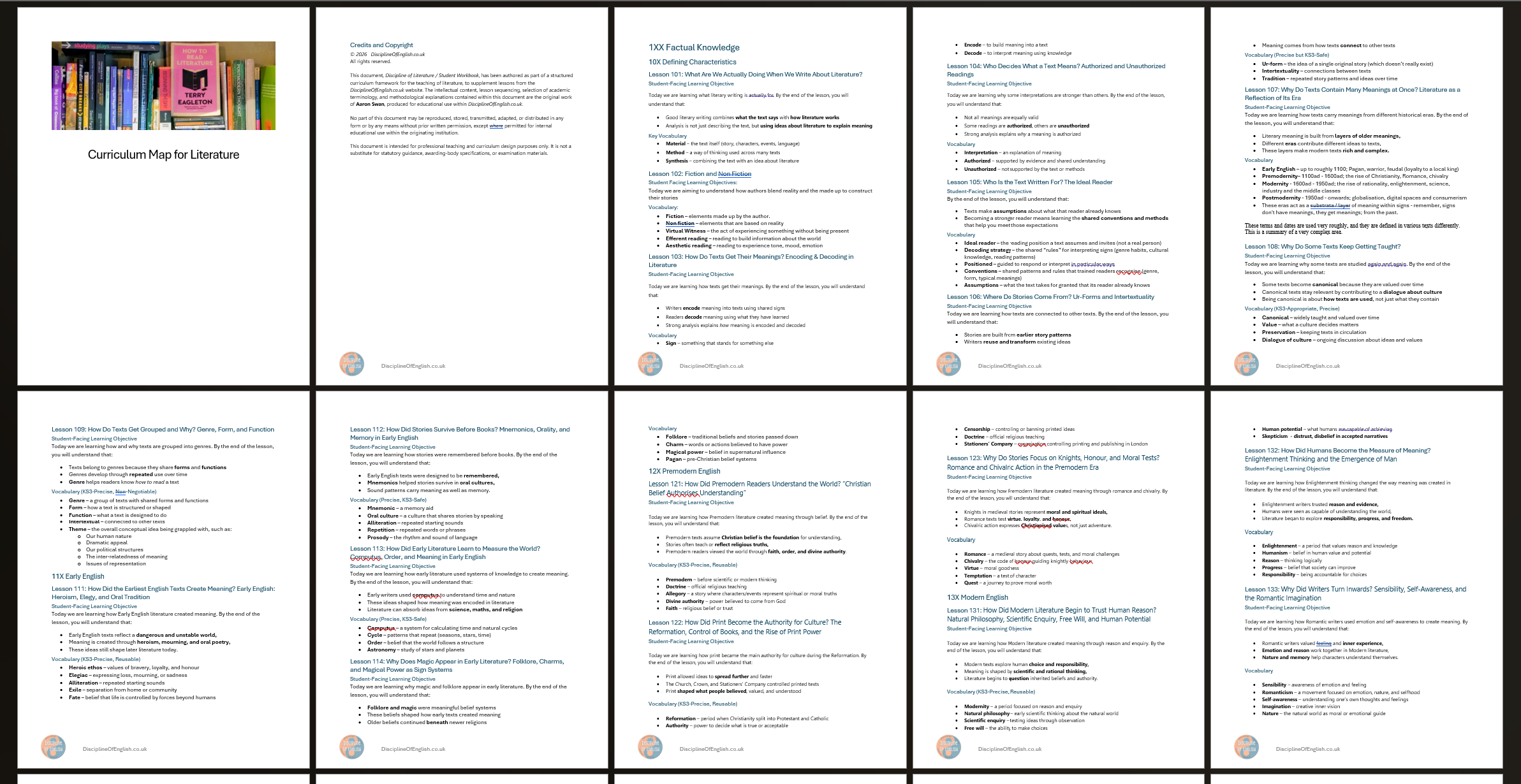

There are many artifacts that have an a-priori structure to their design. Almost all text books contain at the beginning, an introduction, a contents page, chapters, glossary, an index and references. This makes perfect sense, but of course is a structure that has only become common and expected through evolution and repetition of the form.
These elements of a text book are highly instructive of how we might build a curriculum – or the inverse is true. That the pedagogy instructing of the curriculum is equally valid to the structure of our textbooks. And yet, our curriculum does not always contain these directed elements. One of the biggest omissions has to be the glossary – I have not yet worked in a department that has, as part of it’s standard set of documents, a glossary. And I challenge you – does your department have a self-curated handbook of terms? Terms which are key ingredients to the delivery of your curriculum?
A literature glossary is a difficult thing to construct because it has the prerequisite of a methodological curriculum that is not always well defined – the glossary is the referrent of the curricular document, it comes after and out from the curricular document. And this is why I think departments don’t have a glossary of terms, because they lack the very curriculum document that identifies them.
This knowledge curriculum (as a separate domain of knowledge to the material text) is the one of the most important structural elements of the curriculum at DisciplineOfEnglish.co.uk. The document defines what knowledge is to be taught, and from that we can extract the vocabulary that is key in using that knowledge. Now that the vocabulary is defined, a glossary can be constructed, which as is shown almost universally in handbooks comes to the benefit of students.
This glossary can be presented in two ways. The first is the typical alphabetized glossary. This is useful if you are looking up a term in isolation. But if you are analysing from within a particular learning objective, the alaphabetized glossary can’t be used to find relevant vocabulary. A better glossary is one that groups words by learning objective (as the lesson does).
So now, DisciplineOfEnglish has two glossaries to explore, both available at Literature’s head page.
The new glossary-by-LO is especially important. It presents all of the available lessons in sequence, along with the key learning objective, and the connected vocabulary. Here’s what the glossary-by-LO looks like:
Lesson 107: Why Do Texts Contain Many Meanings at Once? Literature as a Reflection of Its Era
Student-Facing Learning Objective:
Today we are learning how texts carry meanings from different historical eras. By the end of the lesson, you will understand that:
- Literary meaning is built from layers of older meanings,
- Different eras contribute different ideas to texts,
- These layers make modern texts rich and complex.
Vocabulary:
- Early English – up to roughly 1100; Pagan, warrior, feudal (loyalty to a local king)
- Premodernity– 1100ad – 1600ad; the rise of Christianity, Romance, chivalry
- Modernity – 1600ad – 1950ad; the rise of rationality, enlightenment, science, industry and the middle classes
- Postmodernity – 1950ad – onwards; globalisation, digital spaces and consumerism
- These eras act as a substrata / layer of meaning within signs – remember, signs don’t have meanings, they get meanings; from the past.
This is what could be considered a ‘minimal prompt’ for analysis. A card that expresses something to know, and a vocabulary to use. Once the LO has been studied, it is hoped that this very minimal prompt is all that is needed to extend one’s analysis.
Imagine these hanging around during revision time, any which way up. If the vocabulary is visible, can the student remember why it is important to Literature? If the LO is visible, can the student remember the kinds of vocabulary useful?
I also have in mind a game to be played using this type of revision card, somewhat like snap. Students shuffle the deck of revision cards and have them in one pack face down with a passage from a text in the middle of the group. They must take it in turns to draw from the deck, then find an extract within the passage that can be synthesised with the card. If done successfully, the card is retained by the player as a victory. If unsuccessful, it is placed to the bottom of the pack. The student with the most cards wins.