
Reading words on the page and turning those into individual units of meaning is referred to as decoding. But connecting units of meaning across large structures requires comprehension. Knowing the types of structures in advance of reading can help comprehension.
Learning Objectives
Teacher Framing:
Structures across disciplines
For Literary studies, structure is given a body of knowledge by theorists such as Todorov from whom we obtain terminology such as equilibrium, disruption, and archetype. We can draw from Barthe’s proairetic and hermeneutic code to discuss structures of literary meaning too.
For Language studies, structure might refer to the question and answer nature of interviews, the use of paragraphing to ‘chunk’ information types, the summary introductions and topic sentences that outline articles, the chronological sequencing or records, the spatial sequencing of inspection.
Before either of these ‘structures’ however is a much more basic knowledge of how texts work, which comes to aid our ‘comprehension’ of texts. General comprehension is a skill required for simple reading; the literacy program. When we are developing our literacy, we are doing more than just decoding words, we are tracing structures of words and attempting to pool content together into comprehension. This lowest order of ‘structure’ is foundational to Language and Literature, but it is not the same structure. At least, not here.
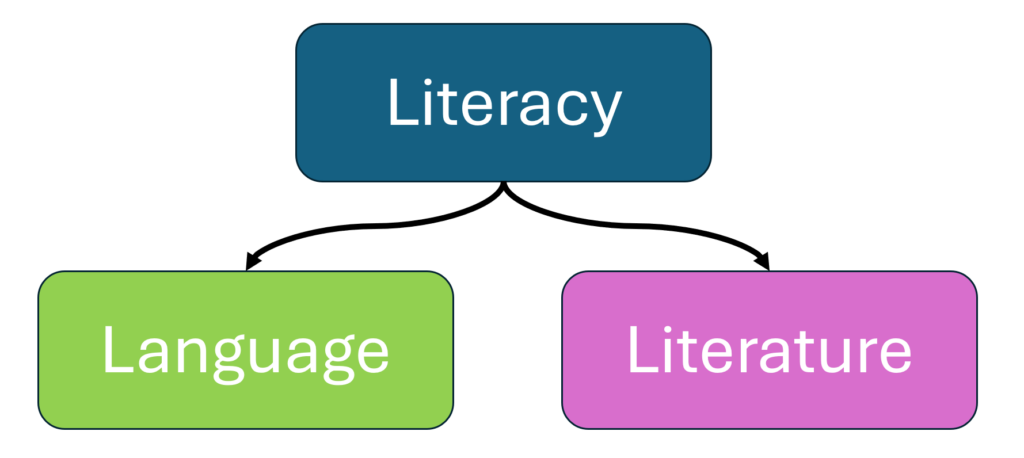
That is because Literacy, Language and Literature are treated as different bodies of knowledge that are divergent in their conclusions, not convergent. They are disciplines deserving of individual time and focus. We can all developed our Literacy skill, our Language knowledge and our Literature knowledge independently of each discipline. It is better not to think of them as a venn diagram with structure as a shared body of knowledge, but three separate bodies but taxonomical bodies of knowledge.
So what is the structure of Literacy that leads to better comprehension of Language and Literature?
Interrogatives
Texts are written as systems of words, each can be decoded individually into single units of meaning. These units of meaning are gathered into sentences for grammatical sense. These sentences are gathered into paragraphs to perform a function. The functions of paragraphs can be explicated so that we can better comprehend the structure of texts.
Who – paragraphs can function as detailing the subjects involved within a text. They will tell us the names, ages, descriptions and histories of subjects. Word classes key to these paragraphs tend to be proper nouns, pronouns – these tend to be the head words in sentences. Dialogue is another significant way of developing detail in ‘who paragraphs’.
What – paragraphs can function as detailing the events and experiences within a text. We learn about the actions and occurrence, which is told to us through dynamic verbs. These verbs tend to be the head word of sentences.
Where – paragraphs can function as detailing the location within a text. We learn about what can be seen, heard or sensed. Concrete nouns tend to be the head words in sentences.
When – paragraphs can function as giving us the era or period. Whilst concrete nouns allow us to detect the period, abstract nouns and prepositions related to time help to locate the period and era.
Why – paragraphs can function as giving us the sequence of events; cause and effect. Writers will rely on connectives to help present the sequence of things.
How – paragraphs can function as giving us the impact on characters; their thoughts, feelings and actions. We might see a focus on the abstract nouns, adjectives or adverbs that help modify the subjects.
Additional rules to interrogatives
Importantly, a writer must not muddy the paragraph by spilling across all information types. It becomes difficult for the reader to comprehend, because it is a kind of information overload. Paragraphs essentially demarcate a transition from one type of information to another.
In exception to the rule however, we see the opening paragraph of news reports cover almost all of the interrogatives to create an expedited ‘summary’ of the story. Each subsequent paragraph details an interrogative one at a time in order of importance.
Paragraphs will revisit interrogatives, there is no correct sequence, and paragraphs can ‘hybridize’ functions to tell a wider range of information. But this variety must always keep in mind the reader. Simple texts limit variation within a paragraph, and complex texts often are so because of the hybridity of information, or even the drastic shift from one function to another.
Implementation
Within a ‘Literacy’ lesson, students can work through the paragraphs identifying what function each is fulfilling, and annotate to one side the interrogative being fulfilled. Knowing this allows us to also focus on the key language classes that imply the function, and highlight those.
Between the function written to one side, and the highlighting done within the paragraph, we have created a ‘skim reading summary’ of the text. A second reading can now focus on these annotations which will help us to recall what was read. As comprehension, working memory or ‘literacy’ improves, this becomes automatic.
Literacy skills should not be correlated as the body of knowledge in Language or Literature, but a preceding skill that improves access to those studies. All need developing as separate disciplines of English, though Literacy can be seen as taxonomically preceding the others. The structures that can be learned in Literacy ultimately help with comprehension of the larger text, just as the structures of Language and Literature do. They are each in need of individual learning and these objectives need to be clear to students.
Student Learning Objectives:
To learn how texts are structured to make meaning clear and accessible.
Core Knowledge:
Well structured texts are easier to understand. Badly structured texts are hard to understand. We make comprehension easier by grouping sentences together because they are doing a similar job – they are telling a kind of information. Each paragraph should do only one job at a time. We can identify the job by deciding what interrogative is being answered; who, what, where, when, why or how.
Key Ingredients:
Key Vocabulary:
- Who – paragraphs can function as detailing the subjects involved within a text. They will tell us the names, ages, descriptions and histories of subjects. Word classes key to these paragraphs tend to be proper nouns, pronouns – these tend to be the head words in sentences. Dialogue is another significant way of developing detail in ‘who paragraphs’.
- What – paragraphs can function as detailing the events and experiences within a text. We learn about the actions and occurrence, which is told to us through dynamic verbs. These verbs tend to be the head word of sentences.
- Where – paragraphs can function as detailing the location within a text. We learn about what can be seen, heard or sensed. Concrete nouns tend to be the head words in sentences.
- When – paragraphs can function as giving us the era or period. Whilst concrete nouns allow us to detect the period, abstract nouns and prepositions related to time help to locate the period and era.
- Why – paragraphs can function as giving us the sequence of events; cause and effect. Writers will rely on connectives to help present the sequence of things.
- How – paragraphs can function as giving us the impact on characters; their thoughts, feelings and actions. We might see a focus on the abstract nouns, adjectives or adverbs that help modify the subjects.
- Function – what the paragraph is focused on doing, its job / role in telling the story.
- Comprehension – understanding
Key Sentence Stems:
“This paragraph’s function is to develop detail in…
“We learn from this paragraph…
“This paragraph increases the detail in…
Key Thinking:
Authors are not ‘free writing’. They control the information being given to us. Authors know the reader can become overwhelmed by information overload. So, seeing what type of information is being delivered bit at a time means we understand how a text is structured to help the reader.
Models
The Tiny Workers Of My Garden

Who
The ants formed a restless community, each individual moving with a certainty that suggested shared purpose. Their small bodies created shifting patterns, as though every member understood its role within the wider, unseen structure guiding their work.
What
They hauled soil, navigated debris, and exchanged brief antennae taps that hinted at rapid communication. Watching their tasks unfold felt like glimpsing a system in motion—gathering, clearing, transporting—each action contributing to a larger sequence I could only partially interpret.
Where
All of this played out along the edge of a sun‑warmed patio slab, where cracks, grains of sand, and drifting leaves created a miniature landscape. The setting magnified their scale, turning ordinary ground into a busy terrain.
When
I watched on a quiet early‑summer afternoon, the kind that slows human activity but seems to energise smaller worlds. Their behaviour, though, belonged to a far older rhythm—patterns shaped across evolutionary time, repeating themselves in this brief moment of my observation.
Why
I watched a dropped crumb trigger a surge of activity, a blocked path forced a rapid rerouting. Each decision seemed both instinctive and strategic, as though their actions were a mechanism that could be predicted and repeated.
How
Their relentless focus invited a steadier attention, a sense that small, purposeful actions accumulate into something meaningful. The ants’ industry left me unexpectedly reflective, as though their world offered a quiet lesson I had only begun to grasp.
Literary example – :
Work through a text carefully and then answer:
- Who is the text about?
- What actions or events do the subjects experience?
- Where is the story set? You can recall things about the place such as the weather too.
- When is the story set? It won’t say it explicitly, but investigate this through the things present and said.
- Why have events occurred? What is the cause and effect?
- How have subjects been affected by the actions, places and periods?
Now Apply To This To Our Text:
Remember, these lesson build the Methodological knowledge. You need to use this now in synthesis (together) with your Material text. When one knowledge transforms the other knowledge, you are being analytical.
Exit Question:
Finish the sentence:
“Texts gain meaning through intertextuality because __________.”
You are listening for:
- transformation
- inherited ideas
- connections
- traditions
Homework:
a) Pre-reading of the next lesson – read through the knowledge so you can be ready to discuss in class.
b) Apply the learning of today’s lesson to your own private reading text. Write a paragraph explaining how today’s learning changes how you might conceive your text. Be sure to use the key vocabulary and sentence stems.
c) Write a paragraph about the discipline of Literature, explain how key words from today’s lesson impact the field overall.
d) Add today’s vocabulary and sentence stems to your own glossary. Highlight any that you are unsure about, but you must also research the meanings yourself and develop your glossary to include this differentiated support.