
Learning Objectives
Teacher Framing:
This lesson extends Unit 13X by introducing irony and related forms as rhetorical methods built on contrast between surface meaning and deeper meaning. Lesson 137 taught students that figurative language can create meaning beyond the literal through comparison and transfer. Lesson 138 now teaches that irony creates meaning through contradiction, reversal, expectation and reality. Irony is not simply “something funny” or “a coincidence.” It occurs when there is a meaningful gap between what is said and what is meant, what is expected and what happens, or what a character knows and what the reader knows. This lesson should focus on verbal irony, situational irony, dramatic irony, sarcasm, understatement and overstatement. These methods belong in Unit 13X because they are language and rhetoric tools that change how the reader interprets words, events or situations. Students should learn that irony depends heavily on context, tone and shared knowledge. Strong analysis explains the gap created by the irony and how that gap changes what the reader understands about the material.
Student Learning Objectives:
By the end of this lesson, students should be able to:
- identify verbal, situational and dramatic irony;
- distinguish irony from sarcasm, understatement and overstatement;
- and explain how ironic contrast changes the reader’s understanding of meaning.
Core Knowledge:
Irony happens when there is a contrast between surface meaning and deeper meaning. Sometimes someone says one thing but means another. Sometimes an outcome is the opposite of what was expected. Sometimes the reader knows something that a character does not know. Irony can create humour, tension, criticism, sympathy or surprise. Related forms include sarcasm, which is verbal irony used to mock or criticise; understatement, which makes something seem smaller or less serious than it is; and overstatement, which exaggerates for emphasis. Irony matters because it makes readers look beyond the obvious surface of the words or events.
Key Ingredients:
Key Vocabulary:
- Irony: a rhetorical method based on a contrast between appearance and reality, expectation and outcome, or words and intended meaning.
- Verbal irony: saying one thing while meaning something different, often the opposite.
- Dramatic irony: when the reader or audience knows something a character does not know.
- Sarcasm: a form of verbal irony used to mock, criticise or ridicule.
- Litotes: presenting something as less serious, important or intense than it really is.
- Exaggeration: exaggerating something to make it seem larger, stronger or more extreme.
- Contrast: a meaningful difference between two ideas, meanings or expectations.
Key Sentence Stems:
- The irony comes from the contrast between… and…
- The surface meaning suggests…, but the deeper meaning is…
- This is verbal irony because…
- This is dramatic irony because the reader knows…, while the character believes…
- The sarcasm criticises… by…
- The exaggeration / litotes makes the subject appear…
- This ironic contrast affects the reader because…
Key Thinking:
Irony is not the same as coincidence. If it rains on a school trip, that may be unlucky, but it is not automatically ironic. It becomes ironic if the trip was organised as a reward for excellent weather forecasting, or if the poster promised “guaranteed sunshine.” Irony requires a meaningful contrast between expectation and reality, not just an unexpected event.
Models
Non Literary Warm Up:

You ask someone how they are, and they report “Yes, I’m fine thank you”, we can interpret this literally. If they respond with a ‘thumbs up’, we can still interpret this literally because ‘thumbs up’ culturally means ‘okay’. But if they shout back angrily “yeah I’m fine thinks”, we might think the opposite is true, that their words cannot be trusted. We interpret that some irony is going on, and that the opposite is true.
Literary example – :
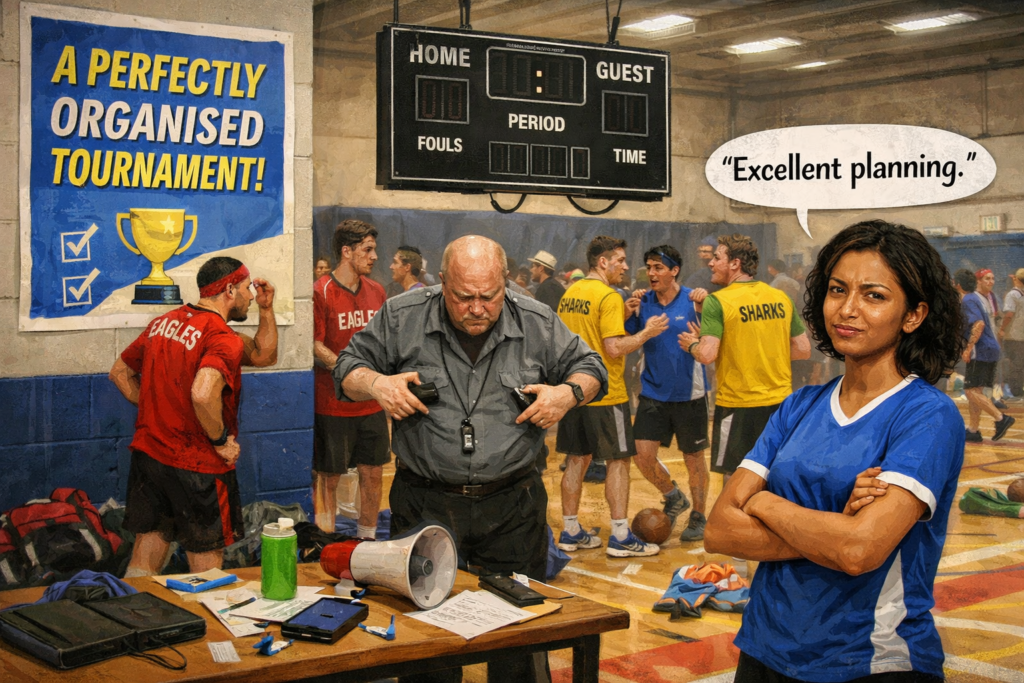
The poster outside the sports hall promised ‘A perfectly organised tournament’ (situational irony: the promise creates an expectation of order). Inside, the scoreboard was blank, the referee had lost the whistle, and the teams were wearing the wrong colours (actual outcome contradicts the expectation). ‘Excellent planning,’ muttered Aisha (verbal irony/sarcasm: the words praise the planning, but the meaning criticises it).
The writer uses irony to show that the tournament is disorganised. The poster promises “A perfectly organised tournament,” so the reader expects order and control. However, the blank scoreboard, missing whistle and wrong team colours create situational irony because the reality is the opposite of the promise. Aisha’s comment “Excellent planning” is verbal irony because she says something positive while clearly meaning criticism. It is also sarcastic because the remark mocks the organisers. The irony makes the failure seem more obvious and humorous.
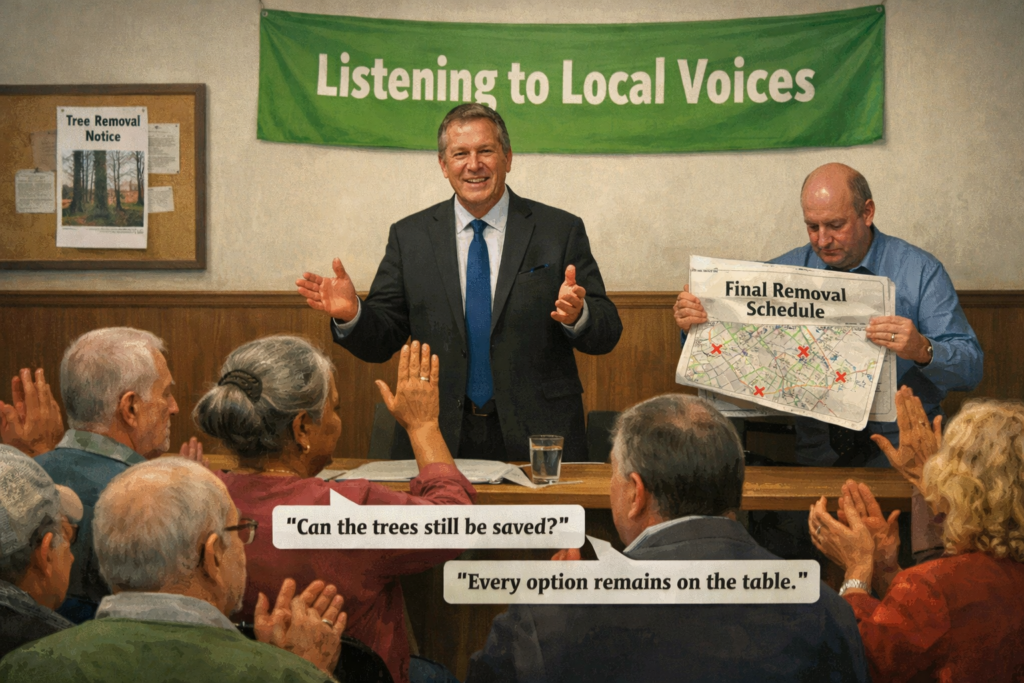
The council leaflet arrived on Monday, printed in bright green ink and headed ‘Listening to Local Voices’ (verbal/situational irony setup: the heading creates an expectation that residents will be heard). By Wednesday, the old trees behind the community centre had already been marked for removal (situational irony: action has begun before listening appears to happen). At the public meeting, Councillor Briggs smiled and said, ‘We are very interested in your views’ (verbal irony: the words suggest openness, but the context suggests the decision is already made). Behind him, the planning officer quietly folded a map labelled ‘Final Removal Schedule’ (dramatic irony: the reader sees evidence that some characters may not notice). Mrs Patel raised her hand and asked whether the trees could still be saved. ‘Every option remains on the table,’ the councillor replied (verbal irony or possible evasion: the statement sounds open while the schedule suggests closure). The room applauded politely, unaware that the first contractors were due at seven the next morning (dramatic irony: the reader knows more than the residents).
The writer uses several forms of irony to make the council seem untrustworthy. The heading “Listening to Local Voices” creates an expectation that residents will influence the decision, but the trees have “already been marked for removal,” creating situational irony because the action contradicts the promise. Councillor Briggs’s claim that “We are very interested in your views” becomes verbally ironic because the context suggests that the decision may already be fixed. Dramatic irony appears when the reader sees the “Final Removal Schedule” and later learns that contractors are due the next morning, while the residents remain unaware. This gap between public language and hidden reality makes the meeting feel dishonest and increases the reader’s frustration on behalf of the community.
Now Apply To This To Our Text:
Students should now read the material chosen by the teacher and complete the following sequence: first, identify any moment where words, expectations or knowledge appear to conflict with reality; second, decide whether the method is verbal irony, situational irony, dramatic irony, sarcasm, understatement or overstatement; third, explain the surface meaning or expectation; fourth, explain the deeper meaning or actual outcome; finally, write one analytical paragraph explaining how the ironic contrast changes what the reader understands about the material.
Exit Question:
Irony is about different degrees of knowledge; saying one thing but meaning other, or readers knowing something the characters do not. How does the header image reflect this?
Homework:
Choose a short paragraph from a story, article, speech, advert or review. Find one example of irony, sarcasm, understatement or overstatement if possible. If the text does not contain one, write your own example linked to the same material. Explain the surface meaning, the deeper meaning, and how the contrast changes the reader’s response.