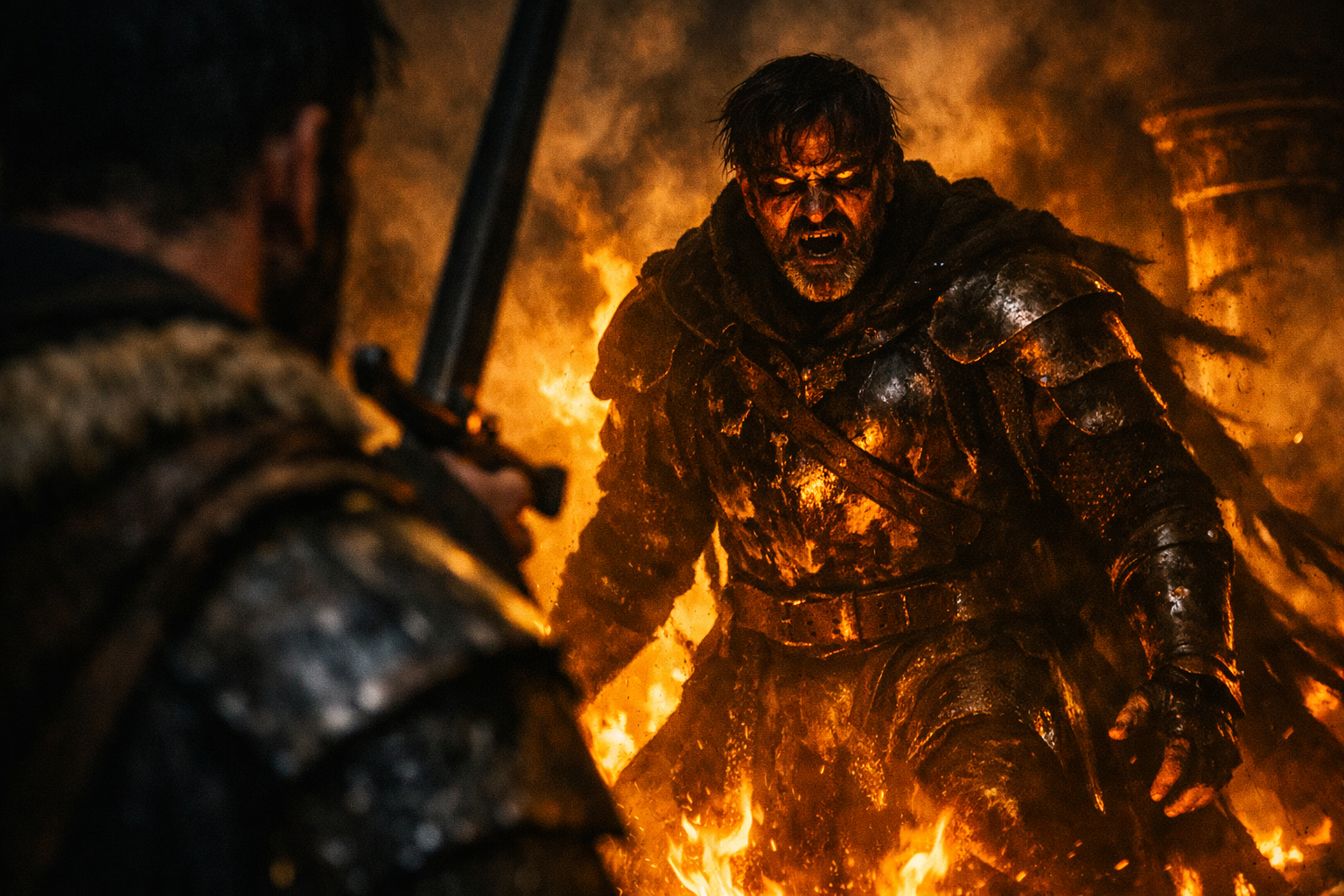

Perspectives in stories matter. Typically, the perspective that we follow is the ‘protagonist’ – and typically we align the protagonist with the function of the hero. Few stories subvert this but by deconstructing and rebuilding Macbeth, we might get a very different view of what role each character fulfills.
The protagonist of a story is the character we follow; the character that we see transformed by the narrative; the character who’s inner thoughts and feelings become significant to the reader. In the story of Macbeth, it would be hard to choose any other character other than Macbeth to fulfil this perspective role. We see Macbeth as a successful general before the play really starts, we see his ‘inner circle of friends’ in Banquo and Lady Macbeth. We see the strange moments he has ‘upon the heath’ with the Witches. We see his inner thoughts and feelings through soliloquys and letters. And by the end of the narrative we see him transformed into a man in existential crisis, questioning the hand that seems to have steered him into this certain futile end.
If we think about Macbeth’s role, either from Propp’s archetypal characters or Greimas actantial model , we would look at his key actions, his motivations and the outcomes. Macbeth is the agent of a regicide, and the indirect murderer to at least Banquo and the family of Macduff. His motivations are ultimately for self-gain. He fulfills Todorov’s structural function of the disruption, subverting the ordained order of Duncan’s royal bloodline. The death of Macbeth fulfills the narrative repair, and it is only through the further regicidal act killing Macbeth that the rightful heir can return to the throne. These moments qualify Macbeth as the antagonist of the story, but this is complicated by the perspective of protagonist.
We see how Macbeth is manipulated by those around him, how he doubts his choices and recognises the virtues of others. It is easy to see him as a conflict, complex character who is still a ‘good guy’, but one that falls from grace because of the evils of uncontrolled women in his life. If we do conclude that women have had a toxic effect on the man then Macbeth becomes a character to sympathise with. We only obtain this sympathy because we see the manipulative events, but changing the protagonist changes the degree of omniscience the audience have. The less we know of Macbeth, the easier it is to identify him as antagonist.
So who fulfills the role of the hero, or restorer, or saviour?
For this we turn to Macduff as the character who first discovers Duncan’s death. Macduff remains a minor character in a servile role until he is thrust into the fray as a major character – we are given a close inspection of his emotion at discovering Duncan’s death, a far too important function to be given to a mere minor character; “Approach the chamber and destroy your sight With a new Gorgon.” It is his recognition of the disruption event (the regicide) that ultimately drives his narrative to repair their story. Macduff represents the societal horror at the death of a legitimate king. Macduff discovers the way to uproot Macbeth, by finding the rightful heir Malcolm, and the English army. And Macduff kills Macbeth, allowing the rightful heir to reclaim the throne. Macduff also is unaware of the divine providence that will allow only him to be the saviour of Scotland. Macduff is the hero of the story, but not the perspective we experience the story through.
Normally, narratives give to us the perspective of the hero, because we are most interested in how heroic characters repair the world and their unique resistance to vice, or how they are transformed by the experiences. We are not particularly interested in sympathising with the antagonist because we need to see them as undesirable, maligned outsiders. But Shakespeare does something different. By giving the perspective of the protagonist to the antagonist, we come to sympathise with Macbeth. When we discuss his degree of culpability, we often defend Macbeth, drawing evidence from the way he is manipulated by the Witches and Lady Macbeth.
Ordinarily, when the perspective is aligned with the hero, we sympathise with his experiences and come to justify his actions, no matter how immoral or unethical they are. A hero is given some limited special exclusion from having to act ethically, to help resolve the narrative. Yet Macbeth is clearly not the hero here, but we are willing to suspend our criticism and consider that he could be the victim of circumstance. This ‘moral exceptionalism’ potentially comes from his function as the ‘protagonist’ – perspective affords him some extenuating circumstance that ordinarily gives the hero ethical wiggle room.
So what we have in Macbeth is a story about a good guy, fixing the world and bringing it back to order, but told through the perspective of the bad guy who is structurally ameliorated. Which has gotten me thinking; we come to validate Macbeth because of perspective, but if we change the character providing perspective, how do sympathies change? What if the story was told through MacDuff’s perspective? I’ve tried to retell this story, whilst staying true to the original text.
Macduff; Kingslayer
A retelling of Macbeth, from the perspective of Macduff
Analysis – the effect of perspective
We first meet Macduff as Duncan arrives at Macbeth’s castle, but it’s reasonable to assume this isn’t the beginning of his narrative. He is an associate of Banquo, Malcolm, Lennox, and others who were involved in securing Scotland’s sovereignty. So like those thanes, Macduff is likely on or near the battlefield, commanding men loyal to him. He hears of the victory, and how Macbeth himself killed Macdonwald and then drove out the Norwegian Lord. Macduff’s role or his position as a thane means he escorts Duncan on this journey.
But between the end of the war and the celebration, is the announcement that Malcolm is the next in line to the throne, a reward hardly deserving for the man played no part in the front lines and was by the King’s side. The pairing of King and Malcolm might show that the son was already being groomed for the title and its responsibilities, being shown that a leader is not on the front line but back where strategic decisions are made. MacDuff is not present at the announcement. Could he be writing a letter to Lady Macduff? If so what would he say? His loyalty is to the king, he need not attend some ceremony of reward, he asks for no reward. It is his duty to serve and as reward is no service, he excludes himself and considers returning home…. Maybe he hears on the wind of a prophecy, a saviour who can return Scotland to its rightful sovereign, foreshadowing some future and an actantial role of saviour that is not yet attributed to a known character.
But he cannot return just yet, he is commanded to escort Duncan to Dunsinaine, where we first meet him, riding to Macbeth’s home. He is not part of the celebration however as he returns, knocking on the door of the home and being greeted by the Porter, to bring a message to awake the King. Macduff is Duncan’s escort, it’s his ‘limited service’, not yet a part of the inner circle. We see that in Duncan’s world, Macduff is merely a servant.
We follow Macduff, a minor character so far, into the setting of the regicide. We ascend with him to Duncan’s room and are greeted by the scene of horror – the murdered King. It’s his emotional reaction we study, this tragedy shakes him to the core. He chastises Macbeth for killing the only two suspects and who breaks to the heirs that “your royal father is murdered”. This minor servant is suddenly elevated, transformed through circumstances into being a major character, and now the nobility see and engage with him. Here, Banquo announces that he will “fight of treasonous malice” and before Banquo can even complete his measure, Macduff steps in and announces “and so do I”. This becomes the volta for Macduff, and it is with this line that he begins his narrative arc from servant to saviour.
Macduff begins the detective work of investigating the regicide and observes that “Malcolm and Donalbain, the King’s two sons, Are stol’n away and fled, which puts upon them Suspicion of the deed.” Why is it that when Macduff is asked about attending Macbeth’s corronation at Scone he declines, choosing Fife? To return home, as the “Thane of Fife had a wife”. His thoughts are for his family.
The next we hear of Macduff in Macbeth’s narrative is that he lives in disgrace, having seemingly aligned himself with Malcolm “To wake Northumberland and warlike Siward”. What happens to Macduff to change his mind? Maybe we see some deeply meditative scene in which Macduff remembers his loyalty is to God’s will, which means Duncan’s bloodline. There is no more evidence, just the reflection of his loyalty Que some scandi-noir existential staring across a misty lake, and evocative bagpipes that indicate some seizmic change in his heart, and his allegiance.
Maybe we now see a prophetic scene parallel to Macbeth’s second visit to the witches. Maybe Macduff stands atop a Stain and sees the clouds parting int he south, golden sunlight giving him his direction of travel. Now both narratives give each protagonist some supernatural guidance. Importantly, neither Macduff nor Macbeth know of the interventions received.
When Macduff is the protagonist, we don’t see the slaughter of the ‘Duff household. Instead, maybe we see Macduff journeying through Scotland and seeing first hand the storms, the widows, the orphans and crazed animals. Macduff witnesses how Scotland no longer knows itself and how this is further evidence to him of Macbeth’s illigitimacy – the weather seemingly pushing him south toward his Macguffin (items of power needed to overthrow an enemy) like divine intervention. This journey reinforces to him that Scotland is no longer a country to love, and without significant reform he must abandon his country. This isn’t just a journey for resolution, but possibly the start of a permanent emigration.
Now our two perspectives coincide, and we see the same test of loyalty by Malcolm. We discover the news of Macduff’s family and the infanticide. The stories he saw across Scotland are now his story; orphans and widows.
Macduff collects a great power in the English army led by Siward and they march on Dunsinane. The audience expects a great clash of powers and a siege warfare but to our great dismay, this climactic moment is denied us. The audience is baited for battle. We come instead to a greater battle of the servant versus the tyrant. But instead of arriving here having built sympathies for Macbeth as an ambiguous antagonist, we have the perspective of Macduff. This whole while, the language has been clear; Macbeth is the tyrant who blisters our tongues, worse than the legions of horrid hell, a butcher whose actions are masked by the dunnest smoke of murky-hell. To Macduff, Macbeth is a Gorgon such as Medusa who has been transformed by greed from celebrated war hero to a monster. Macbeth could be revealed to the audience with all of the imagery conveyed above as a true terror to be destroyed. To defeat such a monster needs more than a mere man but divine providence – a prophecy needs to be fulfilled; a man not born of women should bet he fear of Macbeth. A simple servant of the king ascends to complete his narrative arc as divine saviour. Macbeth is not human and “We’ll have [macbeth], as our rarer monsters are, Painted upon a pole”.
When Macduff defeats Macbeth, it is the resolution and final act of a very Todorovian narrative arc in which the characters fulfil the actantial roles roles of saviour and monster. From Macduff’s perspective, it is a story that is easy for the audience to understand. The hero and villain are plain to see.
Conclusions
What I find fascinating about this thought experiment is how it breaks the traditional perception of the character roles. We can only sympathise with Macbeth because he is given the narrative position of protagonist, but if this is changed and we follow the life of the true hero, Macduff, Macbeth’s nature is much simpler to identify. Shakespeare subverts the traditional view of aligning the protagonist with the hero, and in-so-doing creates a narrative in which we build greater sympathy for the antagonist than any other character.
- The protagonist is not a function of the hero but a structural design choice by the author
- The protagonist inherits the sympathies of the audience
- The protagonist can hide the true nature of the character’s actantial function
- Deconstruction the text is an important part of dismantling assumptions
- Characters are ‘well made’ when they have transformative experiences
- Transformation is usually, but not exclusively, reserved for the hero journey

Leave a Reply