
Think of your last Ikea purchase; An item of flatpack furniture. The front cover shows the whole, the final outcome. The inside contains a set of ‘tools’. These precede the granular step-by-step process. A step will often show a macro, with a micro step being done upon it; a shelf is seen but then a close inspection of a dowel going into the edge of the shelf. Each of these makes building your exciting new Nëbuer (I read a funny way of inventing Skandi furniture is to reverse your name and place an umlaut over the first vowel. I give you, my son as Ikea furniture!) possible.
Curriculum should follow the same principles. This isn’t assuming that Ikea know better how to create learning documents, but that they better follow the pedagogy of instruction. English must show a full text in its entirety before we investigate the granular. We must show the cognitive tools and make sure they are understood before we attempt to deploy them. The macro picture must be shown as well as micro steps. At no point are we asking students under instruction to ‘guess’ or ‘discover’ the process, but to see and repeat the process.
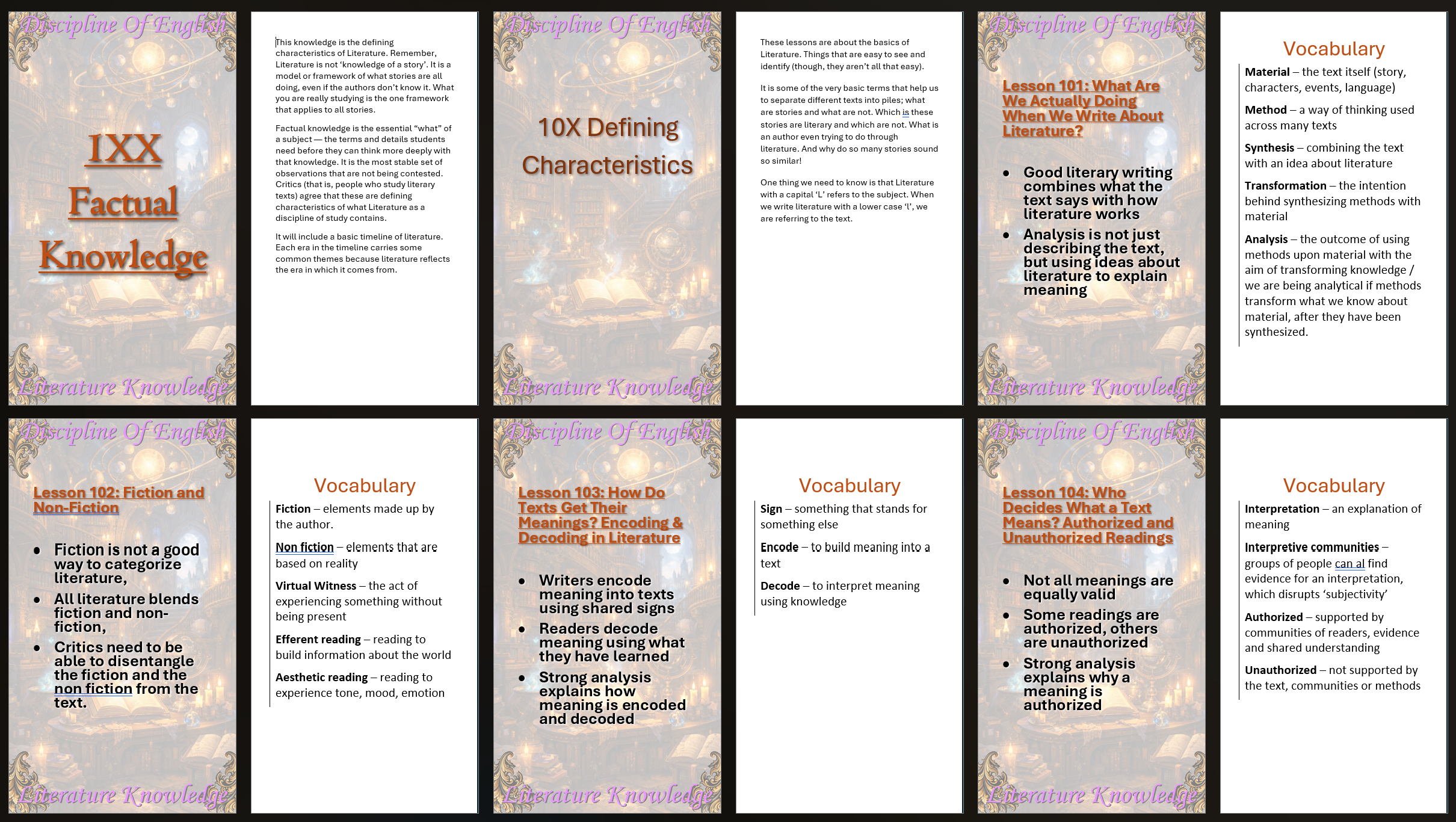
When these are all in place, especially as a core document, we can start to do something interesting things with them. One opportunity is to take the tools and present them in a new form. Something I’m excited about is the idea of reformatting the basic tools as a set of revision cards that can be deployed in many different ways…
Flashcard Revision:
- Spread around your study area, face up or face down!
- Use the LO to prompt your recall of the vocabulary…
- Use the vocabulary to recall your knowledge of the learning!
Passage attack:
- Shuffle the deck,
- Have a passage for study printed large,
- Take and read the top card, then find a quote that the card applies really well to.
- Highlight the quote and place the card around the text – connect them with a line.
- If you cannot make a connection, place the card to one side.
Two player challenge:
- Shuffle the cards,
- Player one picks up a card and holds it so that each player can only see one side,
- Player one must read the side visible, and recall the side that is obscured. Player 2 reads the obscured side and awards points for accuracy.
Concept Duel
Two students draw one card each. Each must argue that their concept is more useful for analysing a given extract. A third student judges using criteria such as precision, evidence, and depth of interpretation.
Build an Essay Plan
Students draw 4–6 cards and use them to create an essay plan. Each card becomes either:
- a paragraph focus
- a key term to define
- an interpretive lens
- a link to context, form, or meaning
Absence Game
Students draw a card and ask: what would I miss in this text if I did not know this concept?
Explain It Like I’m Basic
Students draw a card, and must explain it in simple language without losing the core idea.
Explain it like I’m S-Tier
Take a card from the pack, and now discuss the card as if you were an expert who could philosophize on the topic.
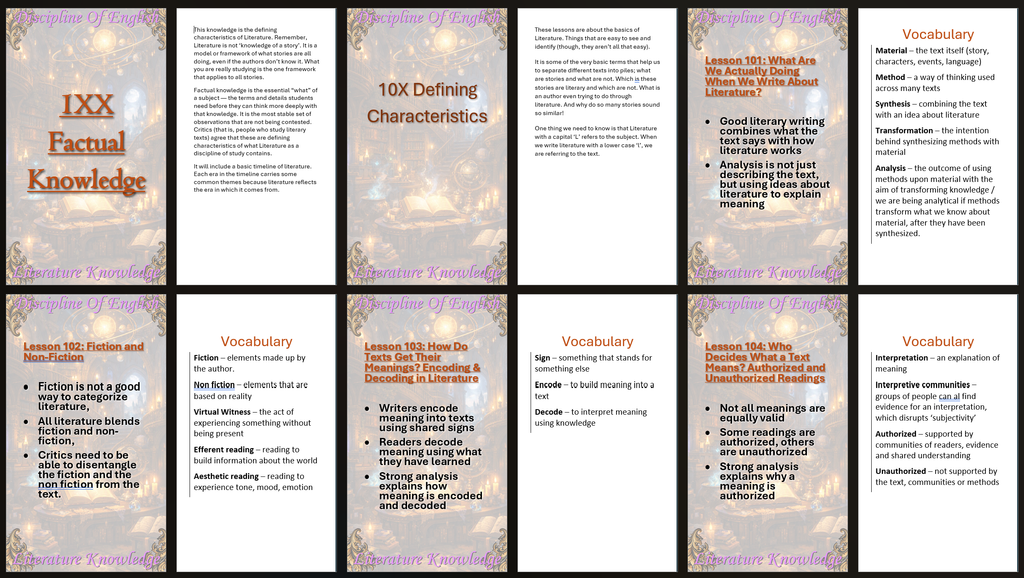
This snip of some of the playing cards shows three different levels of the learning objectives:
- The top level module; Factual Knowledge,
- The second tier grouping; factual knowledge,
- The individual lesson and learning objective.
The reverse of each card presents the key knowledge or vocabulary. They aren’t meant to teach the lesson, but be a prompt for the lesson that was learned. And because DisciplineOfEnglish.co.uk builds its lessons in a text-agnostic manner, they apply to all texts. The student brings the text or passage to the cards, and explores how these cards change the way we talk or view the text.
The cards represent the end point in the curriculum structure, from the full picture, through the tools, the learning mechanism, and then the condensed form. This final version is the goal of facilitation – to empower students to work and learn independently. We make it into fun, accessibly activities to enourage students to value this independence. The dominant form of curriculum in state schools simply cannot achieve this.
Leave a Reply