Learning Objectives
Teacher Framing:
This lesson develops students’ understanding of sequencing as a structural method. Lesson 121 taught students that paragraphing can organise information into focused chunks. Lesson 122 showed that perspective controls access to information. Lesson 123 showed that tense positions the reader in time. Lesson 124 now asks how the writer orders information across the whole material. Sequencing is the arrangement of events, ideas, details or stages in a chosen order. This order may be chronological, but it does not have to be. Writers may organise material by importance, cause and consequence, problem and solution, contrast, general to specific, or withholding and reveal. Students should learn that sequence is not simply “what happens first, next and last”; it is a writer’s decision about what the reader should know first, what should be delayed, and how each new piece of information changes what has already been understood. This lesson remains within Unit 12X because it studies the organisation of information across the material rather than the classification of words, clauses, sentences or form conventions.
Student Learning Objectives:
By the end of this lesson, students should be able to:
- identify the order in which information is presented;
- explain whether the sequence is chronological or organised by another principle;
- and analyse how the order of information changes the reader’s understanding of the material.
Core Knowledge:
Sequencing is the order in which a writer presents information. Some texts follow chronology, which means events are presented in the order they happened. Other texts choose a different order. A news report might begin with the most important information, then explain causes later. A story might begin in the middle of an event and only reveal the cause afterwards. An argument might begin with a problem, then present evidence, then offer a solution. Writers use sequence to guide the reader’s attention. The first information usually frames what follows, while delayed information can create curiosity, tension, surprise or clearer understanding.
Key Ingredients:
Key Vocabulary:
- Sequence: the order in which information, events or ideas are presented.
- Chronological order: an order that follows the sequence in which events happened.
- Non-chronological order: an order that does not follow time sequence exactly.
- Cause and consequence: an arrangement that explains why something happened and what resulted from it.
- Problem and solution: an arrangement that identifies a difficulty before explaining how it might be fixed.
- Withholding: delaying information so that the reader does not know everything immediately.
- Reveal: the moment when delayed information is given to the reader.
Key Sentence Stems:
- The information is sequenced by…
- The writer begins with… in order to…
- The sequence is chronological because…
- The sequence is non-chronological because…
- The writer withholds… until…
- This reveal changes our understanding because…
- The order of information guides the reader from… to…
- By placing… before…, the writer makes the reader…
Key Thinking:
Tense and sequencing are connected, but they are not the same. Tense shows the time position of verbs. Sequencing shows the order in which information is presented to the reader. A text can use past tense and still be sequenced non-chronologically if it begins with a later event and then moves back to an earlier cause. Strong analysis explains why the writer chose that order and how it affects the reader’s understanding.
Models
Non Literary Warm Up:

Have you ever done any video editing? You start by having a timeline, and you place video clips onto this timeline. You can move those clips left and right to change the order in which they are presented. So there are two ‘timelines’ going on; the actual sequence of clips as shown to the audience, and the original chronology in which they happened. Sometimes, breaking the chronology and placing them out of sequence tells a better story.
Literary example – :
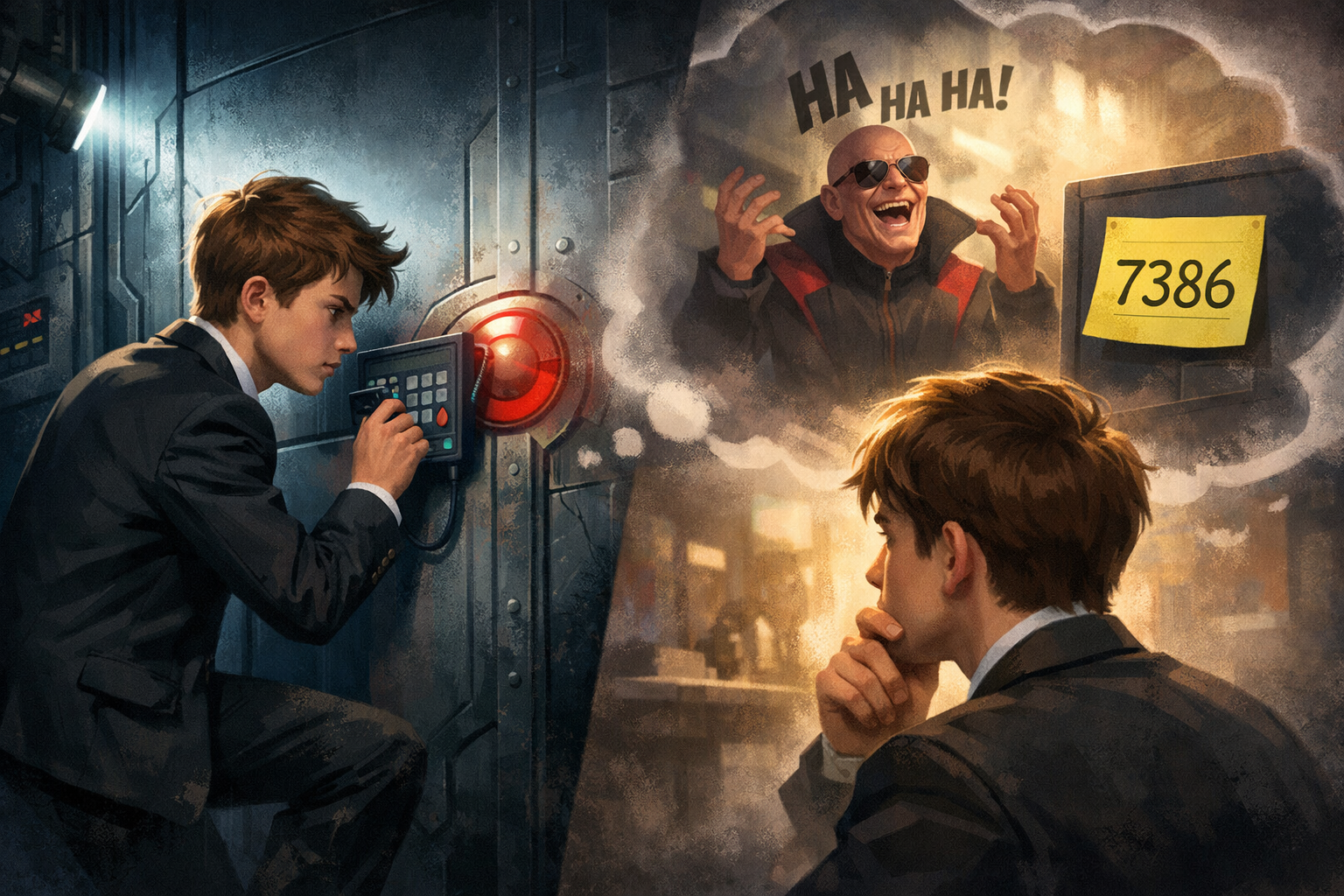
He crouched before the door, the cold metal reflecting the faint red glow of the lock’s sensor. The keypad blinked expectantly, each pulse a reminder of time slipping away. His fingers hovered, steady but tense, as he weighed the risk of guessing wrong. The lair was silent except for the hum of machinery behind the walls, and the faint echo of his own breath. He adjusted his tie—a strange gesture of composure—and began to enter the digits, each press deliberate, each pause heavy with calculation.
Then the memory surfaced, sharp and intrusive. The villain’s laughter filled the room again, echoing from the past like a taunt. He could see the man’s grin, the gleam of satisfaction as he mocked the boy’s failure. But behind that cruel face, on the edge of the monitor, a yellow post-it note had caught his eye—four digits scrawled in thick black ink. 7386. The image burned into his mind, and now, standing before the door, he realised the laughter might have concealed the answer all along.
The story’s structure deliberately fractures chronological order to heighten tension and deepen character insight. The first paragraph situates the reader in the present moment, where the spy confronts the locked door. The second paragraph, however, interrupts this present narrative with a flashback, shifting the sequence to an earlier moment where the character experienced humiliation and and defeat. This non-linear arrangement creates a heroic moment from past and present: the memory becomes a solution for the current problem. By telling the story out of sequence, the narrative uses memory of defeat as the key to progress.

The detective looked at the CCTV feed from earlier and the manager was right, a woman had been stealing items. He could see her taking baby formula from the shelves and placing it into her handbag.
The detective closed his eyes. He saw her returning home to hungry children… babies. He thought back further, a pregnant woman being fired from her job. And further still, a father leaving quietly to never return.
“I’m sorry,” the detective began, glancing around the screen, “but this is inadmissible as evidence. The date and time stamps are incorrect. There’s nothing here I’m willing to follow up on.”
The manager was startled and began to demand an answer, but the detective had already stood and was leaving the office.
The material uses a sequences of flashbacks gradually going further back in time. Each flashback seems to provide a cause and effect so that the sequence tells a story of how the woman comes to stealing baby formula. It is because of this sequence that the actions of the detective are motivated; he now feels sympathy for the woman that the store manager does not. Sequence can be used to writers to show how sympathy is create.
Now Apply To This To Our Text:
Students should now read the material chosen by the teacher and complete the following sequence:
- First, divide the material into its main stages;
- label the order of information as chronological, non-chronological, importance order, cause and consequence, problem and solution, withholding and reveal, or another clear pattern;
- identify what the writer presents first and what is delayed; fourth, explain how each new stage changes what the reader understands;
- write one analytical paragraph explaining how sequencing organises the reader’s experience of the material.
Exit Question:
Why do some stories choose to reveal something about the ending at the beginning of the text?
Homework:
Choose a short article, report, story extract or school communication. Identify the first, middle and final stages of information. Decide whether the sequence is chronological or organised by another principle. Then rewrite the opening by changing the order of information and explain how the new sequence changes the reader’s understanding, curiosity or response.