
Learning Objectives
Teacher Framing:
This lesson begins Unit 16X by establishing form as a recognisable pattern of communication. Earlier factual units have taught students how meaning, purpose, audience, structure, word classifications, phrase and clause types, and sentence classifications work. Unit 16X now shows how those choices become conventional patterns that readers can recognise. Form is not the same as material or purpose. The material is the object being studied, such as a particular article or speech. Purpose is what the text is trying to do. Form is the recognisable shape or category the material takes, created by repeated conventions in layout, structure, audience, register, sentence function and language choices. Students should learn that naming a form is useful, but not enough for analysis. Strong analysis explains how the specific material uses, adapts or challenges form conventions.
Student Learning Objectives:
By the end of this lesson, students should be able to:
- define form as a recognisable pattern of communication;
- distinguish form from material, purpose and function;
- and explain how form conventions shape meaning for a reader.
Core Knowledge:
Form is the recognisable type or shape a text takes. A text might take the form of a story, article, report, advert, speech, letter, review or guide. Forms become recognisable because they often use repeated conventions. These conventions might include a typical audience, layout, structure, tone, vocabulary, sentence functions or purpose. However, a form is not a fixed recipe. Writers can use conventions, adapt them or mix them. Strong readers identify the form, then explain how that form changes the way the material works.
Key Ingredients:
Key Vocabulary:
- Form: the recognisable shape, type or category a text takes.
- Convention: a repeated feature commonly associated with a form.
- Material: the specific text or extract being studied.
- Function: the job a text performs for its audience.
- Genre: a broader category of text, often linked to subject, style or expectation.
- Mode: the channel or way communication happens, such as written, spoken, visual or digital.
- Layout: the visual arrangement of information on the page or screen.
- Form convention: a typical feature that helps readers recognise and understand a form.
Key Sentence Stems:
- The form of this material appears to be…
- This form is recognisable because…
- A convention of this form is…
- The material uses this convention by…
- The material adapts the form by…
- The form shapes meaning because…
- The form is different from the purpose because…
Key Thinking:
It is incorrect to say, “The purpose is an article.” An article is a form. Its purpose might be to inform, explain, persuade, entertain or argue. It is stronger to say, “The material takes the form of an article, and this form helps the writer organise information for a public readership.”
Models
Non Literary Warm Up:

Imagine seeing a football shirt, a school blazer and a police uniform. Each is made of fabric, but the form tells us what kind of clothing it is and what social role it performs. A reader recognises a form in a similar way. The words are the material, but the recognisable pattern tells us how the text is likely to work.
Literary example – :
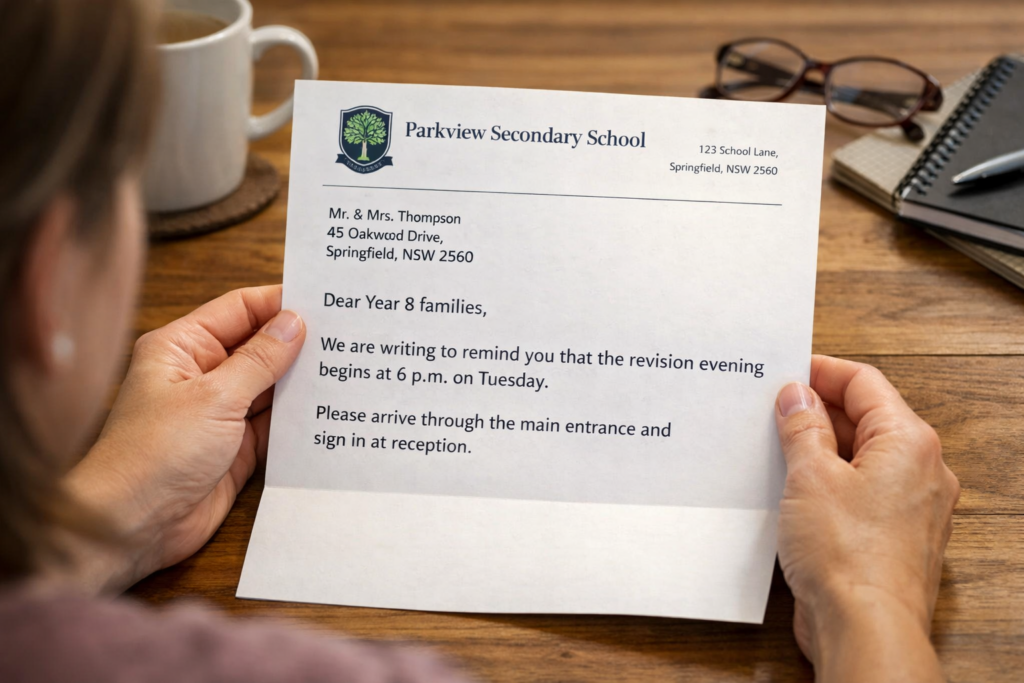
“Dear Year 8 families, We are writing to remind you that the revision evening begins at 6 p.m. on Tuesday. Please arrive through the main entrance and sign in at reception.”
The material appears to take the form of a school letter or formal communication. This is shown by the opening “Dear Year 8 families,” which identifies the audience directly. The form convention of polite instruction appears in “Please arrive through the main entrance.” This form shapes meaning because the information is presented as official, practical and directed towards families who need to attend an event.

Newark Bypass Opens, Promising Faster Journeys and Less Congestion
Newark’s long‑awaited A46 bypass upgrade has officially opened today, marking a major milestone for one of the region’s most significant road projects.
The £686m scheme—approved by the Secretary of State for Transport in October 2025—widens 6.5km of the A46 between Farndon and Winthorpe, replacing the notorious single‑carriageway bottleneck with a dual carriageway designed to ease congestion and improve safety.
The project also delivers a new flyover at Cattle Market roundabout and a new bridge over the A1, improving traffic flow across key junctions. National Highways says the upgrade will support trade, reduce delays, and strengthen connections between the M1, A1 and central Lincolnshire.
Local leaders have welcomed the opening, highlighting benefits for Newark’s economy, future housing growth, and daily commuters.
The form appears to be a local news report because it presents a public issue affecting residents and includes reported viewpoints. The opening gives time and place, “At 7.15 on Monday morning” and “Ash Road,” along with the action “has opened” and the effect “a major milestone”. This summary is a common feature of news articles. Subsequent paragraphs then build detail one interrogative at a time, so that the second paragraph builds more about the action in the “£686m scheme”, “replacing the notorious single carriageway” and “improving safety”. The action is built around the verbs replacing and improving. It focuses on clear information, broken into information types, in a priority order. The summary allows readers to move on quickly if they do not need detailed information.
Now Apply To This To Our Text:
Students should now read the material chosen by the teacher and complete the following sequence:
- identify the likely form (the text type);
- list three conventions (norms / rules) that help identify that form;
- explain whether the material follows or adapts those conventions;
- distinguish the form from the purpose;
- write one analytical paragraph explaining how form shapes the reader’s understanding of the material.
Exit Question:
Look through the header image; what forms can you see? How do their conventions and purpose differ from one another?
Homework:
Choose one short text from everyday life, such as a letter, advert, review, article, speech, email or guide. Identify its form, two conventions of that form, and one way the form helps the text achieve its purpose.