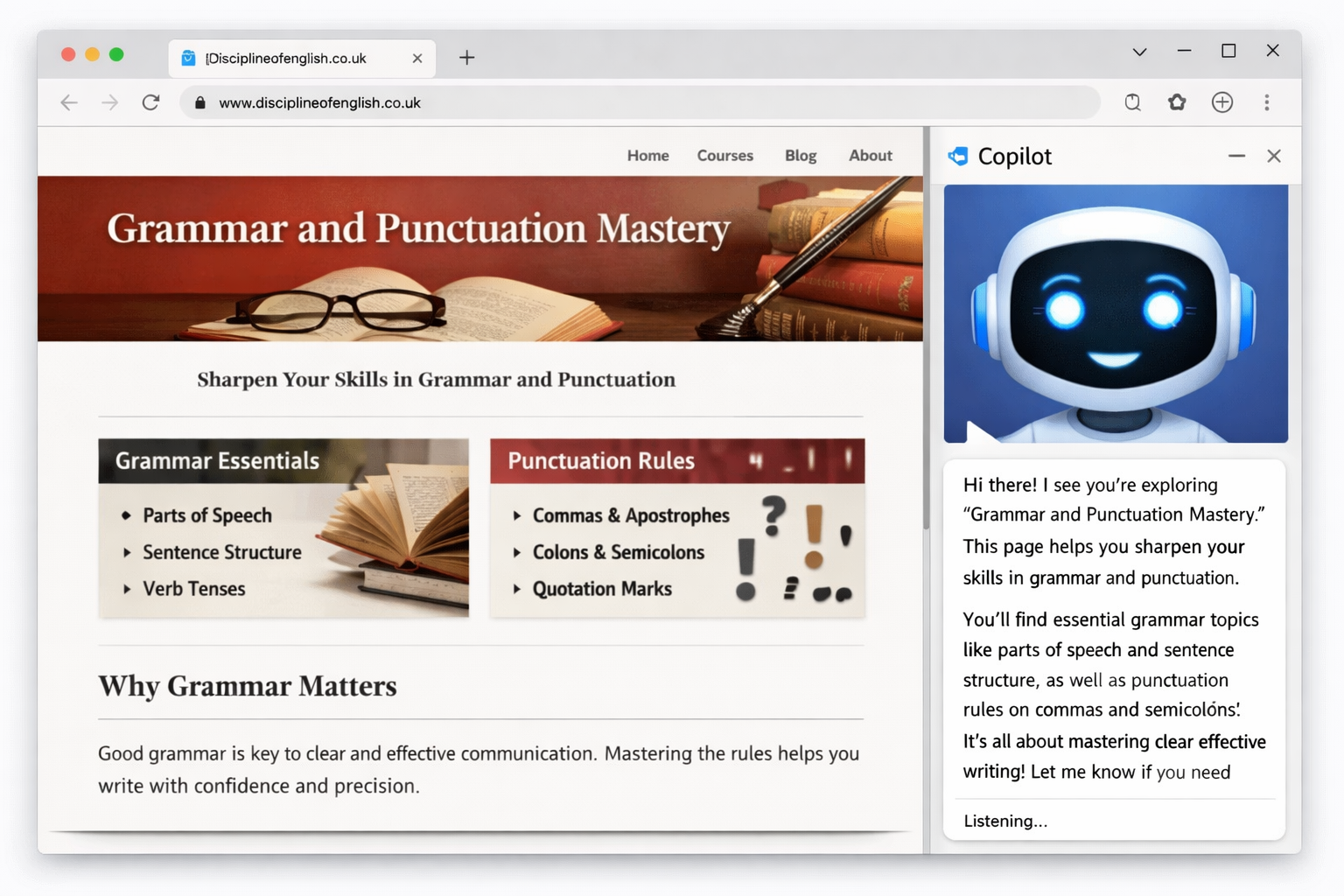

One of the aims of Discipline Of English is to increase the accessibility of an English curriculum. To that end, building a curriculum as a website rather than as Power Points marks a significant uptick in accessibility for students. Not only is the entire curriculum always available, it is widely accessible on all devices.
Being a web-based curriculum increases the integration of AI and digital services. Web browsers have built in text-to-speech, language-to-language translations and now also LLM transactions. Users of the curriculum can engage with AI to listen to and better understand the curriculum. This is the ultimate goal of DoE, to push at the boundaries of accessibility and build a curriculum that is maximally accessible.
This has necessitated a change in the way the lessons are built using the Gutenberg blocks. The open and close panes that view blocks of the lesson must be open for AI to read the content. Previously, the panes have all been set to ‘close when a new one opens’, which keeps the website tidy for the user. But, it means that AI can only ever help with the one open pane. Now, a student can open all panes increasing access to support from AI readers.
This also has the benefit that a webpage can be printed fully, or have available for viewing only the panes that matter most. The teacher framing for instance would likely be closed, but the student learning objectives and activities open.
I wonder how long it will be before the written dialogue of a chat engine will be replaced by a generated face which talks through the content with you – the spoken dialogue is already available on mobile browsers such as Chrome. It would create a virtual teacher that for many presents an entirely facilitated revolution away from a classroom experience, toward an entirely assisted learning experience. For many, this is ethically troublesome; replacing the teacher with a virtual assistant.
But schools and teachers must start doing this if they are to be part of an incoming future. Private enterprise already is, and selling this service back to schools. Many online course are already running this very same model. Teachers who think we are building a future without them have missed the message – it already happened. Schools and teachers actually need to play catch-up with this technology.
This website proves that teachers and schools can build a next generation curriculum. And as many private providers and online courses are already finding, students greatly benefit from this technology.