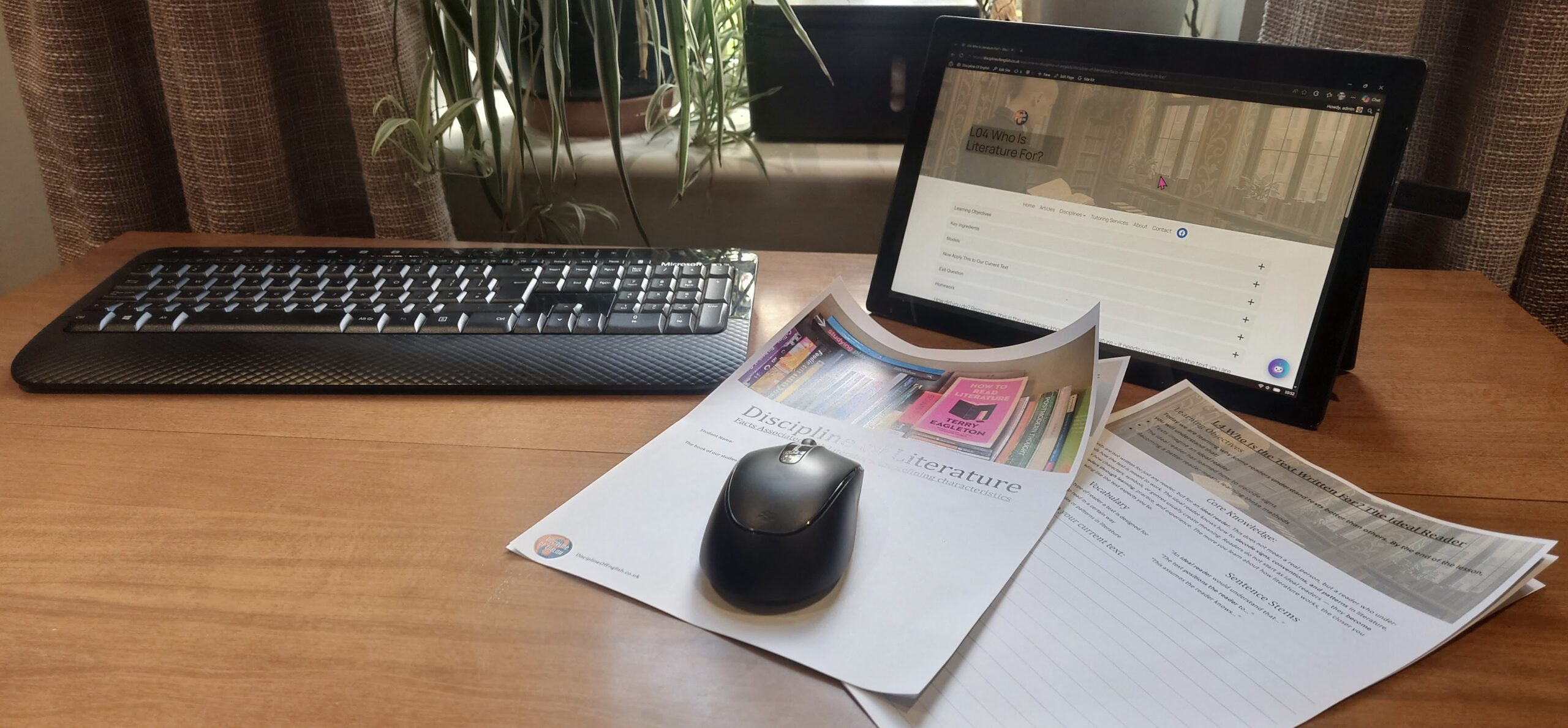

Discipline of English is becoming a full online curriculum, which could be delivered at home by parents, by tutors, by school mentors, or even by schools. As it is an evolving project, it draws upon my experiences and observations of curriculum at many different schools. And one thing that I’d been very impressed by in my past experiences was a custom printed workbook designed for each department, replacing the blank notebooks most schools still use.
Imagine knowing your curriculum, knowing your lessons, knowing your discrete packets of knowledge, and having all of this structured into a scheme of work. And lesson plans. And lesson resources. But not making the final implementation in giving this to the student – instead, they get a blank notebook that looks rather like lessons are being delivered ‘on the fly’.
This is the reality of most schools. Students are required to fill the notebook by hand with the many definitions and core knowledge that already exists in multiple documents for the benefit of the department.
But not all schools do this. Some have their own workbooks custom printed, which already contain the key glossaries and core knowledge required by the discipline. It’s actually genius. If it is something that a student must know, then it is important enough to be identical from student to student. If it is important enough that all students have it, then why not give it.
The most obvious counter to giving the learning and having students copy the learning into their books, is that the copying forces students to read the work, which begins the learning process. And whilst a part of me still agrees that yes, this highly passive structure forces students to read the work, I do not believe it actually passes knowledge into memory.
There is a substantial body of research that is sceptical, sometimes outright critical, of the instructional value of having students copy from the board, especially when the copying is lengthy, passive, or treated as a proxy for learning (Sweller, 1988; Paas and van Merrienboer, 1994; Kirschner, 2006). Copying requires simultaneous reading, holding information in working memory, and handwriting — a multitasking burden that consumes cognitive resources needed for actual learning. Decades of research show that verbatim transcription produces far weaker retention than generative note‑taking – summarising, organising, transforming (Kiewra, 1989; Mueller and Oppenheimer, 2014). Students with weaker handwriting fluency, dyslexia, or limited working memory capacity are disproportionately overloaded by copying tasks (Gathercole and Alloway, 2008; Kirkby et al, Bournemouth University; Berniger and Graham, 1998). Ethnographers often describe copying as a classroom management tool rather than a learning tool (Black and Williams, 1998; Jean Anyon, 1980; Brian Street and the New Literacy Studies Tradition). Interestingly, even in highly structured, teacher‑led models, copying is not the mechanism that improves learning (Rosenshine, 2010).
Well, as the lessons are all planned in DisciplineOfEnglish.co.uk, there seems no reason why a workbook shouldn’t be available that is already populated with the key vocabulary, core knowledge and sentence stems.
The first workbook to accompany the first group of Literature lessons; Defining Characteristics of Literature is not available in the curriculum area. It provides the learning objectives, core knowledge the key vocabulary, sentence stems and a space to write their important conceptual response. One of these should be printed and used for each literary text the student studies, becoming a booklet of analytical phrasings.