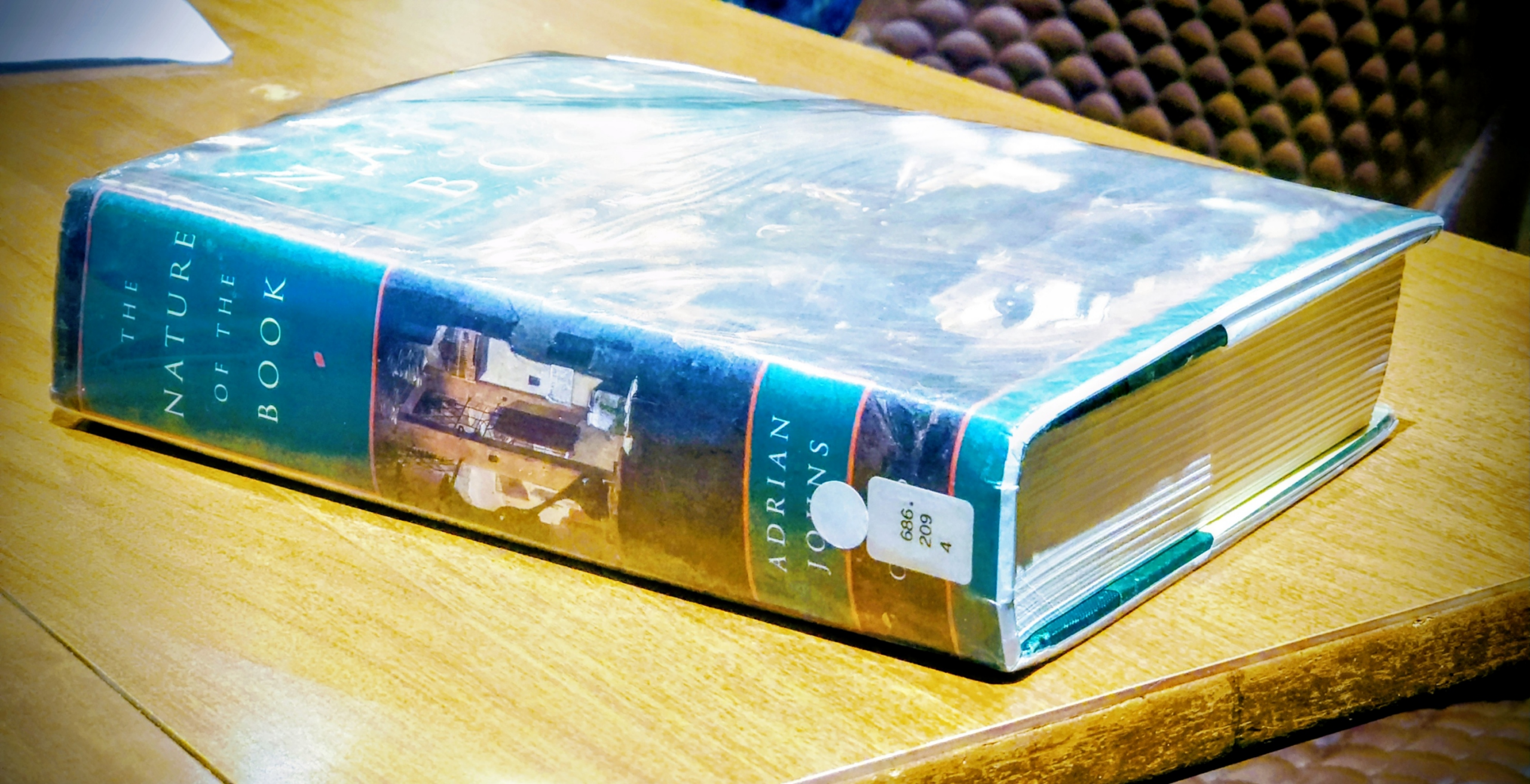

In my previous post, I attempted to impart some of Adrian Johns’ examination of the durability, permanence or ‘fixity’ inherent in printed literature, to maintain meanings indefinitely. It has been assumed by other academics that the very technology, the print itself and the construction of the book, carries some innate permanence as a priori, but Johns counters this and proposes that we should establish a line of credibility to a printed work rather than come to literature with some preconceived idea of authority.
How does a text control its message? As lay readers, we assume that message and function comes from the words themselves and so we investigate the narrative and conscious building of language and its ethos, pathos and logos to convey authority. Adrian Johns’ The Nature Of The Book presents the argument that textual authority also comes from the physical construction and the technological process, something that I never mention in class, but has now informed how I think about delivering English disciplinary learning. One of the intentions of DisciplineOfEnglish.co.uk is to investigate the perspectives of academics to adapt the content of a course, and a line from Johns’ The Nature of The Book has been particularly intriguing in presenting the physical form as something highly adaptable in building authority and meaning;
“The elements of the printed book – its format, layout and typography – acted as no more than elements in an instrument, the book itself, that was useful for constructing knowledge. They were the tools, among others, which users forged for meanings.” (p29)
Johns tells us that meaning and authority comes not just from within the narrative but from the construction process which can be played with and changed. Johns even suggests that the physical form can be tuned as an instrument, to meet the desirable function, meaning and knowledge. And if Johns’ argument is central to the wy we investigate Literature, should it be taught alongside the narrative in a High School setting? Afterall, the specifications do talk about language, form and structure.
We know that the form is an especially important part of knowledge in Media Studies, as we discuss how broadsheets tend to select serif fonts whilst tabloids trend towards sans serif. It would be wrong however to suggest that Broadsheets and serif fonts are naturally imbued with authority – some audiences actively pursue tabloids papers because they are incredulous toward the assumed-authority of those forms. Different styles are seen as naturally authoritative to different audiences. Those audiences who attribute authority to the establishment will decode serif fonts as authority of tradition and a container for traditional dominant narratives. Those audiences who are incredulous toward traditional authority will decode serif fonts as having authenticity and the voice of labour, a container for non dominant narratives. The choices being made in the very construction of the physical media such as the typographical choice is one that conveys a relationship with the reader; what do readers trust and where does our faith come from.
Johns is ultimately working on answering the question: ” could a printed book be trusted to be what it claimed?” The text we have in our hand might not belong to the publisher, distributor or the author that we assume. Johns argues that no text can be assumed a priori to be authentic and that impropriety is a routine hazard.
Can a text be trusted as what it claims to be?
When the object of literature first arrives in our hand, what do we do with it? I suppose we open to page 1 and start reading. Maybe we read the introduction before hand, or the synopsis. When my daughter was a child, before we started reading together I would go through all the parts of the book. She would name the front over, the back cover, the spine. We would look for the barcode and ISBN number and investigate the object. We have some books that are self-published and distributed, coming with no ISBN or barcode. This kind of investigation prompts question of ‘what is this, where did it come from, who made it, what is its purpose’, and these are all lines of investigation that inform the degree of credibility in the book. It should give us some awareness of “transgressions of civility emanating from a print’s [unauthorised] practitioners”.
When I was a teenager, I had a meagre income from working in my local pub, and excessive want for Amiga video games. The fastest and cheapest way to get hold of these was as pirated copies. The pirate copies would often come with a new title screen crediting the pirating group, showcasing their own branding and name as the opening credit page. What I owned was not the work of the author, and piracy wanted credit for this particular disk, changing that very data present. I was naive at the time to assume that the piracy process didn’t change any other part of the game such as the narrative or iconography, though I suspect not. They were simply consumable items to profit from. Printed material is equally not immune to pirating, and contrary to popular assumption that texts had their authority fixed through the technology of print, piracy and careless printing expanded the rate of divergence. Print as a technology cannot reliably be said to than increase the standardisation of knowledge. Some pirated copies even beat the authorised version out of the press, such as Martin Luther’s German translation of Scripture. Johns even notes that in the C18th, unathorised copies might have out numbered authorised copies 90:1, and these were full of deviations from the master copy. Different font choices, errors in spelling, errors in alignment, removing expensive images and tables, dropping footnotes and citations… parts of the constructed text that are each part of the sum of authority.
Does it matter? Thinking back to my hooky copy of Dizzy’s Treasure Island, the game was ripped from an original floppy disk onto a new floppy disk, and done so with all the accuracy of a computer. The bits and bytes would be basically identical and so the only harm being done by the crime is upon the finances of the authorised producer. No harm seems particularly done upon the player who experiences an identical ‘reading’ as someone with an authorised copy. So what if anything is inherently wrong with piracy, when the reading between divergent copies is identical? And if a press has an identical layup to the original copy, how can unauthorised copies of texts come to be harmful to readers? Afterall, we live in a society of democratised knowledge; Wikipedia being the archetype of the mass distribution of free knowledge. This seems to be the end goal and ultimate panacea of civilization; freely accessible knowledge.
How does pirating harm when we value sharing?
Johns begins to tackle this problem by arguing that piracy actually attempts to undermine and reform the whole structure of the book trade. Amazon.com has itself been critized of this very model, “blamed for decreasing a book’s value; but it was also praised for destroying the hegemony of publishers,” (Stefan Michel, IMD.org). I suppose that at the heart of a book is the conflict between the intention of the auteur, the value of knowledge to a culture, the ongoing maintenance of ‘brand identity’ and profitability. The book trade balances these things and unauthorised copies disrupt authorised knowledge.
Let’s take an example from today’s social media to respond to matters of the value of authorised print versus the wide dissemination of unauthorised copies. I came across a Facebook post recently describing how classrooms are beset with the disruptive influence of small numbers of students; that there us a war of attrition going on between schools that need students to be in the classroom, and teachers that need whole classes to make progress; that the effort to get one disruptive child to confirm to classroom etiquette reduces the value added to all other students; the math doesn’t work out, and the small gains made by the one disruptive student is negated by the cumulative loses of everyone else. The post was met by sweeping celebration; teachers championing the cry to expel the one child to the benefit of the majority and protest against what was felt to be bad governance of schools. But the post was AI generated. According to one AI detector, was 100% AI generated content. The post had plagiarized the work of others (as LLMs do) and presented a one sided view of a normal classroom problem. It seemed almost to radicalize teachers against their very pedagogy, against the civilised expectations of Humanism, and against even the safeguarding expectations teachers are contractually obliged to fulfil. This post was made behind the anonymity of a Facebook Company identity, with no attributing author or address. The page links to a company selling TEFL courses.
Such content is clearly engagement-farming. It uses the sometimes traumatising work experiences of some teachers to validate a wider movement that is anti-message; it conflicts with ‘no child left behind’ which is to teaching as the Hippocratic Oath is to medicine. But the post isn’t trying to rally a movement, nor make a difference to education, it’s to rally engagement in a product which the Facebook group functions to serve the needs of.
The importance of provenance and traceability
Publications, editors and credibility matter because they provide protections against this type of manipulative behaviour. Credited authorship provides accountability. Publishing houses act as a gatekeeper of quality. Brand credibility is built over time at great expense. As Johns puts it;
“Issues of literary credit were often resolved, as a matter of everyday practice, into assessments of the people involved in the making, distribution and reception of books. Readers worried about who decided what got into print, and about who controlled it once it was there… Printers and booksellers were manufacturers of credit.” (p32)
This agency of printers and booksellers is indispensable in manufacturing credibility in books, and anonymity an agent of suspicion. The text is intended as a reliable representation of something that an author has witnessed and intends to pass on. Johns explores how the knowledge field of science has a very specific interest in books and their reliability, because this was the medium through which new ideas, observations or inventions were being dispersed. Texts needed to be reliable and accurate for original messages to be decoded properly. This was a limitation to the successful reproduction of Boyle’s air pump in 1660, and according to Shapin and Schaffer’s Leviathan And The Air Pump, nobody was able to successfully follow the textual descriptions to create a working model. How can distant readers know that the pump can really work if a working model cannot be reproduced following the exact instructions depicted? Johns explains that in circumstances such as this, scientists would often travel back and forth to help others replicate what they had attempted to write down. Thus, knowing and being able to contact the author was paramount in the continuation of a culture of knowledge.
Johns explores several historians who point out that actually, science writing did not necessarily need for the reader to be able to reproduce an experiment. The text could through rhetorical means portray great detail and persuade readers that the text is as good as being witness to the experiment. Through the text, the reader becomes a virtual witness, rendering the practice of replication obsolete. Hence why credibility becomes so important; if we are to take the very wording of the text as good as being present to the experience, then we are giving the book an incredible responsibility.
Becoming a virtual witness through the text
This is important to our literary studies today and we use texts to become virtual witness to events we are unable to be present in (such as the past or the future), or have no desire to be physically present at (such as war or trauma). Through the text, we obtain the experience from a distance. The book acts as our representative at the experience, and from the reality represented in the book we draw our personal opinions. Our opinion then is only as good as the text, but importantly, our impression is only as good as our ability to decode what the author has written.
Almost all [Literary Critics] put themselves in the place of [the contemporaneous reader] and assume that their own act of reading replicates that of the [ideal reader]. But this substitution may not be entirely innocuous. A rather different approach is suggested if one identifies reading itself as a skill, just as historically specific as the more obvious dexterity involved in experimentation. If reading has a history, then assuming that modern* readers’ responses to a printed page accurately reproduce those of [contemporaneous readers] becomes problematic. Attendance to the conventions constraining the appropriation of printed objects in particular historical settings seems much more pertinent.
* note the use of lower case ‘l’ to denote ‘todays’ ‘ reader, and not the Modernist reader of seventeenth century. This is a distinction important to make when high school education uses the term ‘Modern text’ to intend that of the seventeenth century and not ‘today’s’ texts.
** The square brackets denote my change, from Johns’ original concept of historicity to my preferred reading of ‘ideal reader’.
The accuracy of the printed edition, or the exactness of the printed work to the author’s intention enables a reader to decode more precisely the meanings being encoded. We require an clear and complete text that has been published reliably in an authorised manner to decode the meanings. Though Johns opens with an example from the science field, it transposes to sociological, historical or psychological fields too – a reader cannot properly reproduce the meanings if we are not abiding to the conventions.
These conventions are cultural as well as technological. A text must have the original printing impressions such as tables and images to impart meaning, but it is not entirely on the shoulders of the printer to ensure accurate decoding is possible. The reader must limit themselves to the cultural reading of the time, using the constraints of a historical setting. Shakespeare’s Macbeth did not kill King Duncan because he was pro-democracy for instance. Such a reading would come from modern sentiments of civil authority, and Shakespeare was not encoding this.
The credit we give to a text then is based on a set of long encoded principles of print culture that have been maintained very carefully. Everything from the paper stock, the quality of the printing upon the cover, the name of the publishing house, the presence of an ISBN, the number of editions printed, the presence of the original pressings in tables and images, all imbue a book with credibility. We should not assume that just because we have the book in our hand, that it is the authorised version. The reader must ensure that they are striving for intended knowledge.
So when we talk to students about language, form and structure, this study really fits into the ‘form’ assessment objective. It is about the credibility of the form which is established by the credit pages, or even the quality and feel in the hand.
How might this knowledge impact what is taught in secondary schools?
Core knowledge: Unauthorised printing through pirating cannot be trusted as they introduce errors, change diagrams, remove citations and can corrupt the overall message. This might be done on ideological or economic grounds, and pirating of books is extremely common. We must not assume that a book we have has merit, or that that physical texts have some fixed value.
Terms:
- Credit, not fixity: Books develop trust, we must not assume them to be trustworthy
- Format – the physical presentation
- Layout – the shaping on the page
- Typography – the quality of the pressings of ink upon the page
- Publisher – who is designing, printing and distributing the book
- Book Sellers – who is putting the book into the hands of the reader
- Agency – knowing who has been responsible, and being able to hold the accountable for both the successes and the failings of a print. Anonymous publication has no agency. Tracing work back to named people is incredibly important in validating the intentions of work.
- Constraint – Knowing the printing era, the printing location, the distribution and so forth goes a long way in directing how we allow ourselves to interpret a text. We must read within the constraints of the publication to decode the author’s meaning correctly.
- Historicity – the historical period in which the text was written, the social norms of that period, and what the author could only have meant because of that historical circumstance.
- Virtual Witness – when a text is well written and well published, and we have confirmed the authenticity, it becomes acceptable to treat the experience as a ‘lived experience’. It becomes as reliable as having been there. This is why credibility matter so much, because we are placing our experiences into the hands of others.
- Rhetoric – to become a reliable ‘virtual witness’, linguistic rhetoric was deployed so that similes and metaphors for instance help to impart the experience. But rhetoric requires reading expertise and not casual interpretation. Rhetoric can damage decoding as well.
Non Literary example:
A social media post is made on a group called ‘Best For Britain’. It claims that migrants are ruining our country. There are no named individuals attributed to the post, nor the group. The social media company does not, nor can it name the individual behind the post and so it is 100% anonymous. There is no editorial standard being followed because there are no structures or hierarchy of people at different levels. It could be deleted by the social media company, but reposted again and again without limitation. The group page links to a website selling investment products. We must learn not to assume that just because something has been posted, that it is legitimate, authorised, or has credit. We must learn to be discerning as readers.
Literary example 1:
Oxford University Publishing produces a Macbeth study guide. In the introductory pages it says ‘readers do not have to worry about the metrical pattern and should just enjoy the natural rhythms that it produces‘. Investigating the text reveals that whilst the edition is authorised, it has a high degree of credit, it has been in publication since 1977. Much more modern study guides say the opposite – that the meter is important to the way we decode the relationships between characters such as that by Ben Crystal in his Springboard Shakespeare series published by Bloomsbury. Students instead learn to count syllables, and see where the meter imparts conditions of power and status upon a character. We note that Oxford University Press is an A+ tier publisher and Bloomsbury is not, but Crystal’s work is much newer. We decide that the Oxford University Press was good for its time, but the lesson is developed by modern study guides and modern educational thinking presented by Bloomsbury.
Literary Example 2:
Wilfred Owens writes about the experiences fighting on the front lines, and rhetoric such as “The shrill demented choirs of wailing shells” has to be decoded very carefully. It has been used to make us a virtual witness to the experiences of war without having to face the dangers. Through his language, we can imagine the terrifying but juxtaposing sounds that are both demented by also choral. It turns harmony into terror, possibly making us doubt the very nature of religious message. What god can we celebrate when such hell can be found on Earth?
Leave a Reply