
🎵 A Song Everyone Still Knows
Ask:
- Why do people still listen to it years later?
- Is it because it’s the only good song?
Establish:
- Lyrics survive because people keep finding meaning in it
- It continues to be used and referenced
- like music that samples earlier tracks, new literature samples older canonical texts
Canonical texts survive for the same reason — they still speak to us.
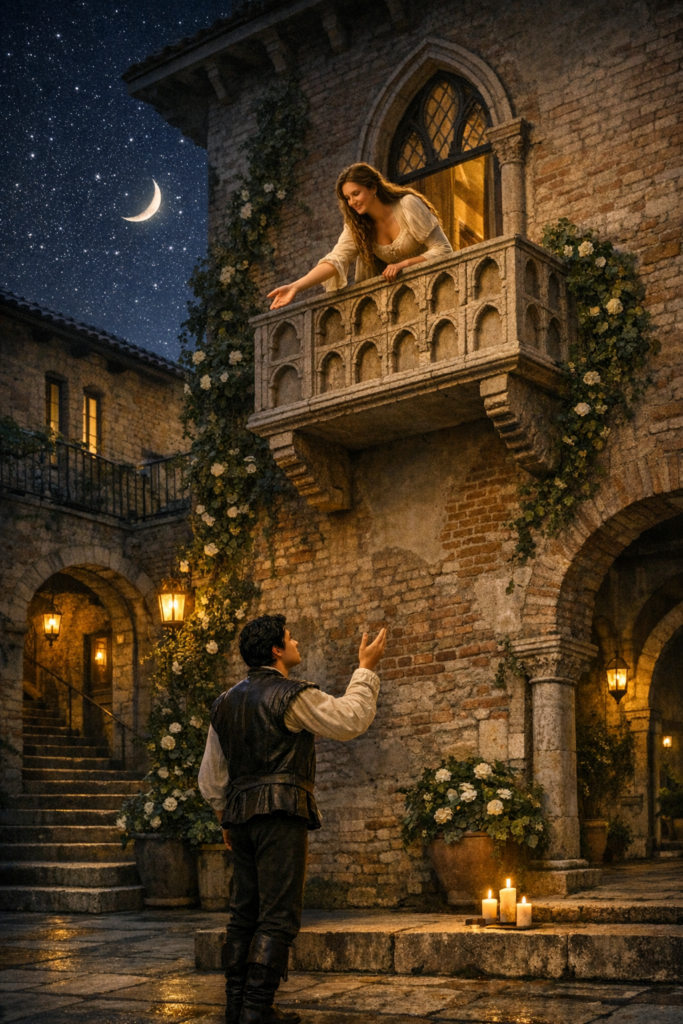
Romeo and Juliet has been part of English culture for 500 years, and exported around the world. But what makes it so powerful?
ROMEO
She speaks:
O, speak again, bright angel! for thou art
As glorious to this night, being o’er my head
As is a winged messenger of heaven
Unto the white-upturned wondering eyes
Of mortals that fall back to gaze on him
When he bestrides the lazy-pacing clouds
And sails upon the bosom of the air.JULIET
O Romeo, Romeo! wherefore art thou Romeo?
Deny thy father and refuse thy name;
Or, if thou wilt not, be but sworn my love,
And I’ll no longer be a Capulet.ROMEO
[Aside] Shall I hear more, or shall I speak at this?
JULIET
‘Tis but thy name that is my enemy;
Thou art thyself, though not a Montague.
What’s Montague? it is nor hand, nor foot,
Nor arm, nor face, nor any other part
Belonging to a man. O, be some other name!
What’s in a name? that which we call a rose
By any other name would smell as sweet;
So Romeo would, were he not Romeo call’d,
Retain that dear perfection which he owes
Without that title. Romeo, doff thy name,
And for that name which is no part of thee
Take all myself.
Consider the following list which demonstrates how has Romeo and Juliet continues to influence our culture:
- Taylor Swift’s Love Story
- Dire Straits’ Romeo and Juliet
- Baz Luhrman’s Romeo and Juliet
- Romeo and Juliet by The National Theatre
- Royal Shakespeare Company; Famous Quotes
- Globe Theatre; Masters of the Arts in Shakespeare Studies
- Art work inspired by Romeo and Juliet
- Fan art inspired by Romeo and Juliet
What does it look like to synthesize the methodologies from this lesson with the material?
Romeo and Juliet has reached canonical status because we continue to reference the text, we turn it into new stories, music and movies regularly. It continues to be performed on the stage. And the signs encoded in Romeo and Juliet are part of our everyday language; we casually drop into speech ‘a rose by any other name would smell as sweet’ and ‘Where for art though Romeo’. The words of the play are now common English phrases. We still consult the stars for guidance about our lives and the future – Romeo and Juliet was part of the system that encoded the stars with fate and though we might not be thinking about the play when reading our horoscopes, we wouldn’t have horoscopes if it wasn’t for literature encoding fate into the star systems. We have a dialogue with the play constantly, asking if people really are in control of their lives or whether we are destined to follow certain paths. The way the play is infused into our culture makes it canonical, and we study it because of this influence on culture.
Why it succeeds:
- Recognises the influence of the text on culture, including our very speech
- Uses language of encoding / decoding to explore the meaning held by signs
- Explains in a disciplinary manner why some texts are valuable and become part of the canon
Canon is about willing influence, not inflicted directives.
Task 1: Canonical or Not — do they continue to influence today’s texts?
Give students short claims:
- Beowulf defeating Grendal
- Arthur and his knights of the Round Table
- Chaucer’s A Knight’s Tale
- The jingle “Washing machines live longer with Calgon”
- Reddit stories
- General niche fiction
Student Task:
- Explain why our current text is studied.
- Your answer must focus on value, not plot.
Provide scaffold:
- This text can be considered canonical because it contributes to a dialogue about __________.
- It has been valued and preserved because __________.
- The text has influenced our society in such ways as ______.
Encourage reference to:
- themes
- social values
- moral questions
- cultural relevance
Finish the sentence:
“An interpretation is authorized when __________.”
You are listening for:
- evidence
- shared understanding
- methods
- how literature works
a) Pre-reading of the next lesson – read through the knowledge so you can be ready to discuss in class.
b) Apply the learning of today’s lesson to your own private reading text. Write a paragraph explaining how today’s learning changes how you might conceive your text. Be sure to use the key vocabulary and sentence stems.
c) Write a paragraph about the discipline of Literature, explain how key words from today’s lesson impact the field overall.
d) Add today’s vocabulary and sentence stems to your own glossary. Highlight any that you are unsure about, but you must also research the meanings yourself and develop your glossary to include this differentiated support.
How did you do? Remember, this is the disciplinary knowledge for Literature – it needs combining with the text you are studying now. Can you use this knowledge to write differently about the text you are studying? When you are ready, access the next lesson in this series.