Board Example
🔒 Where did mankind come from?
Ask:
- Was mankind designed by a creator?
- Or has mankind merely the latest in a long sequence of adaptations to life?
Analogy:
- In Premodernity, origin of the species is explained in scripture and science has to mold around this assertion of origin, or be false.
- Scripture was taught as beyond question or beyond doubt.
Teacher line:
“Faith wasn’t an opinion — it was the method.”
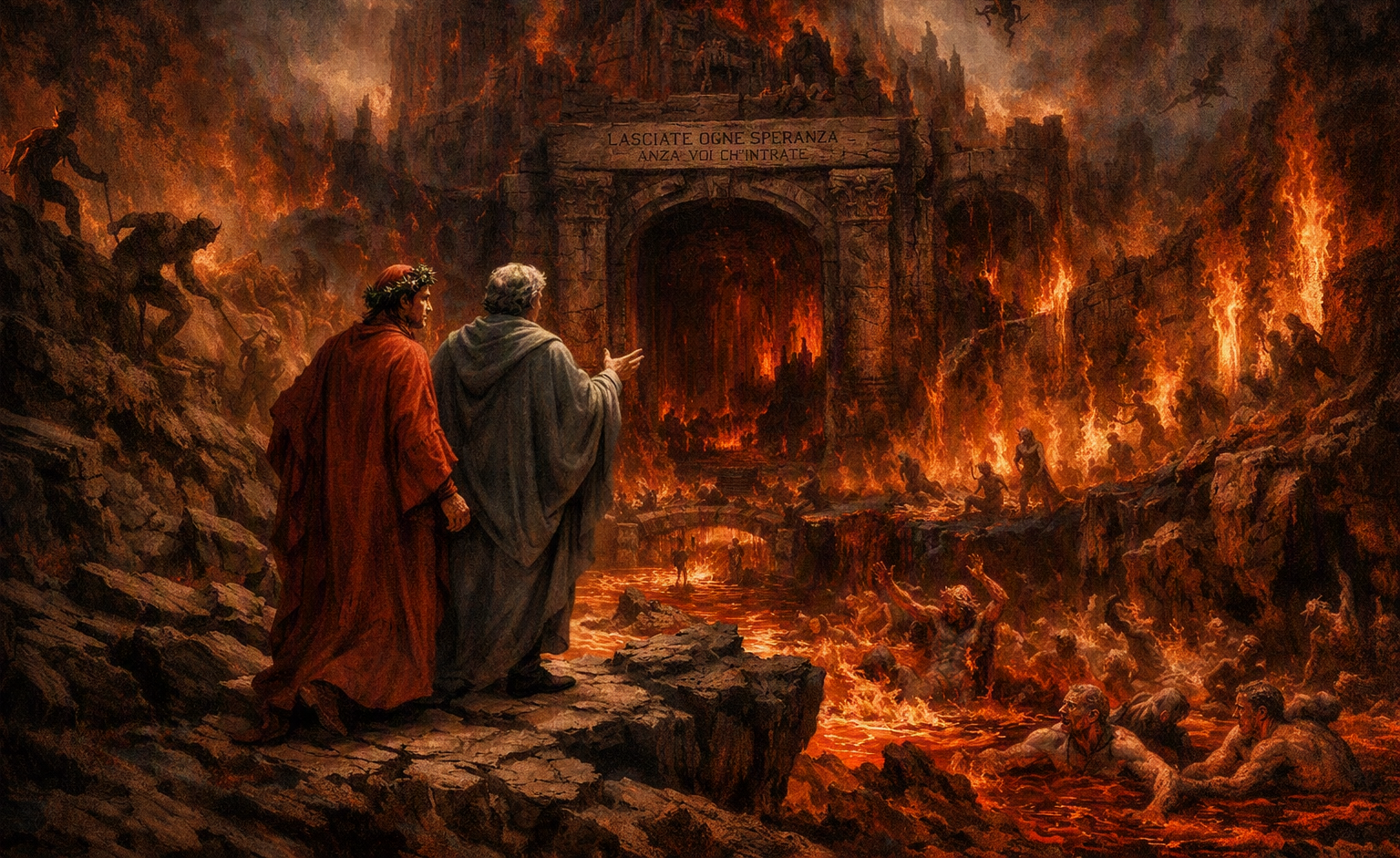
Inferno is the first part of a three-part epic poem called The Divine Comedy, written in the C14th. It tells the story of a fictionalized Dante who becomes lost in a dark forest and then undertakes a spiritual journey through Hell, guided by the ancient Roman poet Virgil. This journey is both literal and allegorical.
MIDWAY upon the journey of our life
I found myself within a forest dark,
For the straightforward pathway had been lost.Ah me! how hard a thing it is to say
What was this forest savage, rough, and stern,
Which in the very thought renews the fear.So bitter is it, death is little more;
But of the good to treat, which there I found,
Speak will I of the other things I saw there.I cannot well repeat how there I entered,
So full was I of slumber at the moment
In which I had abandoned the true way.
Question: What signs within the story do we feel today are encoded as ‘Christian signs’?
Written in 1794 as part of Songs of Experience, William Blake’s The Tyger interrogates divine creation through a lens of awe and dread. Its rhythmic intensity and burning imagery evoke the sublime, asking how a fearsome creature could be forged by the same hand that made innocence and light.
Tyger Tyger, burning bright,
In the forests of the night;
What immortal hand or eye,
Could frame thy fearful symmetry?In what distant deeps or skies.
Burnt the fire of thine eyes?
On what wings dare he aspire?
What the hand, dare seize the fire?And what shoulder, & what art,
Could twist the sinews of thy heart?
And when thy heart began to beat.
What dread hand? & what dread feet?What the hammer? what the chain,
In what furnace was thy brain?
What the anvil? what dread grasp.
Dare its deadly terrors clasp?When the stars threw down their spears
And water’d heaven with their tears:
Did he smile his work to see?
Did he who made the Lamb make thee?Tyger Tyger burning bright,
In the forests of the night:
What immortal hand or eye,
Dare frame thy fearful symmetry?
Question: Can you see the signs that have been encoded with Christian meaning by earlier traditions?
Task 1: Which explanation reflects Premodern thinking?
A. “This character learns a lesson because the plot demands it.”
B. “This character understands the lesson through Christian teaching.”
Student Task
Choose one moment from our current text where a character faces judgement, morality, or destiny.
- Identify how faith or divine order might shape its meaning.
- Explain how Premodern thinking helps us interpret the moment.
Provide scaffold:
- This moment reflects the Premodern belief that __________.
- A Christian belief has to be encoded first for the narrative to be understood as______.
- The narrative is acting as an allegory for the scripture of___.
Encourage focus on:
- sin
- judgement
- destiny
- moral testing
- divine order
Finish the sentence:
“Premodern literature teaches that belief authorises understanding because __________.”
You are listening for:
- divine order
- doctrine
- faith→meaning
- allegory
a) Pre-reading of the next lesson – read through the knowledge so you can be ready to discuss in class.
b) Apply the learning of today’s lesson to your own private reading text. Write a paragraph explaining how today’s learning changes how you might conceive your text. Be sure to use the key vocabulary and sentence stems.
c) Write a paragraph about the discipline of Literature, explain how key words from today’s lesson impact the field overall.
d) Add today’s vocabulary and sentence stems to your own glossary. Highlight any that you are unsure about, but you must also research the meanings yourself and develop your glossary to include this differentiated support.
How did you do? Remember, this is the disciplinary knowledge for Literature – it needs combining with the text you are studying now. Can you use this knowledge to write differently about the text you are studying? When you are ready, access the next lesson in this series.