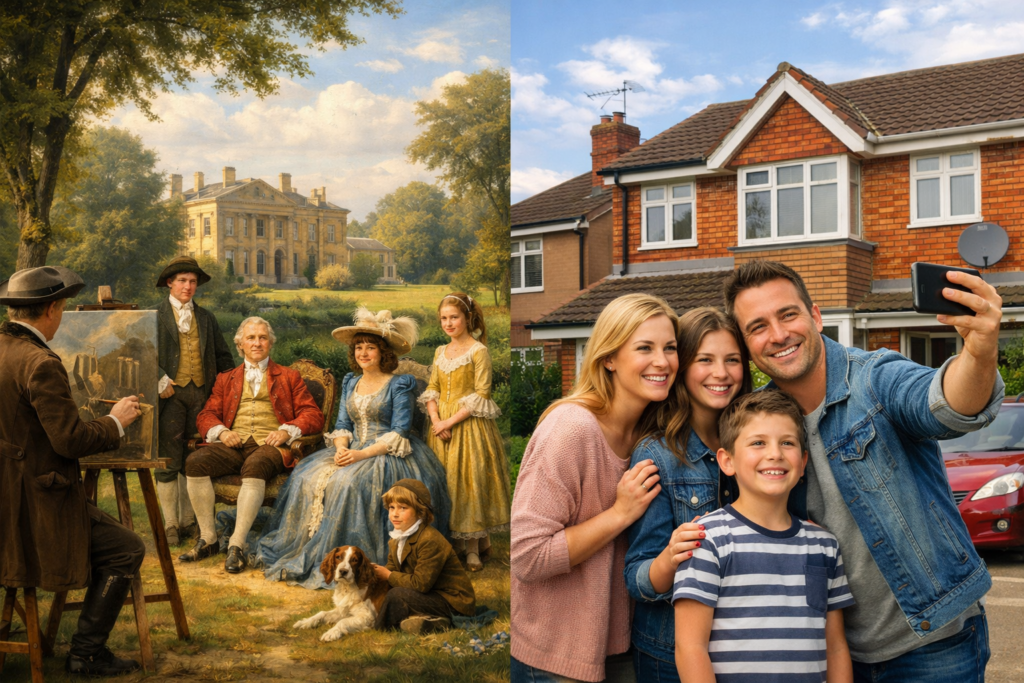
📷 A Painting vs a camera phone photograph
Ask:
- Which one is the most expensive to produce, and who would have access to each?
- Does one exclude certain classes of people?
Establish:
- Early Literature is like portrait paintings; they were expensive to produced so only the wealthy commissioned them, and they always focused on nobility, never the lower classes (why would you pay an artist an exorbitant sum to paint the local servant?)
- Camera phone photographs place portraits into the hands of ordinary citizens, who record their own lives and those around them. Now, poor can be recorded as part of history and not excluded from it.
- Novels reduced the barriers of entry to literature, so it could create portraits of the everyday lives of ordinary citizens.
Teacher line:
“The novel records a wider range of life and experiences, rather than summarising morals.”
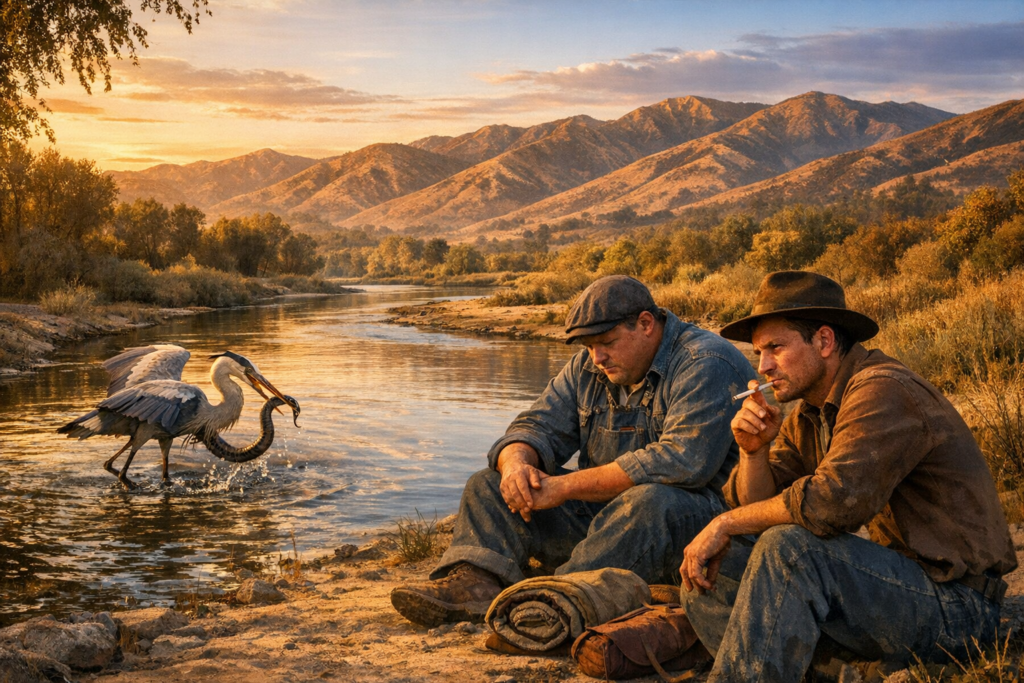
When George and Lennie sit by the riverbank in Chapter 1, and George explains how their life is different from other ranch workers — emphasising their shared dream, their poverty, their constant movement between jobs, Lennie’s dependency, and the harsh economic reality.
Lennie pleaded, “Come on, George. Tell me. Please, George. Like you done before.”
“You get a kick outta that, don’t you? Awright, I’ll tell you, and then-we’ll eat our supper.”
George’s voice became deeper. He repeated his words rhythmically as though he had said them many times before. “Guys like us, that work on ranches, are the loneliest guys in the world. They got no family. They don’t belong no place. They come to a ranch an’ work up a stake and then they go inta town and blow their stake, and the first thing you know they’re poundin’ their tail on some other ranch. They ain’t got nothing to look ahead to.”
Lennie was delighted. ‘That’s it—that’s it. Now tell how it is with us.”
George went on. “With us it ain’t like that. We got a future. We got somebody to talk to that gives a damn about us. We don’t have to sit in no bar room biowin’ in our jack jus’ because we got no place else to go. If them other guys gets in jail they can rot for all anybody gives a damn. But not us.”
Lennie broke in. “But not us! An’ why? Because …. because l got you to look after me, and you got me to look after you, and that’s why.” He laughed delightedly. “Go on now, George!”
“You got it by heart. You can do it yourself.”
“No, you. I forget some a’ the things. Tell about how it’s gonna be.”
“O.K. Someday—we’re gonna get the jack together and we’re gonna have a little house and a couple of acres an’ a cow and some pigs and – “
“An’ live off the fatta the lan’. ” Lennie shouted. “An’ have rabbits. Go on, George! Tell about what we’re gonna have in the garden and about the rabbits in the cages and about the rain in the winter and the stove, and how thick the cream is on the milk like you can hardly cut it. Tell about that, George.”
“Why’n’t you do it yourself? You know all of it.”
What does it look like to synthesis the methodologies of this lesson with some material?
This scene demonstrates why Of Mice and Men must be a Modern novel, because the prose form allows Steinbeck to represent the everyday experiences of ordinary workers with close attention to emotion, speech rhythms, and social reality. George’s explanation of their life as migrant workers uses realistic detail, showing insecure work, loneliness, and economic pressure — concerns typical of Modern literature’s shift toward observation rather than moral instruction.
The novel’s form lets readers follow George’s internal frustration, responsibility, and moral conflict over Lennie, something earlier genres such as epic or romance would not prioritise. By dwelling on their routine, their dream, and their vulnerability, the scene exemplifies how the novel is designed to explore individual experience over time, giving narrative importance to people who were previously excluded from literature. This is exactly the function of the Modern novel: to document real social life in accessible prose, revealing meaning through lived experience rather than inherited truths.
Why it succeeds:
- Uses Literary vocabulary: prose, realism, individual experience, social observation
- Explains how meaning is created through form
- Connects the scene to Modernity’s worldview
- Shows the novel as a necessary form, different and new to previous earlier literature
- Elevates the extract beyond plot → into method
Task 1: Novel or Earlier Form?
Give students descriptions and ask which suit the novel:
- A long focus on one person’s thoughts
- A symbolic journey representing Heaven
- Detailed descriptions of work and home life
- Verse designed for performance
Student Task
Choose one moment from our current novel.
- Explain how the novel form allows this moment to exist.
- Explain what this reveals about Modern values.
Provide scaffold:
- This moment could only exist in a Modern novel because __________.
- It reflects Modern realism / individual experience by __________.
Encourage focus on:
- inner thoughts
- time passing
- social setting
- realism
- consequence
- new, democratized printing
- the highly accessible prose writing style
Finish the sentence:
“The novel developed because Modern writers needed to __________.”
You are listening for:
- represent experience
- observe society
- show individual lives
- explore realism
a) Pre-reading of the next lesson – read through the knowledge so you can be ready to discuss in class.
b) Apply the learning of today’s lesson to your own private reading text. Write a paragraph explaining how today’s learning changes how you might conceive your text. Be sure to use the key vocabulary and sentence stems.
c) Write a paragraph about the discipline of Literature, explain how key words from today’s lesson impact the field overall.
d) Add today’s vocabulary and sentence stems to your own glossary. Highlight any that you are unsure about, but you must also research the meanings yourself and develop your glossary to include this differentiated support.
How did you do? Remember, this is the disciplinary knowledge for Literature – it needs combining with the text you are studying now. Can you use this knowledge to write differently about the text you are studying? When you are ready, access the next lesson in this series.