
One of the core pedagogies of DisciplineOfEnglish is that the sub disciplines (Language, Literary and Literature) are separate bodies of knowledge. On the Venn diagram, the central shared cell is smaller than the individual domains (though I would argue that Literacy is a skill and not a body of knowledge, so that it barely even crosses with Lanaguage and Literature). But this is often now how English is taught. Today I shared with a class of year 10 a distinction between Language and Literature; that the former is concerned with grammatical certainty, whilst the latter is concerned with symbolic ambiguity. And it makes sense…
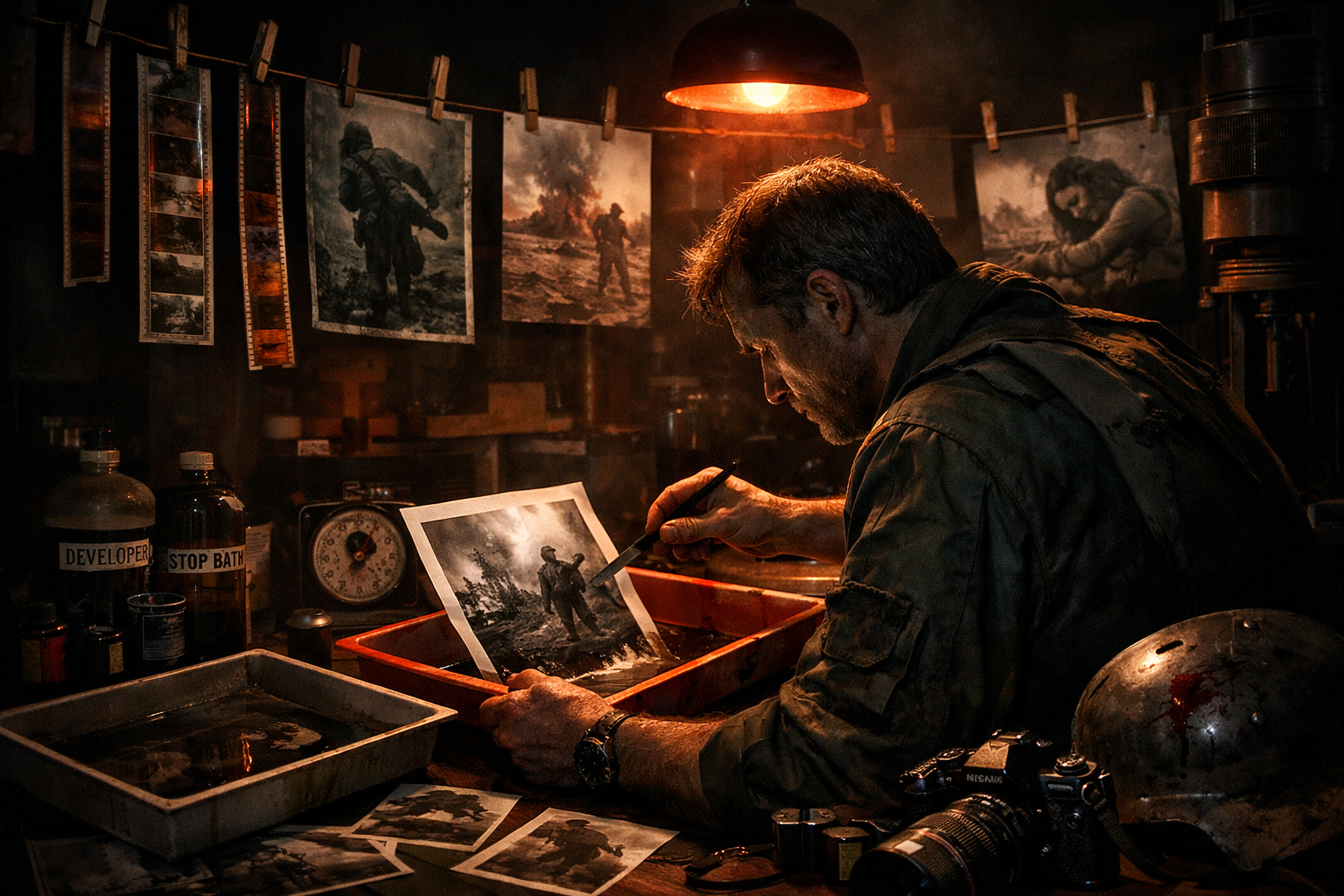
We can demonstrate the conceptual difference with any text, and War Photographer by Carol Ann Duffy is a good example. We study this is an artifact of Literature (not Language), which means according the the concept of ambiguity, that the author is concerned with symbolic and uncertain meanings, not grammatical certainty. We could imagine a companion artifact from a newspaper or blog, in which the author explores the issues of voyeur journalism and how photographers are guilty of creating sensational spectacle.
Such an article would be studied through the lens of grammatical certainty. That article would be attempting to transmit some known, definable and prescribed body of knowledge and conclusion – we should know clearly the moral position of the author. Grammar is the tool of certainty because it is an agreed sign system to which we all adhere and deviation from convention is highly frowned upon.
The poem however is not adhering to grammatical convention. If it were, it should write to the edge of the page, not arbitrarily carriage return mid-sentence. When we find wording that rhymes, or has meter, has the word been selected because it carries the most accurate meaning – or because it carries prosodic effect? If meaning is subordinate to prosody, how can we know for certain what was meant?
So what is the ambiguity in War Photographer? We start with the themes of the poem; roles, responsibility, morality, editorial standard, accountability and we ask the question, what is the meaning within the text, constructed by the author. Does Duffy feel that photographers are guilty of ignorance or that photographers are exempt from some moral imperative for intervention? Her position can’t be both as these are mutually exclusive positions. Let’s investigate:
In his dark room he is finally alone
On the one hand, the dark room is the space given to develop exposures. On the other hand, he observes “Belfast. Beirut. Phnom Penh”… is ‘dark’ symbolic of his trauma – a room of terror. We can’t know if ‘dark’ is simply the grammatical identifier of space, or a symbolic code.
spools of suffering set out in ordered rows.
‘Spools’ implies a chaos of quantity, in direct conflict with the structure of ‘ordered rows’. Does the subject feel overwhelmed by the morality of his actions, or is the subject objective and professional in his work space? The meaning struggles to be reconciled when terms could be symbolic or grammatic.
The only light is red and softly glows,
An easy symbolic discovery for students here; red is clearly more than a grammatical colour frequency, and implies also danger and guilt (“My hands are the same colour as yours” – Lady Macbeth). But again, it’s in direct conflict with ‘softly glows’.
as though this were a church and he
a priest preparing to intone a Mass.
Belfast. Beirut. Phnom Penh.
In a world where the majority hold some religious position, and religions generally encourage peace and harmony, how can there be an almost equal body of war? Is Duffy arguing that the world is one of devotion and worship, or of terror? Is his photography the salvation and he the saviour? Then why do wars continue in an asyndetic list?
In only the first few lines, we can say that we have no idea what Duffy’s moral position is – virtually every statement or line can be self-contradictory. There is as much evidence to say that Duffy is critical of the actions of the war photographer as there is evidence for the importance of the war photographer; we cannot say if war photographers have moral exemption or not; we cannot say if war photographers are guilty or not. The meaning is ambigious because the symbolism across the poem can be read in different ways.
However, the reader is still going to have some aesthetic response to the text. We will see more clearly some symbols, rank some more highly, and argue some moral conclusion based on what we subjectively experience. What we obtain is not insight into the author’s moral position, but an insight into our own moral position.
We are really analysing ourselves.
The critic however should be above this introspection. It is the role of the critic not to be affected by the text like a lay-reader but to study the possible outcomes from the poem. On the one hand, there is enough symbolic ambiguity to argue either that war photographers have some exemption from the normal moral actions of citizens – to intervene and help those in need. On the other hand there is enough symbolic ambiguity to argue that war photographers are complicit in an economy of sensationalism and spectacle. Why not save a soul, and help them to tell their story and empower their voice, rather than allow the victim to perish and tell the story from some second hand perspective? Readers, argues the critic, express their own moral position through the poem and maybe supplant this onto the author who remains ambiguous and removed from its conclusions.
And so a Language body of knowledge deals in different kinds of texts for different purpose. For Language, it’s about knowing what has been told and accurately interpreting messages – a Language study attempts to know for certain who the murderer us – an article for a newspaper aims for grammatical certainty. Literature is about acknowledging the internal contradictions and the inherent ambiguity of symbolism. We cannot know what literary authors mean or intend, and literary authors arguably aren’t even aiming for clarity. Otherwise they’d be writing for a newspaper.
Leave a Reply