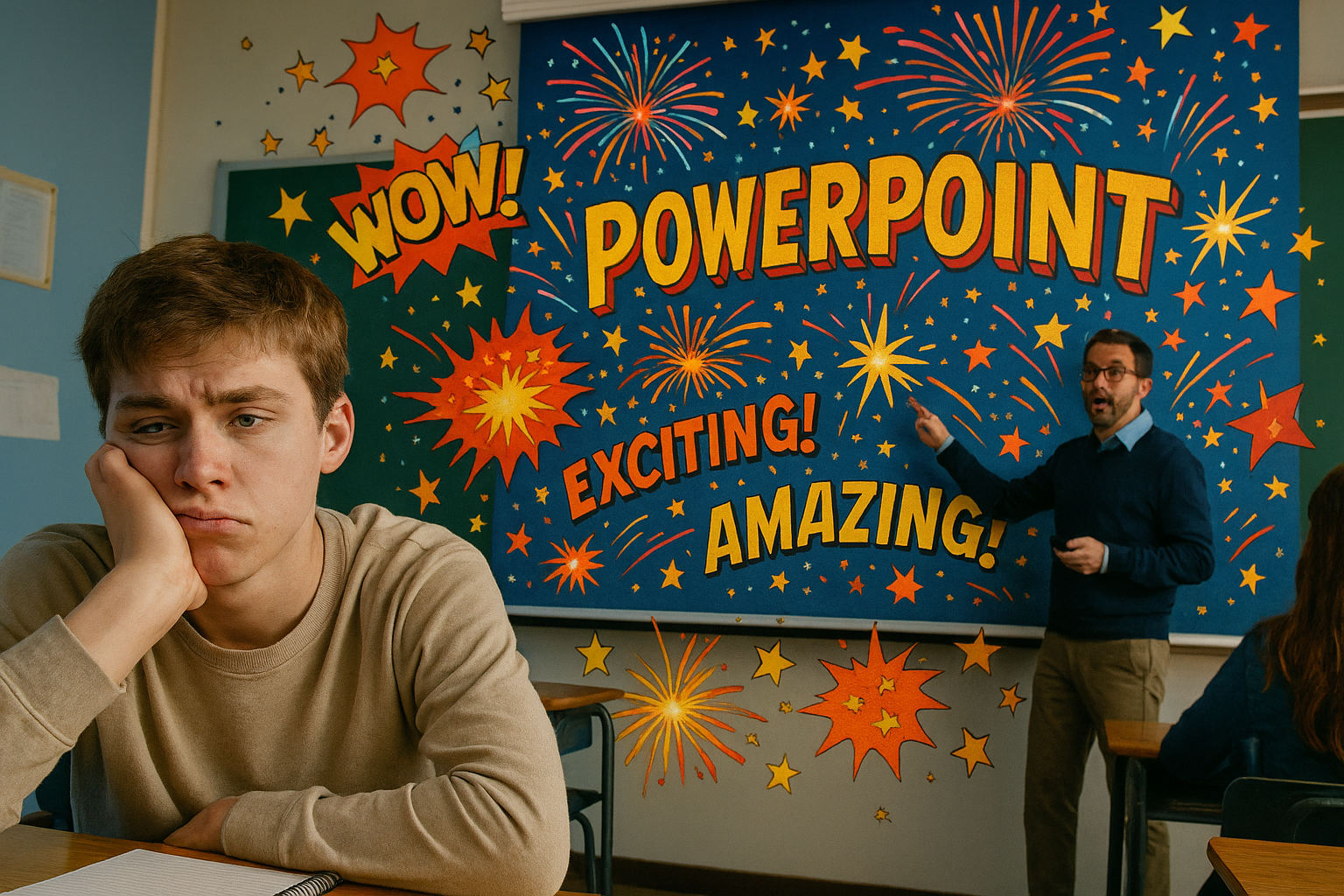

Students become bored during lessons. They become bored of the lesson. They are bored by the lesson. And sometimes, no matter what we try to do as teachers, there seems to be no antidote to their boredom. But in trying to fix boredom we are actually contributing to greater difficulty accessing the lesson. Maybe teachers are thinking about this the wrong way around.
What surely has become the most common tool for tackling student boredom is Microsoft’s Powerpoint . It incorporates such pedagogical recommendations as that of ‘dual coding’, by making visual cues for the learning. Students no longer just listen to the teacher, but can see it too. The text on the board will reflect the teaching being delivered, but of course plain old text is cold, atonal and passive. We can give text a real punch by recreating the intonation through animations; serious points slide in like brogues to an interview; inciteful points float in like lightbulb moments; troublesome ideas fade away like whisps being discarded; humorous points bounce in a sprung tail. Now the visual text feels personal and connected to the tone. The visual form is aided by Powerpoint’s many supported file types; jpeg images are inserted, gifs, colour palettes, wav audio files. Now the powerpoint is more than just text but a full multi-media experience. It also provides the pedagogical mechanism of ‘chunking’ – we can break down parts of the lesson into elements provided on different slides. Now the lesson is formatted into slides of information to micromanage the learning into ‘moments’. The period between the moments can also become fuel for student boredom, but the dedicated Powerpointer can add transition animations from one slide to the other, maybe a dramatic curtain reveal suitable for the stage, or the studious page turn of focused academia, or the cinematic zoom and twist between scenes of a narrative.
Is it exciting enough yet? Does it speak to the student now? How about a topic-appropriate joke in the corner, an allusion to make the meaning more interesting, a silly photo of a sad cat in the bath… Are the students not entertained? Are you not entertained?
All of this ‘fluff’ adds to the cognitive load experienced by the student. This concept is called the extraneous load exerted by the material. The more elements are added, the more extraneous load is being built into the learning.
There is also the matter of teacher-by-teacher difference. We will not all ‘encode’ meaning into our Powerpoints in the same way as one-another. If one teacher encodes a humorous point with a bouncing animation, but another teacher does not, the student has to decode the presentational difference; the student has to see there are two different forms with the same function. For meaning to be fixed upon signs, a great deal of time, repetition and association is required. If all teachers agree and stick to a presentation format, then encoding can become ‘myth’, as Roland Barthes tells us; part of our cultural knowledge. If all teachers place titles at the top, underlined, then students come to know the top and underline sign is the title. Divergence from this becomes problematic.
Highly elaborate, embroidered, energy intensive presentations might create greater interest from the student but at the cost of accessibility from extraneous load, and will not benefit from agreed sign systems which take time to form. But actually, have the efforts in making a triple-A Powerpoint raked in the interest at the box office? Has it been a hit?
In my experience, no. Not at all.
The energy put into making elaborate presentations doesn’t turn a profit; it does not make back in student interest what the teacher puts in.
I feel this also applies to a particular publication which attempts to ‘upsell’ Shakespeare’s plays, by turning them into a comic strip, filled with jokes, asides and quirks. Schools purchase them by the class-set, they are de rigueur for standard material or for struggling students. Despite the tens of thousands that state education has paid into this publication, I have never found a student’s engagement in the play increase. It breaks the same rules of Cognitive Load Theory that our Powerpoints and suffers the same lack of engagement.
So what does peak the interest from students? Generally, it’s relationships with the people around them and the awesome (as in, the power to illicit the emotion of awe – not the emotion of excellence) nature of the subject. Teachers are not trying to create blockbuster, multimedia, immersive experiences – we are trying to build relationships. Teachers are not required to ‘big up’ the material, it should stand alone on its own merits. Teachers should be as excited by the material as we hope students will become, and exhibit our interest, but we are are only advocates for the material. We are not its marketing and production team.
The lessons presented here attempt to avoid the trap of upselling. They attempt not to fill the absence of a teacher through synthetic personalisation. They attempt to be clear and easy to follow so that there is room left for relationship building and for awe.
What is needed by all learners however, is another human to share the experience with from whom to receive the model of awe at the material itself. These lessons then are always best undertaken with a friend, with a tutor or mentor, or even in the classroom with the teacher.
The discipline of English is awesome, and this is easier to see and to share in when it is left to stand on its own merit without trying to turn it into the next big hit.
Leave a Reply