

🎮 A Video Game Tutorial
Ask:
- Can a beginner play like an expert?
- Does the game expect you to learn controls?
Establish:
- The game imagines an ideal player
- You become that player through learning
- We can be positioned within the game by setting the difficulty and levels of assistance
- New titles assume you have played earlier titles, and so knowing a history or sequence of games is important; an ideal reader knows roughly how to play any video game through familiarity with other titles.
- Different titles in the same genre share ideas, not to plagiarize but because using this previously encoded system is easier than teaching players a new style
- New titles build upon what has been learnt in older titles
Texts work the same way. Historical texts train you to better read new texts.
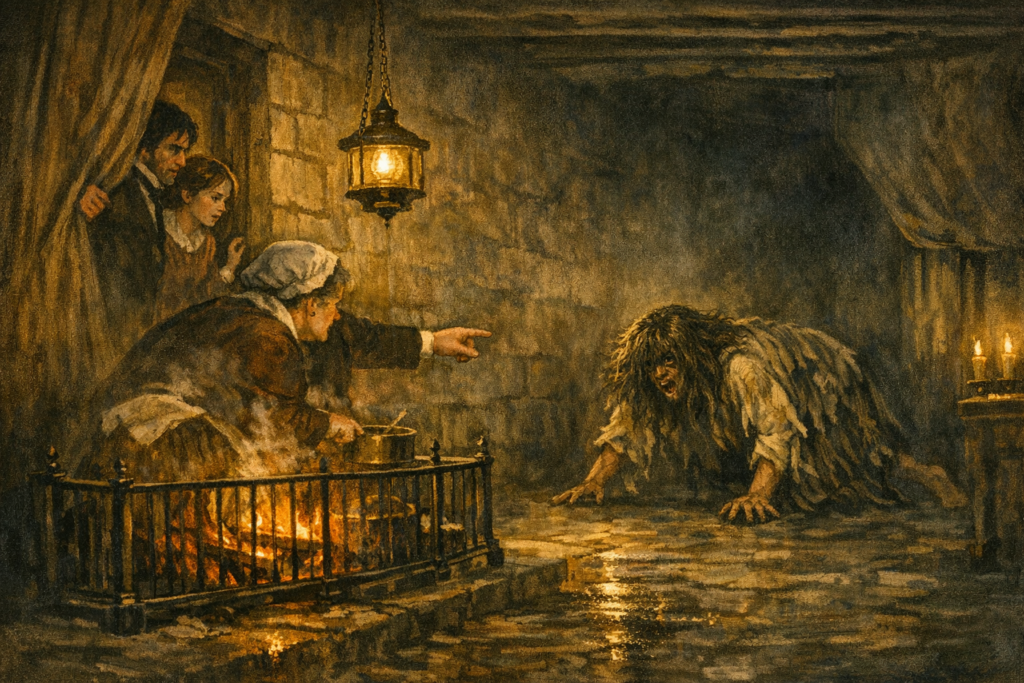
Charlotte Bronte uses the archetypal character (done many times before) of a crazed women; Bertha. Bertha is Rochester’s real wife who he has kept hidden, ashamed of his marriage. In this scene, he reveals Bertha to the woman he is having an affair with.
“You know this place, Mason,” said our guide; “she bit and stabbed you here.”
He lifted the hangings from the wall, uncovering the second door: this, too, he opened. In a room without a window, there burnt a fire guarded by a high and strong fender, and a lamp suspended from the ceiling by a chain. Grace Poole bent over the fire, apparently cooking something in a saucepan. In the deep shade, at the farther end of the room, a figure ran backwards and forwards. What it was, whether beast or human being, one could not, at first sight, tell: it grovelled, seemingly, on all fours; it snatched and growled like some strange wild animal: but it was covered with clothing, and a quantity of dark, grizzled hair, wild as a mane, hid its head and face.
“Good-morrow, Mrs. Poole!” said Mr. Rochester. “How are you? and how is your charge to-day?”
“We’re tolerable, sir, I thank you,” replied Grace, lifting the boiling mess carefully on to the hob: “rather snappish, but not ’rageous.”
A fierce cry seemed to give the lie to her favourable report: the clothed hyena rose up, and stood tall on its hind-feet.
“Ah! sir, she sees you!” exclaimed Grace: “you’d better not stay.”
“Only a few moments, Grace: you must allow me a few moments.”
“Take care then, sir!—for God’s sake, take care!”
The maniac bellowed: she parted her shaggy locks from her visage, and gazed wildly at her visitors.
What does an answer look like when it synthesizes the methodologies from this lesson with the material?
This moment positions the reader to recognise Bertha’s behaviour as a sign of madness because the text draws on gothic conventions of confinement and violence. An ideal reader understands that nineteenth‑century literature often encoded mental illness through physical wildness, animalistic movement, and imprisonment, so the scene invites us to decode Bertha not simply as a “violent woman” but as a figure shaped by historical literature. The ideal reader is someone who is aware of that in Literature, women are often presented as ‘dangerous’ such as Lady Macbeth, Miss Havisham or Medusa. The ideal reader is not surprised to find Bertha is mad because we have a similar education in books as the author. We are positioned by literature to decode Bertha’s actions as the ‘hysterical woman’.
⭐ Why this succeeds
- Explicitly uses Literary vocabulary: ideal reader, positions the reader, signs, decoding
- Moves beyond describing events to explaining how meaning is produced
- Shows the reader applying shared cultural knowledge about the gothic genre
- Connects the scene to literary patterns, not just plot
The ideal reader isn’t smarter — they are better trained and wider read.

Task 1: What films are needed for an audience of Avengers Endgame?
Possible options:
- Disney’s Frozen 1 and 2
- Star Wars 1 – 9
- Iron Man, Captain America, Spider Man
Student Task
Choose one moment from our current text.
- Explain what the text expects the reader to understand.
- Explain what an ideal reader knows that helps them understand this moment.
Scaffold:
The text positions the reader to __________.
An ideal reader understands this because __________.
Encourage use of the following vocabulary:
- signs
- conventions
- genre
- narrative patterns
Finish the sentence:
“An ideal reader understands a text better because __________.”
You are listening for:
- training
- learned knowledge
- decoding
- conventions
Why This Lesson Completes the Spine
You now have a coherent methodological sequence:
- What literary writing is for (synthesis, not spotting)
- How meaning works (encoding / decoding)
- Why some meanings count (authorization)
- Who can find them (ideal reader)
This makes later work on:
- historical sign systems
- institutions
- canon feel necessary, not imposed.
a) Pre-reading of the next lesson – read through the knowledge so you can be ready to discuss in class.
b) Apply the learning of today’s lesson to your own private reading text. Write a paragraph explaining how today’s learning changes how you might conceive your text. Be sure to use the key vocabulary and sentence stems.
c) Write a paragraph about the discipline of Literature, explain how key words from today’s lesson impact the field overall.
d) Add today’s vocabulary and sentence stems to your own glossary. Highlight any that you are unsure about, but you must also research the meanings yourself and develop your glossary to include this differentiated support.
How did you do? Remember, this is the disciplinary knowledge for Literature – it needs combining with the text you are studying now. Can you use this knowledge to write differently about the text you are studying? When you are ready, access the next lesson in this series.