
two structures of power looming over a city

Lit221 Ideology and power

Accessibility options: Use your browsers translation, screen reader and AI summary tools to help your studies.

This lesson foregrounds the ideological structures that underpin literary texts. Drawing from the CECA framework, students explore how governance systems form the political “meta‑narratives” that authors either contain (uphold) or subvert (challenge).
The lesson uses disciplinary knowledge from sociology, political history, post‑colonialism, and Marxist criticism, aligning with the explanation that ideology is fundamentally about “who serves what” within a society.

Students will learn how literature both reflects and critiques systems such as feudalism, monarchy, republicanism, and democracy, helping them recognise political power as a constructed sign system rather than a natural background condition.

By the end of the lesson, students will:

  • Understand the differences between feudalism, monarchy, republic, and democracy.
  • Explain how these systems shape power, privilege, and citizenship in a society.
  • Analyse a literary extract through the lens of ideology (who has power, who serves power, and why).

Different societies organise power in different ways. Some systems give power to a single ruler or a small elite; others distribute power to citizens. Writers often show how these systems benefit some groups and disadvantage others. When reading literature, we can look beyond the story to ask:

  • Who has power?
  • Why do they have it?
  • Who is expected to serve, obey, or remain silent?

Understanding political systems helps us see how authors critique fairness, justice, and authority.

Student‑friendly anchor:

“Texts reflect the ruling, government or political systems which we can study through the narrative.”

  • Feudalism — a hierarchical system where land is exchanged for loyalty; peasants serve nobles, nobles serve a monarch.
  • Monarchy — a system where power is held by a king or queen, often justified by divine right.
  • Republic — a state where power is held by elected representatives rather than hereditary rulers.
  • Democracy — a system where citizens have political power, often through voting.
  • Meta‑narrative — a dominant ideological story (e.g., the divine right of kings).
  • Subversion — challenging or undermining the dominant ideology.
  • Containment — upholding or reinforcing the dominant ideology.
  • “This society functions through a ______ system, meaning that power is…”
  • “The author subverts / contains this political structure by…”
  • “This character’s role reflects the values of a ______ society because…”
  • “The tension in this moment arises from the expectations of a ______ system…”

🚫 Incorrect method:

“This text is old so people had kings back then.”

Why this is wrong:
It treats power structures as a historical coincidence rather than a deliberate ideological framework. It lacks disciplinary analysis of why the system exists and who benefits from it.

Correct direction:
Students should identify the governance structure, explain its values, and analyse how the text reinforces or challenges those values.

Imagine four different school structures:

  • Feudalism: The headteacher gives all authority to a few senior staff, who control entire houses; students do what they are told because of their position, not fairness.
  • Monarchy: One headteacher rules the school permanently and can change rules without consultation.
  • Republic: A school council is elected to represent student voices and help make decisions.
  • Democracy: Students vote directly on major policies.

Different structures dramatically alter who makes decisions — and this is what writers reveal through the ideology present within their narratives. Some texts are deeply ideological, some are not.
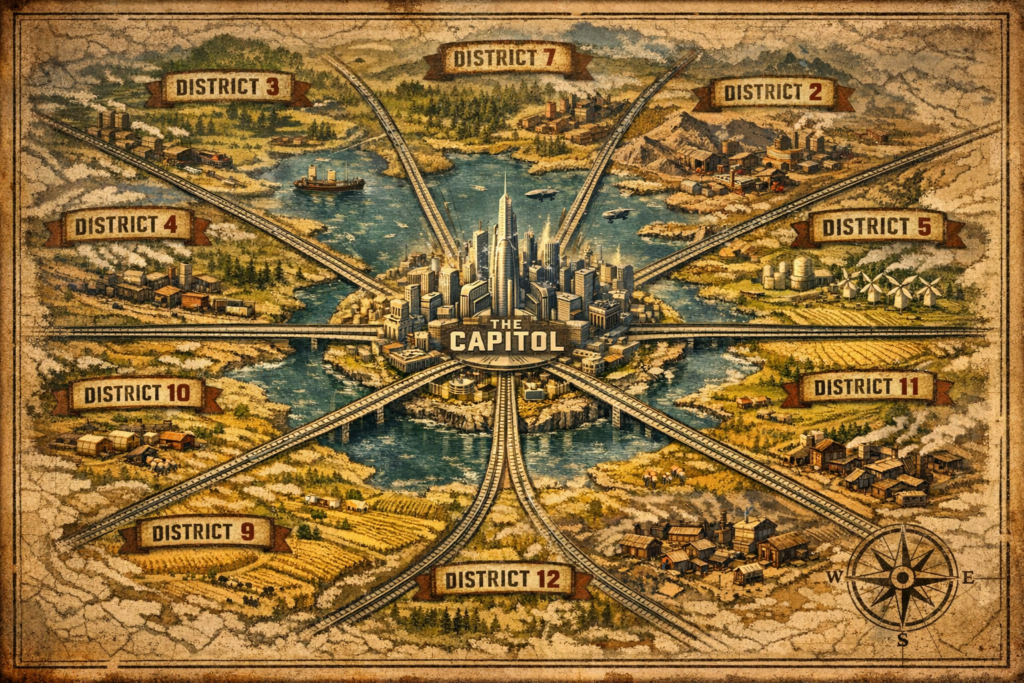
For this example, we will use The Hunger Games (2008) by Suzanne Collins, a widely known text that presents a modern critique of authoritarian power. The novel’s world, Panem, juxtaposes feudal‑style servitude with a centralised autocratic regime, making it ideal for ideological analysis.

Katniss describes District 12 as bound to the Capitol by hunger and labour. People owe everything to the Capitol — food, fuel, survival — while gaining nothing in return. The Capitol’s wealth is displayed as dazzling excess, contrasted sharply with the scarcity in the districts. The Reaping ritual is treated with forced celebration, masking an oppressive structure beneath ceremony.

Why this demonstrates the lesson objectives:

  • Shows a feudal‑like hierarchy where districts supply labour to an elite centre.
  • Reveals how ideology is maintained through ritual, fear, and spectacle.
  • Demonstrates the containment of a dominant political narrative (“the Capitol protects you”).
  • Highlights early signs of subversion in Katniss’s perspective.

Question: How does The Hunger Games present ideas of power?

“The Capitol is mean to the districts and treats them badly. It shows the leaders are unfair. But Katniss fights against this, she has power because she has skills through her weapons and she reveals her power during the private session with the game makers. She ends up leading the revolution, become the figure of power that inspires others.”

Why this fails

  • Describes events, not ideological structures.
  • Lacks vocabulary such as feudalism, monarchy, or domination.
  • Focuses on morality rather than political mechanics.

This moment exposes a feudal‑style ideological structure, where the Capitol functions as an elite ruling class extracting labour and resources from dependent districts. The Reaping ritual acts as a device of authority to control the lower classes, masking exploitation with enforced celebration. Collins critiques this authoritarian hierarchy by revealing how power flows in only one direction — upward — The Hunger Games is subversive toward these ideological structures by showing how people can take power from authority through revolution in a way that would be censored in countries that continue to oppress their citizens. Literature acts as a lived experience that can inspire people, and authority often wants to hide these type of experiences to quash any person being inspired by Katniss to become a revolutionary icon.

Why it succeeds:

  • It talks about the ideological governance within the story
  • It recognises who has power, how it is wielded and what purpose it serves
  • It recognises the cultural impact of ideological narratives

Question – Match the countries to their system of governance:

  • Britain
  • America
  • Saudi Arabia
  • Monarchy rule
  • Democracy
  • Republic
  • Britain
  • America
  • Saudi Arabia
  • Democracy
  • Republic
  • Monarchy rule

Britain is an interesting case; it has a monarchy, but it does not have power over Parliament to enact laws or make legal decisions. Britain’s Monarchy is symbolic, unlike that of Saudi Arabia, whose Monarch has absolute power and directly controls ministries.

Analyse a different extract from your class text (or a provided excerpt) using today’s ideological vocabulary.

Instructions

  1. Identify the political structure present (feudal, monarchical, republican, democratic).
  2. Use at least two key vocabulary terms.
  3. Begin with one sentence stem.
  4. Explain how the political structure shapes relationships, conflict, or expectations.

Success Criteria

A strong response will:

  • Correctly identify the governance system.
  • Analyse political power structures, as well as personality or plot.
  • Explain how ideology shapes behaviour or conflict.

Stretch

Compare how two characters either contain or subvert the dominant ideology.

Finish the sentence:

a) Pre-reading of the next lesson – read through the knowledge so you can be ready to discuss in class.

b) Apply the learning of today’s lesson to your own private reading text. Write a paragraph explaining how today’s learning changes how you might conceive your text. Be sure to use the key vocabulary and sentence stems.

c) Write a paragraph about the discipline of Literature, explain how key words from today’s lesson impact the field overall.

d) Add today’s vocabulary and sentence stems to your own glossary. Highlight any that you are unsure about, but you must also research the meanings yourself and develop your glossary to include this differentiated support.

How did you do? Remember, this is the disciplinary knowledge for Literature – it needs combining with the text you are studying now. Can you use this knowledge to write differently about the text you are studying? When you are ready, access the next lesson in this series.