
Layers of social structures

Lit223 Ideology of class, citizens and social structures

Accessibility options: Use your browsers translation, screen reader and AI summary tools to help your studies.

This lesson introduces students to the disciplinary concepts of class, citizenship, and social structures, expanding CECA’s ideological framework with modern sociological research. Students explore how societies organise people into hierarchies based on wealth, status, occupation, or power; how these hierarchies determine people’s opportunities and life chances; and how literature reflects, critiques, or subverts these structures.

According to major sociological analysis, social structures involve “patterned social relations” that shape inequality and determine how individuals interact within a society.
Research on social stratification explains that class is a hierarchical system based on access to wealth, income, education, and power, which in turn influences opportunities and privileges across society.
Political theorists also describe class as historically tied to systems of production, economic relations, and cultural prestige (Marx, Weber, Bourdieu).

These ideas allow students to read literature not just as stories, but as representations of social order, revealing who holds power, who is marginalised, and why.

By the end of the lesson, students will:

  • Understand what class, citizenship, and social structures mean in sociological terms.
  • Recognise how texts represent or challenge hierarchical systems.
  • Analyse characters and situations through concepts of power, status, and inequality.

Class refers to how society groups people based on wealth, job, education, or status. Some groups have more chances in life, while others face more barriers. Social structures are the invisible systems that shape how society works — who has power, who gets listened to, who gets opportunities. Citizenship is about belonging to a community, along with rights and responsibilities, but different groups may experience citizenship unevenly.

Stories often show characters struggling with or benefiting from these systems. When we read literature, we look at how social structures shape characters, and how authors highlight fairness, inequality, or injustice.

  • Social class — a grouping based on wealth, education, income, and occupation; shapes life chances and power.
  • Social stratification — the hierarchical layering of society, producing unequal access to resources and opportunities.
  • Citizenship — belonging to a community with certain rights and responsibilities; can be unequal in practice.
  • Power / privilege — advantages given to certain groups due to status or class position.
  • Life chances — opportunities available to people based on their class position.
  • Hierarchy — ranking people or groups above or below others.
  • Mobility — the ability to move between social classes.
  • “This text represents a hierarchical social structure through…”
  • “The character’s class position affects their opportunities because…”
  • “The author critiques the distribution of power by showing…”
  • “Citizenship is shown to be unequal when…”
  • “The narrative reveals how social stratification shapes…”

🚫 Incorrect method:

“This character is poor so their life is sad.”

Why this is wrong:
It focuses on stereotype, not social structure. It ignores that poverty results from systemic inequality, not individual failure. It also fails to use disciplinary language.

Correct direction:
Students must analyse how social structures limit life chances, how class position influences behaviour, and how authors expose inequalities.

HSBC has produced a bank account in response to structural inequality – this is a civic duty performed on behalf of and in the benefit of ordinary people. It could help give people who are financially very vulnerable some safety. It supports the lowest social class by attempting to improve their life chances – without a bank account it is almost impossible for them to have social mobility (the opportunity to improve their outcomes).
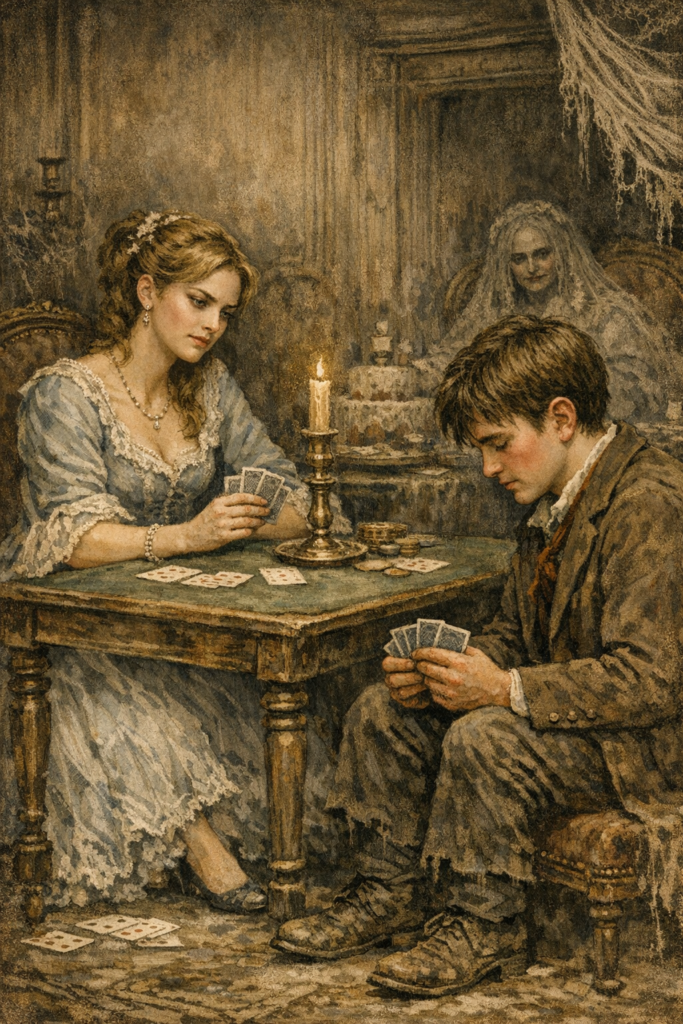
This lesson uses Great Expectations (1861) by Charles Dickens, a novel rooted in questions of class, citizenship, and social hierarchy. Dickens exposes how Victorian society organised people into rigid social layers, shaping their opportunities, relationships, and identities.

So she sat, corpse-like, as we played at cards; the frillings and trimmings on her bridal dress, looking like earthy paper. I knew nothing then of the discoveries that are occasionally made of bodies buried in ancient times, which fall to powder in the moment of being distinctly seen; but, I have often thought since, that she must have looked as if the admission of the natural light of day would have struck her to dust.

“He calls the knaves Jacks, this boy!” said Estella with disdain, before our first game was out. “And what coarse hands he has! And what thick boots!”

I had never thought of being ashamed of my hands before; but I began to consider them a very indifferent pair. Her contempt for me was so strong, that it became infectious, and I caught it.

She won the game, and I dealt. I misdealt, as was only natural, when I knew she was lying in wait for me to do wrong; and she denounced me for a stupid, clumsy labouring-boy.

“You say nothing of her,” remarked Miss Havisham to me, as she looked on. “She says many hard things of you, but you say nothing of her. What do you think of her?”

“I don’t like to say,” I stammered.

“Tell me in my ear,” said Miss Havisham, bending down.

“I think she is very proud,” I replied, in a whisper.

“Anything else?”

“I think she is very pretty.”

“Anything else?”

“I think she is very insulting.” (She was looking at me then with a look of supreme aversion.)

“Anything else?”

“I think I should like to go home.”

Why this scene demonstrates the learning objectives:

  • Shows how class hierarchy defines social identity.
  • Reveals how stratification creates shame, aspiration, and conflict.
  • Highlights unequal citizenship experience within a supposedly unified community.
  • Demonstrates how social structures shape characters’ desires.

Question: How does Dickens present the differences between characters?

“Pip feels embarrassed because Estella is rude to him. She sees that his hands have had to work hard, Pip helps Jo at the forge and is poor enough that he is unlikely to be very clean. She notices his boots too – we might think that thick boots are good quality, but Estella seems to rebuke them. It must be that she thinks ‘work’ boots are strange compared to the shoes that gentlemen wear.”

Why it fails

  • It describes the plot alone rather than showing awareness of the social structures, hierarchy, or class-based exclusion.

This moment reveals the workings of social stratification, as Estella’s privileged position gives her power to judge Pip as inferior. Dickens exposes how class determines a person’s life chances and social value. Pip’s sudden awareness of his “commonness” demonstrates how social structures shape identity, belonging, and citizenship within Victorian society.

Why it succeeds:

  • Synthesis of disciplinary concerns with the plot
  • Use of sophisticated language which shows awareness of social issues
  • Demonstrates the student is able to analyse in ways compatible with the world, not just within a text

Question:

What right does the wealthy, elite or nobility classes have to judge the poor, less mobile groups?

  • Can we sympathise with the difficulties faced by poorer groups?
  • Can we recognise that wealth is inherited – but so is poverty. Inheritors of wealth or poverty did not earn what they received.
  • Can we recognise that elites and nobility are just as likely to fail, but far less likely to fall. That is structural inequality.

Analyse an extract from your current class novel using today’s key concepts.

Instructions

  1. Identify references to class, citizenship, or social structure.
  2. Use at least two vocabulary terms.
  3. Begin with one sentence stem.
  4. Explain how the social system shapes the character’s behaviour or opportunities.

Success Criteria

Explains how structures shape outcomes

  • Uses key vocabulary accurately
  • Shows understanding of social hierarchy
  • Moves beyond description to analysis

Propose something that people can do which supports lower social groups

Students could refer to ideas about:

  • Inclusivity
  • Sympathy
  • Reducing barriers
  • Avoiding stereotypes and judgement

a) Pre-reading of the next lesson – read through the knowledge so you can be ready to discuss in class.

b) Apply the learning of today’s lesson to your own private reading text. Write a paragraph explaining how today’s learning changes how you might conceive your text. Be sure to use the key vocabulary and sentence stems.

c) Write a paragraph about the discipline of Literature, explain how key words from today’s lesson impact the field overall.

d) Add today’s vocabulary and sentence stems to your own glossary. Highlight any that you are unsure about, but you must also research the meanings yourself and develop your glossary to include this differentiated support.

How did you do? Remember, this is the disciplinary knowledge for Literature – it needs combining with the text you are studying now. Can you use this knowledge to write differently about the text you are studying? When you are ready, access the next lesson in this series.