

Is 30deg hot? Is 30deg hot to a human? Is 30deg hot to a human who ordinarily lives in a dessert? Is 30deg hot to a scorpion living on the scorching sand? All terms need some ‘opposite’ to create a degree of perspective; this is not that; that is not this. 15-20deg is a good temperature for people, 0-10deg is a bit cold for people. The term ‘hot’ needs the term ‘cold’ to be known. In a world such as the bottom of the ocean, where the temperature is unchanging, there is no need for terms ‘hot and cold’ to exist.
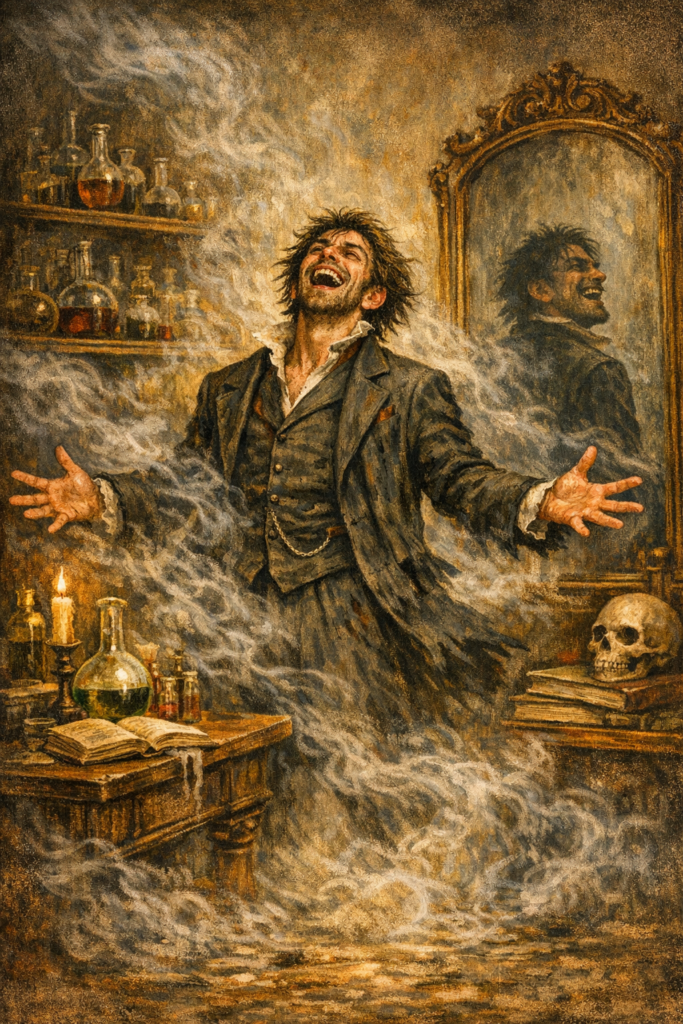
Stevenson’s novella explores the dual nature of humanity through the violent separation of Dr Jekyll and Mr Hyde. The story is built on binary opposition: good versus evil, restraint versus impulse, reputation versus desire. Meaning emerges through these contrasts, revealing identity as something structured by difference rather than stability.
I saw that, of the two natures that contended in the field of my consciousness, even if I could rightly be said to be either, it was only because I was radically both; and from an early date, even before the course of my scientific discoveries had begun to suggest the most naked possibility of such a miracle, I had learned to dwell with pleasure, as a beloved daydream, on the thought of the separation of these elements. If each, I told myself, could be housed in separate identities, life would be relieved of all that was unbearable; the unjust might go his way, delivered from the aspirations and remorse of his more upright twin; and the just could walk steadfastly and securely on his upward path, doing the good things in which he found his pleasure, and no longer exposed to disgrace and penitence by the hands of this extraneous evil. It was the curse of mankind that these incongruous identities were thus bound together—that in the agonised womb of consciousness, these polar twins should be continuously struggling. How, then were they dissociated?
I hesitated long before I put this theory to the test of practice. I knew well that I risked death; for any drug that so potently controlled and shook the very fortress of identity, might, by the least scruple of an overdose or at the least inopportunity in the moment of exhibition, utterly blot out that immaterial tabernacle which I looked to it to change. But the temptation of a discovery so singular and profound at last overcame the suggestions of alarm. I had long since prepared my tincture; I purchased at once, from a firm of wholesale chemists, a large quantity of a particular salt which I knew, from my experiments, to be the last ingredient required; and late one accursed night, I compounded the elements, watched them boil and smoke together in the glass, and when the ebullition had subsided, with a strong glow of courage, drank off the potion.
The most racking pangs succeeded: a grinding in the bones, deadly nausea, and a horror of the spirit that cannot be exceeded at the hour of birth or death. Then these agonies began swiftly to subside, and I came to myself as if out of a great sickness. There was something strange in my sensations, something indescribably new and, from its very novelty, incredibly sweet. I felt younger, lighter, happier in body; within I was conscious of a heady recklessness, a current of disordered sensual images running like a millrace in my fancy, a solution of the bonds of obligation, an unknown but not an innocent freedom of the soul. I knew myself, at the first breath of this new life, to be more wicked, tenfold more wicked, sold a slave to my original evil; and the thought, in that moment, braced and delighted me like wine. I stretched out my hands, exulting in the freshness of these sensations; and in the act, I was suddenly aware that I had lost in stature.
Why it fits:
- Shows binary structures organising characters’ thinking.
- Reveals the instability of certain binaries (beast outside / beast within).
- Demonstrates how narrative meaning relies on paired contrasts.
- The author makes this explicit in the narrative in which the two binaries are in battle over identity – but most texts do this implicitly.
Question: How is the characters of Jekyll and Hyde presented?
What is the opposite to each of the following:
- Hot
- Fast
- Life
- Fixed
- The
- We
Students apply the concept of binary opposition to a chosen extract from our class text.
Instructions to Students
- Identify one binary pair operating within the extract (e.g., civilised/savage, order/chaos, just/unjust).
- Use at least two key vocabulary terms from today’s glossary (binary opposition, structural relation, difference, dominance).
- Begin your response using one of the sentence stems:
- “This binary opposition constructs meaning because…”
- “The text privileges ___ over ___ by…”
- Explain how meaning is produced through contrast, not by describing events.
Success Criteria
A successful response will:
- Identify a clear binary pair
- Use structuralist terminology accurately
- Explain how meaning arises from difference
- Avoid plot summary or moral judgement
How is our society today built up from binary opposition?
- What is ‘war’ paired with that makes us feel war is morally good or morally bad?
- What is democracy paired with that defines it as good or bad?
- What is welfare paired with which defines it as good or bad?
You could think about war being paired with images of autocracy, revolt and ‘terrorism’ – these are bad things, therefore war must be good. Or, war could be paired with images of migrants fleeing war, civilian casualties and spiraling costs – war is then defined as bad.
Democracy can be paired with signs of authoritarianism and oppression to define democracy as good.
Welfare can be paired with signs of poverty and exploitation to define it as good, but it can also be paired with responsibility and consequences to make welfare seem bad.
a) Pre-reading of the next lesson – read through the knowledge so you can be ready to discuss in class.
b) Apply the learning of today’s lesson to your own private reading text. Write a paragraph explaining how today’s learning changes how you might conceive your text. Be sure to use the key vocabulary and sentence stems.
c) Write a paragraph about the discipline of Literature, explain how key words from today’s lesson impact the field overall.
d) Add today’s vocabulary and sentence stems to your own glossary. Highlight any that you are unsure about, but you must also research the meanings yourself and develop your glossary to include this differentiated support.
How did you do? Remember, this is the disciplinary knowledge for Literature – it needs combining with the text you are studying now. Can you use this knowledge to write differently about the text you are studying? When you are ready, access the next lesson in this series.