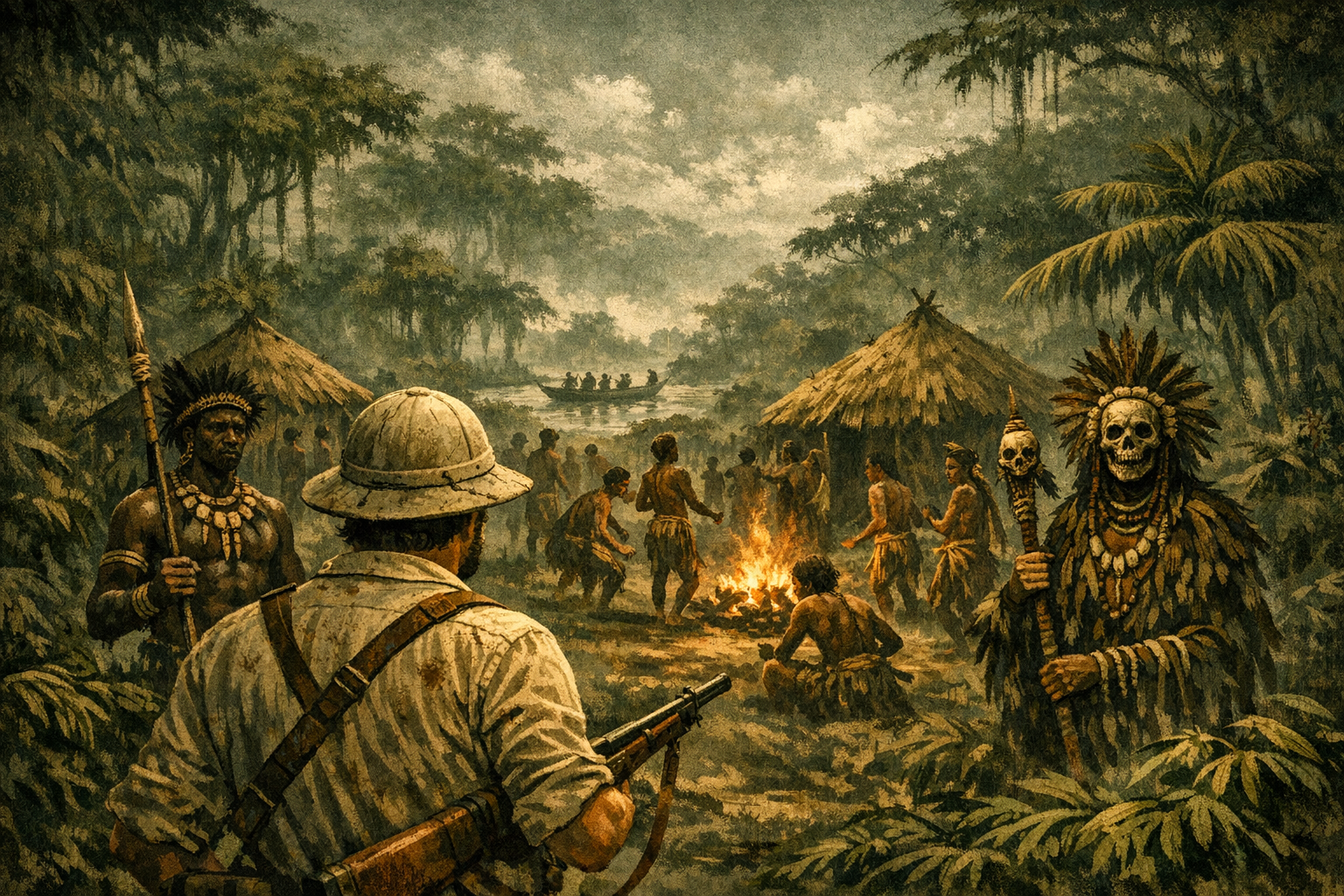
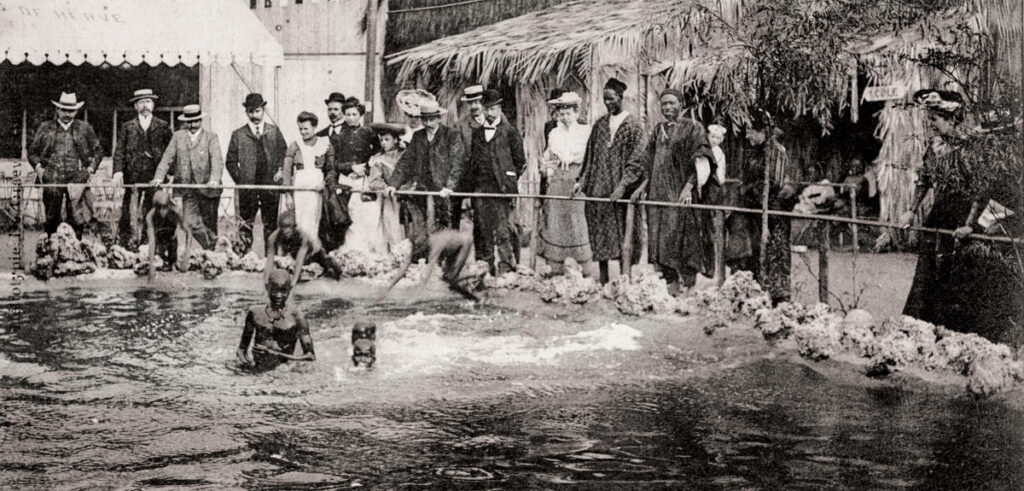
In 1994, Safari Africain, France, built an ‘African village’ where 25 Ivorians, including children, were hired to live and perform daily life “as a tribe” for visitors. They were expected not just to perform, but to live there. This ultimately meant they lived in inadequate conditions for the climate, they were underpaid and clearly exoticized. It has been called a modern day ‘human-zoo’, and played into colonial exoticism – that white Europeans intend to gaze upon non-white European culture as if it is a strange spectacle for enjoyment.
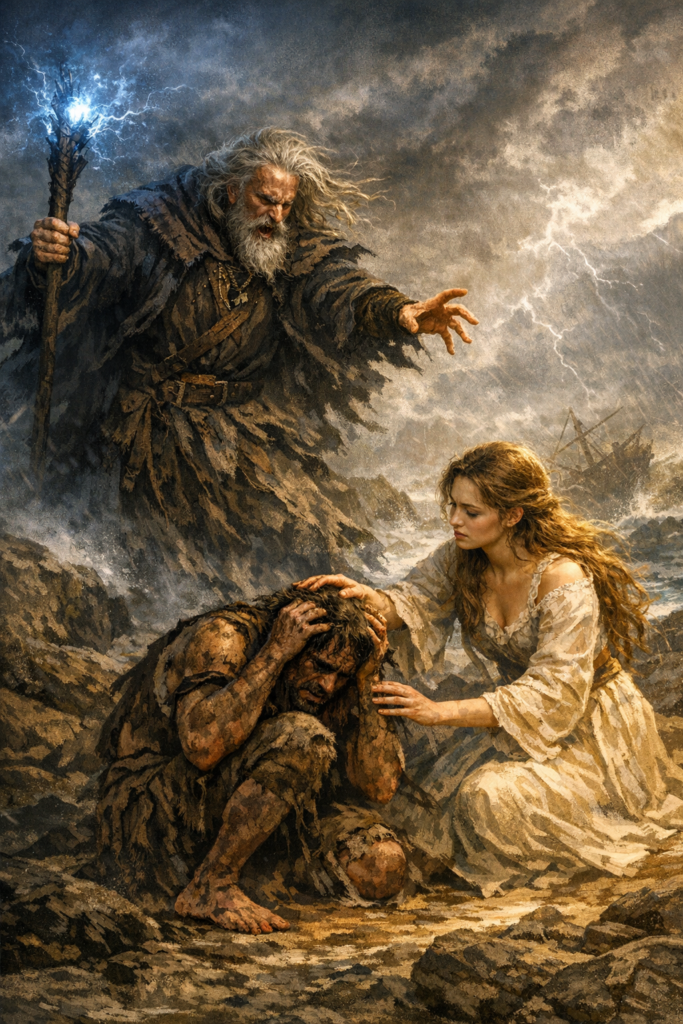
The Tempest tells of a story in which Prospero is evicted from his country, where he is the rightful king. Lost at sea with his daughter Miranda, he is fortunate enough to come across an island where they become stranded. Once there, he finds Caliban, a representation of native tribes people, and Prospero asserts himself as the king of this new land. Caliban is mistreated, abused, and made to do Prospero’s bidding.
MIRANDA
Abhorrèd slave,
Which any print of goodness wilt not take,
Being capable of all ill! I pitied thee,
Took pains to make thee speak, taught thee each hour
One thing or other. When thou didst not, savage,
Know thine own meaning, but wouldst gabble like
A thing most brutish, I endowed thy purposes
With words that made them known. But thy vile race,
Though thou didst learn, had that in ’t which good natures
Could not abide to be with. Therefore wast thou
Deservedly confined into this rock,
Who hadst deserved more than a prison.CALIBAN
You taught me language, and my profit on ’t
Is I know how to curse. The red plague rid you
For learning me your language!PROSPERO
Hagseed, hence!
Fetch us in fuel; and be quick, thou ’rt best,
To answer other business. Shrugg’st thou, malice?
If thou neglect’st or dost unwillingly
What I command, I’ll rack thee with old cramps,
Fill all thy bones with aches, make thee roar
That beasts shall tremble at thy din.CALIBAN
No, pray thee.
Aside. I must obey. His art is of such power
It would control my dam’s god, Setebos,
And make a vassal of him.
Why this suits the learning objectives:
- We see the preference for white male ruler,
- Prospero mistreats the native Caliban,
- Caliban is represented through a series of stereotypes that reduce the dignity and civilisation of native people, perpetuating prejudice against non-European culture,
- It suggests that difference from white European is deficient.
Question: How has Caliban been presented by Miranda and Prospero?
Present the following three statements and ask students to select which are accurate, partly accurate, or problematic — and explain why:
1. “European culture is more advanced than other cultures because it developed technology first.”
2. “Some cultures appear different because they follow sign systems and traditions we may not recognise.”
3. “When a text shows non‑European cultures as exotic or strange, it is simply describing the world as it is.”
Task: Choose a short extract featuring cross‑cultural interaction, power imbalance, or representation of “the other.” Analyse how the text constructs cultural difference using today’s key terms.
1. Identify the subject being represented (a character, group, culture, belief system).
2. Select one or two key vocabulary terms (e.g., *exoticism*, *eurocentrism*, *subaltern*, *othering*).
3. Use a sentence stem to begin your paragraph:
“The text exhibits eurocentrism by presenting…”
“This moment exoticises the group through…”
“The subject becomes subaltern because…”
“Difference is portrayed as deficiency when…”
4. Explain how the representation is constructed through selection, bias, and dominant narrative choices rather than objective description.
5. Avoid moral judgement or paraphrase; focus on how representation is built and what ideologies it sustains.
Finish the sentence:
It’s important not to misrepresent the cultures of other societies and their sign systems because…
Indicative content could be:
- Misrepresentation causes harm
- Misrepresentation reduces the value, self worth and identity of other cultures
- There is no justification as to why one society would be better than another
- Many of the criticisms of other cultures stem from a response to harms done to them by colonization
a) Pre-reading of the next lesson – read through the knowledge so you can be ready to discuss in class.
b) Apply the learning of today’s lesson to your own private reading text. Write a paragraph explaining how today’s learning changes how you might conceive your text. Be sure to use the key vocabulary and sentence stems.
c) Write a paragraph about the discipline of Literature, explain how key words from today’s lesson impact the field overall.
d) Add today’s vocabulary and sentence stems to your own glossary. Highlight any that you are unsure about, but you must also research the meanings yourself and develop your glossary to include this differentiated support.
How did you do? Remember, this is the disciplinary knowledge for Literature – it needs combining with the text you are studying now. Can you use this knowledge to write differently about the text you are studying? When you are ready, access the next lesson in this series.