
There is a persistent fantasy in education that academic knowledge is somehow “in” the world, waiting to be discovered by any sufficiently curious learner. Give students enough time, enough freedom, enough inquiry prompts, and they will arrive at the same disciplinary understandings that took scholars centuries to define. This is the logic behind discovery learning, constructivist classrooms, and the endless parade of “student‑led” activities that promise deep learning through minimal teaching. The learning experience is one with some moto of create the right learning environment and the students will flourish for themselves.
But this fantasy collapses the moment we look at how academic subjects actually work. Disciplinary knowledge is not self‑evident or explicit. It is not lying dormant in texts, objects, or experiences as some a-priori truth. It is not something a novice can become aware to through exposure and familiarity.
To understand why, we need a better analogy—one that captures the complexity of academic knowledge and the necessity of explicit instruction.
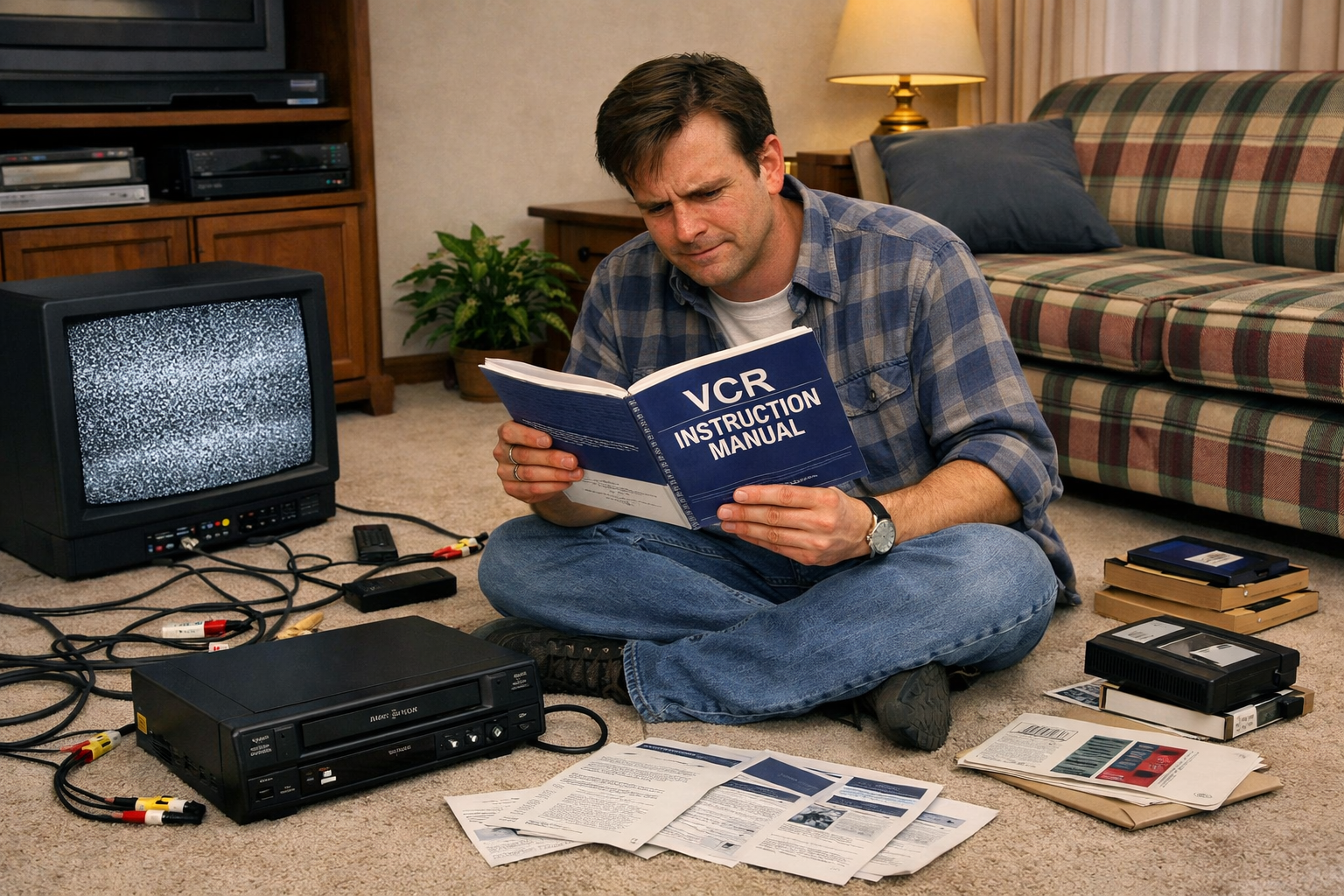
Academia, I want to suggest, is like a VCR. Or even more so, trying to set the recording time for a future TV show… something often impossible even with the manual…
The VCR Problem: facts, concepts and procedures are not obvious
A VCR is a sophisticated piece of hardware. You cannot deduce its internal logic simply by looking at it. You cannot infer the function of its circuitry by pressing buttons. You cannot reverse‑engineer its operation by “exploring” it. The machine is opaque to the novice and its complexity requires the pairing of a manual with the machine. A VCR from a junksale, without its operating manual, is basically scrap value.
In this way we can imagine academic subjects. A student cannot infer the logic of literary interpretation simply by reading a novel. They cannot discover the principles of historical causation by looking only within the text. They cannot intuit the structure of algebra by staring at equations. These fields of knowledge are not natural phenomena that students can see if teachers merely point them in the right direction, like how to get to Greggs; they are human‑constructed systems of thought, refined over generations, each with its own methods, conventions, and internal logic.
Just as a VCR requires a manual, academic subjects require teachers. Both the manual and the teacher explain the internal logic that cannot be inferred simply by looking at the object of study. This structural feature is what makes a discipline academic.
Why Discovery Learning Fails
Educational research has been remarkably consistent on this point. Decades of studies comparing explicit instruction with discovery‑based approaches show the same pattern: novices learn more, understand more, and retain more when they are taught directly.
Kirschner, Sweller, and Clark’s landmark paper Why Minimal Guidance During Instruction Does Not Work (2006) synthesises half a century of evidence. Their conclusion is blunt: discovery learning is “ineffective, inefficient, and potentially harmful” for novices because it overloads working memory and provides no stable schema for organising new information.
Hattie’s meta‑analyses reach similar conclusions. Explicit teaching, worked examples, and direct instruction consistently produce high effect sizes. Unguided inquiry does not. Without prior knowledge, learners cannot generate the right questions, recognise the right patterns, or evaluate the right interpretations. Students are like someone trying to operate a VCR without a manual — pressing buttons, making guesses, and hoping something meaningful happens.
This is actually what an academic might be doing but this is a highly systemised process in which the actions of every button and every combination are being recorded, along with the affects they seem to have. The affect needs replicating, and comparing to other sequences of button presses that might reach the same effect. Academia is a qualitative and quantitative approach to discovering facts, concepts and procedures that infer meaning or lead to outcomes. Students are simply not doing this kind of investigation, and neither is it the aim of lower levels of education to create this playground approach to trial and error, or discovery via play.
The Manual Is the Method
If the VCR analogy holds, then the “manual” for an academic subject is the method that gets meaningful results — the disciplinary way of seeing, thinking, and reasoning that experts have already discovered through their systemised approach.
In English studies, this means:
- how texts encode meaning
- how readers decode and justify interpretations
- how literary conventions shape what can be said
- how ideology, representation, and history inflect meaning
- how arguments are constructed, evidenced, and authorised
These are not skills that can be “picked up” through exposure. They are conceptual tools that must be taught, modelled, and practised. They are the operating instructions for the subject.
This is why the idea of a “bookless” literature curriculum as built by DisciplineOfEnglish.co.uk is so revealing. Many teachers cannot imagine English without texts because they assume the text is the subject. But the text is the hardware. The subject is knowledge of a methodology that obtains the best outcomes in the most straightforward manner. A curriculum built on disciplinary knowledge recognises that what students need is not more exposure to novels but more access to the conceptual manual that makes those novels intelligible.
The Myth of the Self‑Teaching Subject
One of the most damaging assumptions in contemporary curriculum discourse is that subjects are self‑explanatory. That if we simply place students in proximity to “rich texts” or “authentic problems,” learning will occur naturally.
But academic subjects are not the study of material with some a-priori meaning that is obvious, explicit or easily detectable. Academics become highly trained in uncovering meaning and encoding this into a language which means others can benefit from that meaning.
A VCR might not be the best example, primarily because the buttons labeled on the device and the procedure of button presses is already designed by the engineers to be as intelligable as possible. The buttons, labels and ‘sense’ contribute to meaningful operation that could be revealed logically. But academic subjects such as Literature, Physics, or Geography are vast systems of interconnecting structures without labels and sense.
This is why novices cannot discover disciplinary knowledge independently. They lack the conceptual schema, the interpretive frameworks or the procedural knowledge for evaluating material. In other words, they lack the manual.
This can also be evidenced in the way we understand students to make progress. Students do not make progress through some innate strength, IQ or intuition which would position them to be able to discover the fundamental constructs within a discipline. And students who do not make progress are not deficient in strength, IQ or intuition. Education is no longer bound by the ideology of the meritocracy wherein the best / most abled rise to the top.
Student Progress Is Not Based On Merit
A persistent misunderstanding in education is the belief that failure to generate disciplinary interpretations, solve disciplinary problems, or recognise disciplinary patterns, reveals something about their innate intelligence. But the research tradition on teacher effects, Opportunity to Learn, and explicit instruction shows the opposite. Novices lacking the conceptual schema needed to make sense of a domain is not evidence of a deficiency in the learner. It is evidence of a deficiency in the curriculum. Students cannot discover what has not been taught.
This position is well established in pedagogy. Rosenshine’s synthesis of cognitive science and classroom observation demonstrates that achievement is primarily a function of instructional quality, not IQ. Similarly, the large‑scale teacher‑effects studies (e.g., Nye, Konstantopoulos & Hedges) show that the difference between an effective and ineffective teacher can amount to a full year of learning, even when controlling for background and measured ability. In other words, the learning environment—and the quality of teaching within it—shapes outcomes far more powerfully than any supposed fixed quotient of intelligence.
The same conclusion underpins the Opportunity to Learn (OTL) framework: students learn what they are taught, and they do not learn what they are not taught. When learners lack disciplinary concepts, interpretive frameworks, or procedural knowledge, this is not a natural state of ignorance to be overcome through discovery. It is a predictable consequence of insufficient access to the conceptual “manual” of the subject. Kirschner, Sweller and Clark’s critique of discovery learning makes this explicit: novices cannot generate disciplinary knowledge independently because they lack the schemas required to recognise what matters, filter what is irrelevant, and evaluate what is plausible.
This is why we cannot expect students to “discover” disciplinary knowledge. Discovery presupposes prior knowledge. It presupposes a conceptual map. It presupposes the very schema that novices do not yet possess. To interpret a text, analyse a historical event, or solve a mathematical problem, students need the disciplinary operating instructions. When these are absent, the learner is not at fault. The curriculum is. The absence of schema is not a sign of cognitive limitation; it is a sign that the manual has not been provided.
The Irreplaceable Role of Expertise
If academic subjects require manuals, then teachers are not facilitators, coaches, or guides. They are the custodians of disciplinary knowledge. They are the ones who make the subject intelligible by extolling the findings of academics. Their findings are what the teacher is responsible for transmitting in ways that students can begin to discern meaningful outcomes through texts. Particularly, the teacher is responsible for explaining its concepts, modelling its procedures, correcting misconceptions and sequencing knowledge coherently.
The alternative — leaving students to discover disciplinary knowledge independently — assumes that novices can do what experts took decades to master. It assumes that the sophisticated machine that is the discipline of study can be operated without a manual, through intuition and play.
What This Means for English as a Discipline
English suffers more than most subjects from the myth of discoverability. Because texts are familiar objects, teachers often assume that interpretation is a natural process or a skill that is mastered through reading. Weaker students often look to their highly abled peers and feel that their analytical wisdom is somehow ‘innate’.
The defining characteristics, the historicity, the genealogy, the theories of representation and ideology and human nature, they are all not intuitive or to be found ‘within the text’. They must be taught.
A disciplinary curriculum for English therefore begins not with texts but with the methods that gives texts meaningful outcomes. It treats literature as the hardware and disciplinary knowledge as the manual. It recognises that students cannot discover the logic of interpretation by reading more novels any more than they can discover the logic of electronics by staring at a circuit board.
This principle has several implications:
- Curriculum must foreground disciplinary knowledge, not tasks or texts.
- Teaching must be explicit, not discovery‑based.
- Assessment must evaluate method, not opinion or personal response.
- Progression must be conceptual, not merely recount the text.
Conclusion: Stop Asking Students to Operate the VCR Without a Manual
The belief that students can discover disciplinary knowledge independently is seductive and places failure not as the responsibility of the curriculum but the responsibility of the child, and their own deficiencies. It misunderstands the nature of academic subjects and misrepresents the role of the teacher who must be a subject expert and be able to translate the discipline. That translation is our responsibility; the language, the imagery, the sequence and timings that constitute the manual for our subject. The manual we each write might be different from one class to the next, but it still purports the very same facts, concepts and procedures as any other manual. We’re not changing the knowledge base, just the language through which we tell it.
Our job is to write the manual that can be read and followed by the students in front of us. We write the manual specifically for their needs. We make the manual as interesting as possible, so that the knowledge feels accessible and meaningful.
Thank god for streaming platforms…
Leave a Reply