🎬 Film Genres
Ask:
- Why do horror films use darkness and suspense?
- Why do comedies use timing and exaggeration?
Establish:
- Shared forms (jump scares, punchlines)
- Shared functions (fear, laughter)
Teacher line:
“Genres exist because audiences like familiarity and convention.”
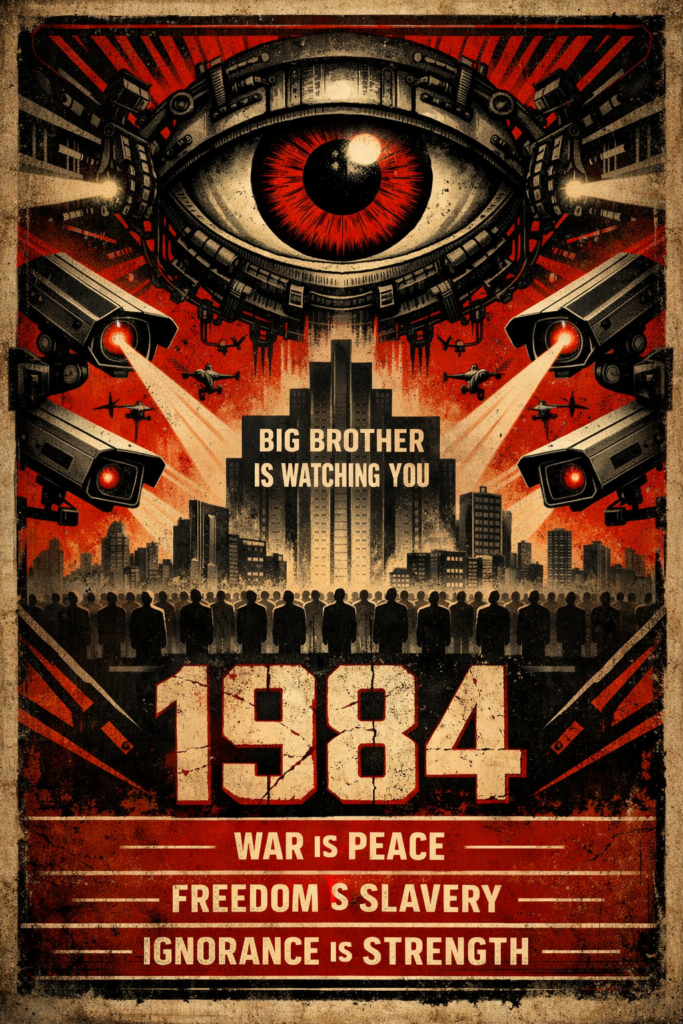
Orwell’s 1984 is follows the character Winston as he negotiates his loyalty to the government, his friends, or the person he loves.
It was a bright cold day in April, and the clocks were striking thirteen. Winston Smith, his chin nuzzled into his breast in an effort to escape the vile wind, slipped quickly through the glass doors of Victory Mansions, though not quickly enough to prevent
a swirl of gritty dust from entering along with him.The hallway smelt of boiled cabbage and old rag mats. At one end of it a coloured poster, too large for indoor display, had been tacked to the wall. It depicted simply an enormous face, more than a metre wide: the face of a man of about forty-five, with a
heavy black moustache and ruggedly handsome features. Winston made for the stairs. It was no use trying the lift. Even at the best of times it was seldom working, and at present the electric current was cut off during daylight hours. It was part of the economy drive in preparation for Hate Week. The flat was seven flights up, and Winston, who was thirty-nine and had a varicose ulcer above his right ankle, went slowly, resting several times on the way. On each landing, opposite the lift-shaft, the poster with the enormous face gazed from the wall. It was one of those pictures which are so contrived that the eyes follow you about when you move. BIG BROTHER IS WATCHING YOU, the caption beneath it ran.
What does it look like to synthesize the methodologies of this lesson with the material?
1984 belongs to the dystopian genre which is hinted to us by the “electric current cut during daylight hours”, the “hate week” and the “enormous face”. Dystopia for Orwell takes the form of a society in which things do not work for citizens, their rights are being attacked and they are under constant surveillance. 1984 is joined by other dystopian texts like Brave New World and Children Of Men, and each author reimagines the common themes of dystopia within their own narrative. What unites them is their shared function; to warn readers about the dangers of power and loss of freedom. These authors are intertextual to one another, and converse, sometimes agreeing with the function of dystopias or the form they take, and sometimes making alternative suggestions.
Task 1: Form or Function?
Give students features and ask them to sort:
- First-person narration
- To persuade readers
- Verse structure
- To challenge power
- Episodic plot
Student Task
Explain the genre of our current text using form and function.
Do not describe the plot.
Provide scaffold:
This text belongs to the genre of __________.
It uses the form of __________ and the function of __________, which connects it to other texts in this genre.
It uses conventions established in earlier texts, such as_______.
Encourage reference to:
- narrative structure
- character types
- setting
- reader effect
Students complete:
Finish the sentence:
“Texts are grouped into genres because __________.”
You are listening for:
- shared form
- shared function
- patterns
- connections between texts
a) Pre-reading of the next lesson – read through the knowledge so you can be ready to discuss in class.
b) Apply the learning of today’s lesson to your own private reading text. Write a paragraph explaining how today’s learning changes how you might conceive your text. Be sure to use the key vocabulary and sentence stems.
c) Write a paragraph about the discipline of Literature, explain how key words from today’s lesson impact the field overall.
d) Add today’s vocabulary and sentence stems to your own glossary. Highlight any that you are unsure about, but you must also research the meanings yourself and develop your glossary to include this differentiated support.
How did you do? Remember, this is the disciplinary knowledge for Literature – it needs combining with the text you are studying now. Can you use this knowledge to write differently about the text you are studying? When you are ready, access the next lesson in this series.