This lesson establishes Early English not as “old texts”, but as a foundational sign system whose meanings persist across later literature.
Early English literature encodes meaning through heroic ethos, elegiac tone, and oral poetic structures, reflecting a world shaped by instability, exile, loyalty, fate, and mortality.
This lesson:
- Prevents Early English becoming trivia or dates
- Makes its ideas usable in later texts
- Establishes Early English as a substratum, not a sealed period
Today we are learning how Early English literature created meaning.
By the end of the lesson, you will understand that:
- Early English texts reflect a dangerous and unstable world
- Meaning is created through heroism, elegy (mourning), and oral poetry
- These ideas still shape later literature today
These are the methodological facts to be retrieved in future units.
- Early English literature reflects a world shaped by danger, exile, and fate.
- Texts emphasise heroic values such as loyalty and courage.
- Elegiac tone expresses mourning, loss, and nostalgia.
- Alliterative verse helped oral stories survive through memory.
Student-friendly anchor:
“Early English stories helped people survive a fragile world.”
- Heroic ethos – values of bravery, loyalty, and honour
- Elegiac – expressing loss, mourning, or sadness
- Alliteration – repeated starting sounds
- Exile – separation from home or community
- Fate – belief that life is controlled by forces beyond humans
- Oral tradition – prior to writing, cultures still had stories but they were spoken, remembered and recalled to others
- “This reflects an Early English heroic ethos because…”
- “The elegiac tone shows…”
- “The use of alliterative verse suggests…”
✅ Acceptable phrasing:
- “This reflects a heroic ethos…”
- “The elegiac tone shows…”
🚫 Do not accept:
- “It’s just sad”
- “They believed weird things”
🎖️ A Soldier’s Memorial
Ask:
- Why do memorials focus on bravery and loss?
- Why is remembrance important in dangerous times?
Establish:
- Honour + mourning exist together
- Survival depends on loyalty and memory
Teacher line:
“Early English literature works like a memorial — it remembers what bravery and valor.”
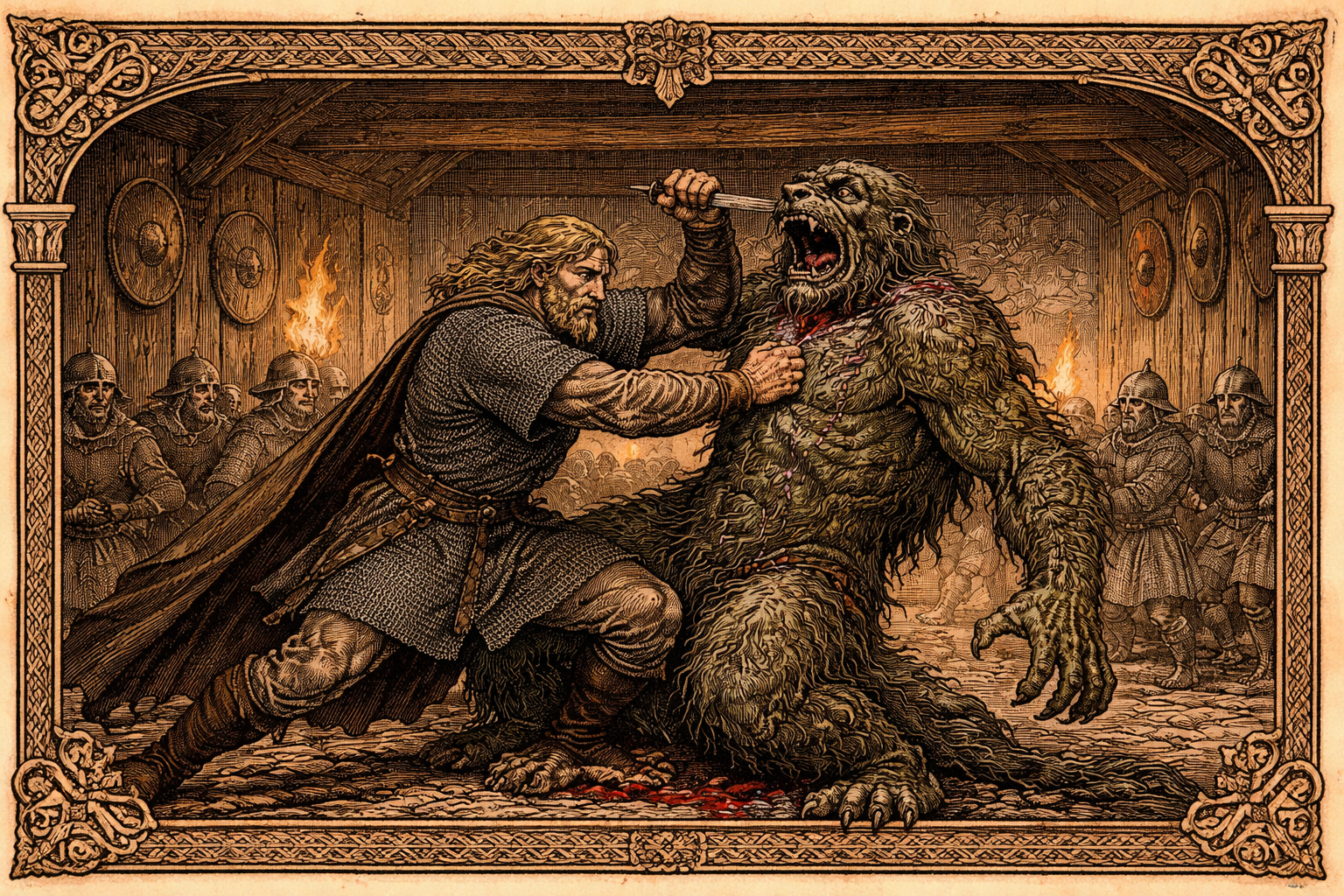
Beowulf has arrived in Denmark and declares why he has come — not for wealth, but out of duty, courage, and loyalty to the suffering king.
“When I was younger, I fought many battles.
I came to help Hrothgar, because all know his wisdom and his goodness.
My people encouraged me, the best of them,
to come to you, King Hrothgar, because they know my strength.
They have seen me return from battle stained with the blood of my enemies.
I drove five great giants into chains,
chased all of that race from the earth.
And now I shall fight Grendel —
alone, without sword or shield —
trusting only in my strength and the judgment of God.”
- Which lines encode the Heroic Ethos (Courage, Bravery, Reputation)?
- Which lines encode meanings of loyalty?
- Which lines encode meanings of fate and divine judgement?
- How has the text been written in a way to aid the recall of oral stories?
Heroic Ethos (Courage, Bravery, Reputation)
Beowulf emphasises physical courage and past feats: “stained with the blood of my enemies… five great giants…” Heroism is measured through battle-tested strength.
Loyalty
He comes because his people “encouraged” him — duty to tribe and king motivates action.
Fate & Divine Judgement
He fights without weapons, trusting “…the judgment of God,” a direct Early English blend of fate + divine oversight.
Oral-Formulaic Memory Style
Short patterned lines + Repetition of heroic credentials + Rhythm that aids recall
In Chaucer’s A Knight’s Tale, published later than Beowulf, we still see evidence of a warrior, but now it resides amongst other signs too which we have not yet studied. This text has multiple competing signs and so it is harder to dig out just those that were formed in Early English.
“He was a verray, parfit gentil knight.
In all his life he never yet spoke ill of anyone.
He loved chivalry, truth and honour,
freedom and courtesy.
He had fought in Christendom and heathen lands,
always praised for his worthiness.
Though he had done great deeds of arms,
he was as meek as a maid.”
- Which lines encode the Heroic Ethos (Courage, Bravery, Reputation)?
- Which lines encode meanings of loyalty?
- Which lines encode meanings of fate and divine judgement?
- How has the text been written in a way to aid the recall of oral stories?
Heroism:
“Great deeds of arms” continues the theme of powerful warriors that was first encoded into literary signs by earlier texts, such as Beowulf.
Loyalty:
“he had fought in Christendom and heathen lands” continues the theme of loyalty that was established in Early English as important in literary characters.
Fate and Divine Judgement:
“And always praised for his worthiness” continues the theme of being judged in Christian terms; that the knight fights for Christendom is what gives him his worth.
Oral story telling:
The text adopts the same short lines that we see in earlier texts which originally aided memory for oral story telling, but now that texts are written, such style will gradually decline in usage.
The Jabberwocky is sometimes called a ‘nonsense’ poem, but it shouldn’t be. It very clearly continues the traditional signs established in Early English. Even in Language studies, you can infer the word classes because of wider grammar is respected. The use of Language terminology is also used to describe other structures of meaning. Heroism, Elegy, and mnemonics act like morphemes and they are used across many places, like a syntax. Literature is a syntax and the common themes are morphemes. We understand the morphemes even when they seem alien, because we have experienced them so often across the syntax of Literature.
’Twas brillig, and the slithy toves
Did gyre and gimble in the wabe:
All mimsy were the borogoves,
And the mome raths outgrabe.
“Beware the Jabberwock, my son!
The jaws that bite, the claws that catch!
Beware the Jubjub bird, and shun
The frumious Bandersnatch!”
He took his vorpal sword in hand;
Long time the manxome foe he sought—
So rested he by the Tumtum tree
And stood awhile in thought.
And, as in uffish thought he stood,
The Jabberwock, with eyes of flame,
Came whiffling through the tulgey wood,
And burbled as it came!
One, two! One, two! And through and through
The vorpal blade went snicker-snack!
He left it dead, and with its head
He went galumphing back.
“And hast thou slain the Jabberwock?
Come to my arms, my beamish boy!
O frabjous day! Callooh! Callay!”
He chortled in his joy.
’Twas brillig, and the slithy toves
Did gyre and gimble in the wabe:
All mimsy were the borogoves,
And the mome raths outgrabe.
- Which lines encode the Heroic Ethos (Courage, Bravery, Reputation)?
- Which lines encode meanings of loyalty?
- Which lines encode meanings of fate and divine judgement?
- How has the text been written in a way to aid the recall of oral stories?
Heroism:
“One, two! One, two! And through and through / The vorpal blade went snicker-snack! / He left it dead, and with its head / He went galumphing back” shows the binary opposition between good and bad, that warriors arise and slay monstrous enemies.
Loyalty:
“And hast thou slain the Jabberwock? / Come to my arms, my beamish boy!” continues the long established syntax that literary characters have to have loyalty. In Early English this was to a local king, and in Premodernity it was to a Christian God. This text seems to be more Modern because it could be a father figure who the warrior is loyal to.
Fate and Divine Judgement:
“And always praised for his worthiness” continues the theme of being judged in Christian terms; that the knight fights for Christendom is what gives him his worth.
Oral story telling:
The text adopts the same short lines, alternating rhyming couplets and metrical pattern (repeating syllables and stress) that we see in earlier texts which originally aided memory for oral story telling. Today, we continue the form of oral story telling in poetry.
Student Task
Choose one moment from our current text.
- Identify an Early English idea (heroism, fate, exile, loss).
- Explain how these signs were first encoded in Early English texts which is now being continued, maybe with some differences.
Provide scaffold:
This moment reflects an Early English idea of __________.
This adds meaning because in Early English culture __________.
Encourage focus on Early English themes of:
- loyalty
- bravery
- strength
- isolation
- mortality
Students complete:
Finish the sentence:
“Early English literature focuses on heroism and loss because __________.”
You are listening for:
- danger
- fragility of life
- survival
- loyalty
a) Pre-reading of the next lesson – read through the knowledge so you can be ready to discuss in class.
b) Apply the learning of today’s lesson to your own private reading text. Write a paragraph explaining how today’s learning changes how you might conceive your text. Be sure to use the key vocabulary and sentence stems.
c) Write a paragraph about the discipline of Literature, explain how key words from today’s lesson impact the field overall.
d) Add today’s vocabulary and sentence stems to your own glossary. Highlight any that you are unsure about, but you must also research the meanings yourself and develop your glossary to include this differentiated support.
How did you do? Remember, this is the disciplinary knowledge for Literature – it needs combining with the text you are studying now. Can you use this knowledge to write differently about the text you are studying? When you are ready, access the next lesson in this series.