This lesson answers a question students rarely ask, but should:
“Why does early literature care so much about time, stars, fate, and nature?”
The disciplinary answer from Document 2a is:
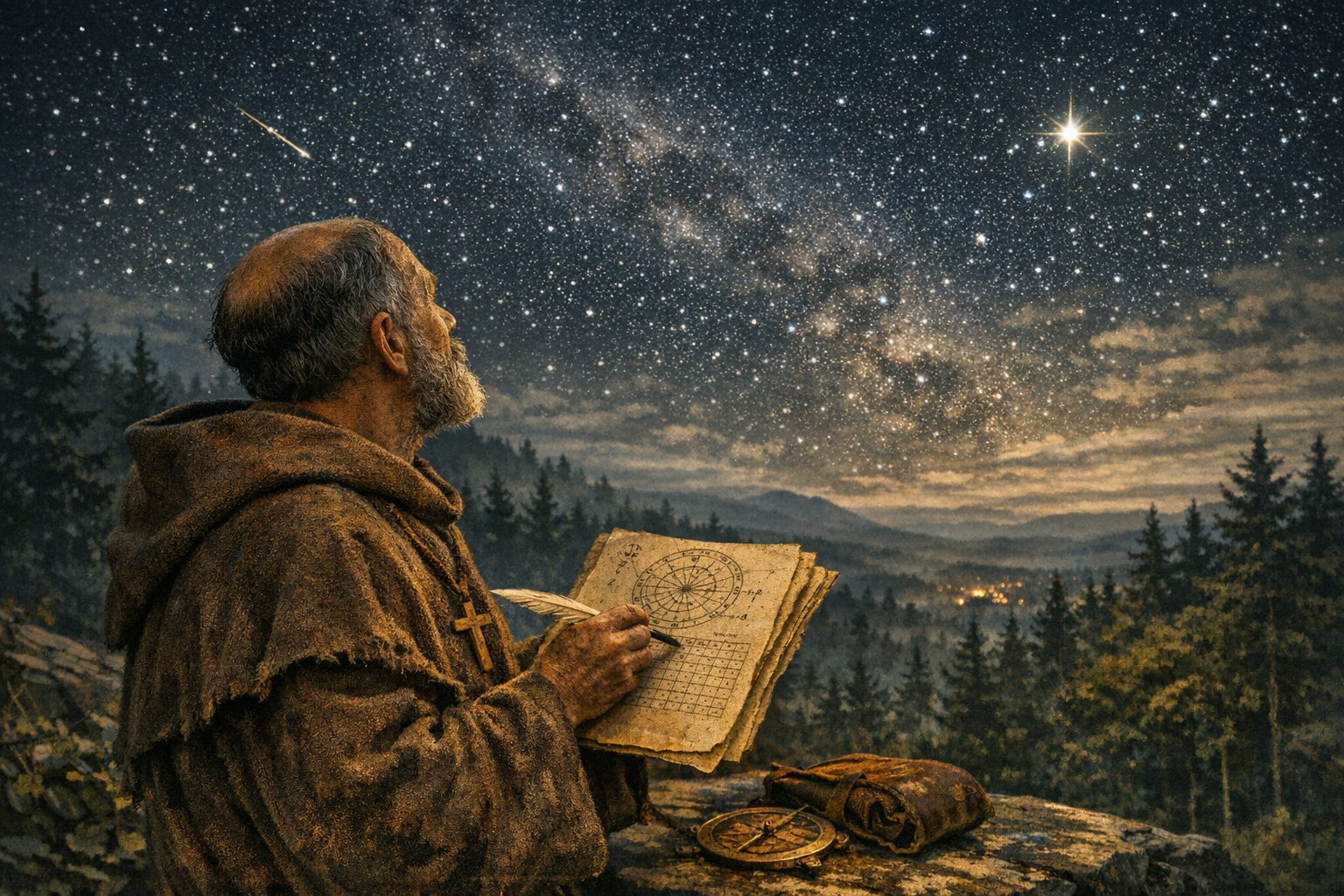
Early English literature absorbed computus — a monastic system for calculating time, seasons, astronomy, and religious calendars — which shaped how writers encoded order, fate, and meaning into texts. Monks were also engaged in establishing when best to plant and cut herbs, and the exact occasions was measured as a celestial event. Accuracy of dates was exceptionally important to collect in the best herbs, and to ensure that religious events were marked on the proper day, hence the stars are connected with assurance; herbs planted on one day will obtain a particular result in future. Calculating religious days now predestines society to be celebrating an event in future. In changes society from following one that can only follow seasons to one that can become more precise and follow days.
This lesson:
- Shows literature borrowing from science, maths, and religion
- Explains why nature imagery is structured, not decorative
- Strengthens the idea of literature as a knowledge system
- Prepares students to read imagery as inherited meaning
Today we are learning how early literature used systems of knowledge to create meaning. By the end of the lesson, you will understand that:
- Early writers used computus to understand time and nature
- These ideas shaped how meaning was encoded in literature
- Literature can absorb ideas from science, maths, and religion
Computus was a system used to calculate time, seasons, and natural cycles. Monks used computus to understand the world as ordered and meaningful. Literature absorbed computus ideas into its imagery and language. Natural imagery often encodes order, fate, and divine structure. Nature in early literature is measured, not random.
- Computus – a system for calculating time and natural cycles
- Cycle – patterns that repeat (seasons, stars, time)
- Order – belief that the world follows a structure
- Astronomy – study of stars and planets
- Almanacs – an early book written by monks to plan for religious dates, planting and reaping, using the stars as date markers.
These integrate with earlier methodological language.
- “This imagery reflects computus because…”
- “Time and nature are shown as ordered through…”
- “The text encodes meaning using natural cycles…”
✅ Acceptable phrasing:
- “This reflects computus thinking…”
- “Nature is shown as ordered…”
🚫 Do not accept:
- “They liked nature”
- “It shows superstition”
Tell students:
“Computus is not background knowledge.”
“Dates and stars driving beliefs about fate and destiny are not simply superstition, but calculated certainty.”
This stops context dumping.
📅 A Calendar
Ask:
- Is a calendar natural or designed?
- Does it help people make sense of time?
Establish:
- Calendars impose order
- Computus was an early version of this
Teacher line:
“Computus turned time into meaning.”
📅 A Birthday
Ask:
When do you celebrate you birthday? We all use a calendar, but on your birthday, the stars will be aligned slightly differently to someone else’s. If you know the layout of the stars, you don’t need a calendar. What you could say, is when x is aligned with y, we will be having cake and music! But now this sounds superstitious, because it feels like you are talking about fate. This is the nature of ‘the future in the stars’. The stars are the original calendar, studied by monks to know when to plant seeds and when to celebrate religious festivals.
Here’s a historically grounded passage that demonstrates computus — the medieval method for calculating Easter — drawn from Bede’s De Temporibus and The Reckoning of Time (725 AD), one of the most influential computistical texts in early England:
“Easter is to be celebrated on the Sunday following the full moon which occurs on or after the twenty-first day of March. If the full moon falls on a Sunday, Easter is celebrated the following Sunday.
To determine this, one must know the Golden Number of the year, the Epact, and the weekday of the Paschal full moon. These are found using the nineteen-year Metonic cycle, wherein the lunar months realign with the solar year.”
Key Computus Elements in the Passage
- Golden Number: Position of the year in the 19-year lunar cycle
- Epact: Age of the moon on January 1st
- Paschal Full Moon: The full moon after March 21
- Sunday Rule: Easter is the first Sunday after that full moon
This passage shows how medieval scholars used astronomical and mathematical reasoning to structure liturgical time — a rhythm that underpins much early English literature.
Works like Beowulf, Pearl, and The Dream of the Rood are steeped in seasonal and feast-day symbolism. Understanding computus helps students decode references to Lent, Easter, and Pentecost.
It models how books were tools for reconciling divine time with human calendars — a theme central to medieval thought.
Romeo and Juliet connects many moments discussing stars, heavens, and even herbs too, to fate and destiny:
Two households, both alike in dignity,
In fair Verona, where we lay our scene,
From ancient grudge break to new mutiny,
Where civil blood makes civil hands unclean.
From forth the fatal loins of these two foes
A pair of star-cross’d lovers take their life;
Whose misadventured piteous overthrows
Do with their death bury their parents’ strife.
The fearful passage of their death-mark’d love,
And the continuance of their parents’ rage,
Which, but their children’s end, nought could remove,
Is now the two hours’ traffic of our stage;
The which if you with patient ears attend,
What here shall miss, our toil shall strive to mend.
❌ Decorative Reading
The writer mentions stars to make the language romantic.
Why it fails:
- Treats imagery as decoration
- Ignores the way encoded meanings is inherited by later texts; calculus and forecasts were already established as literary whilst stars were encoded as indicating destiny long before.
✅ Computus‑Based Reading
References to stars, fate, and natural cycles in Romeo and Juliet reflect computus thinking, where astronomy and time were believed to reveal divine order. Shakespeare inherits this sign system, encoding the lovers’ fate as part of a larger, measured structure beyond human control. We can trace the encoding of stars to fate, right back to the almanacs written by monks who studied astronomy to work out what dates in future would be used to celebrate religious events, and this ‘destiny‘ is an inherited meanings encoded in Early English. Audiences continue to decode stars as meaning fate because authors adopt these encoded signs.
“This explains where the meaning comes from, not just what is described.”
Student Task
Choose one example of nature or time in our current text.
- Explain how it reflects order or cycles.
- Explain what meaning this adds.
Provide scaffold:
This example reflects computus because __________.
It adds meaning by showing __________ as part of an ordered system.
Encourage focus on:
- stars
- seasons
- time passing
- fate
- nature imagery
Finish the sentence:
“Computus influenced literature by __________.”
You are listening for:
- order
- cycles
- time
- nature
- meaning
a) Pre-reading of the next lesson – read through the knowledge so you can be ready to discuss in class.
b) Apply the learning of today’s lesson to your own private reading text. Write a paragraph explaining how today’s learning changes how you might conceive your text. Be sure to use the key vocabulary and sentence stems.
c) Write a paragraph about the discipline of Literature, explain how key words from today’s lesson impact the field overall.
d) Add today’s vocabulary and sentence stems to your own glossary. Highlight any that you are unsure about, but you must also research the meanings yourself and develop your glossary to include this differentiated support.
How did you do? Remember, this is the disciplinary knowledge for Literature – it needs combining with the text you are studying now. Can you use this knowledge to write differently about the text you are studying? When you are ready, access the next lesson in this series.