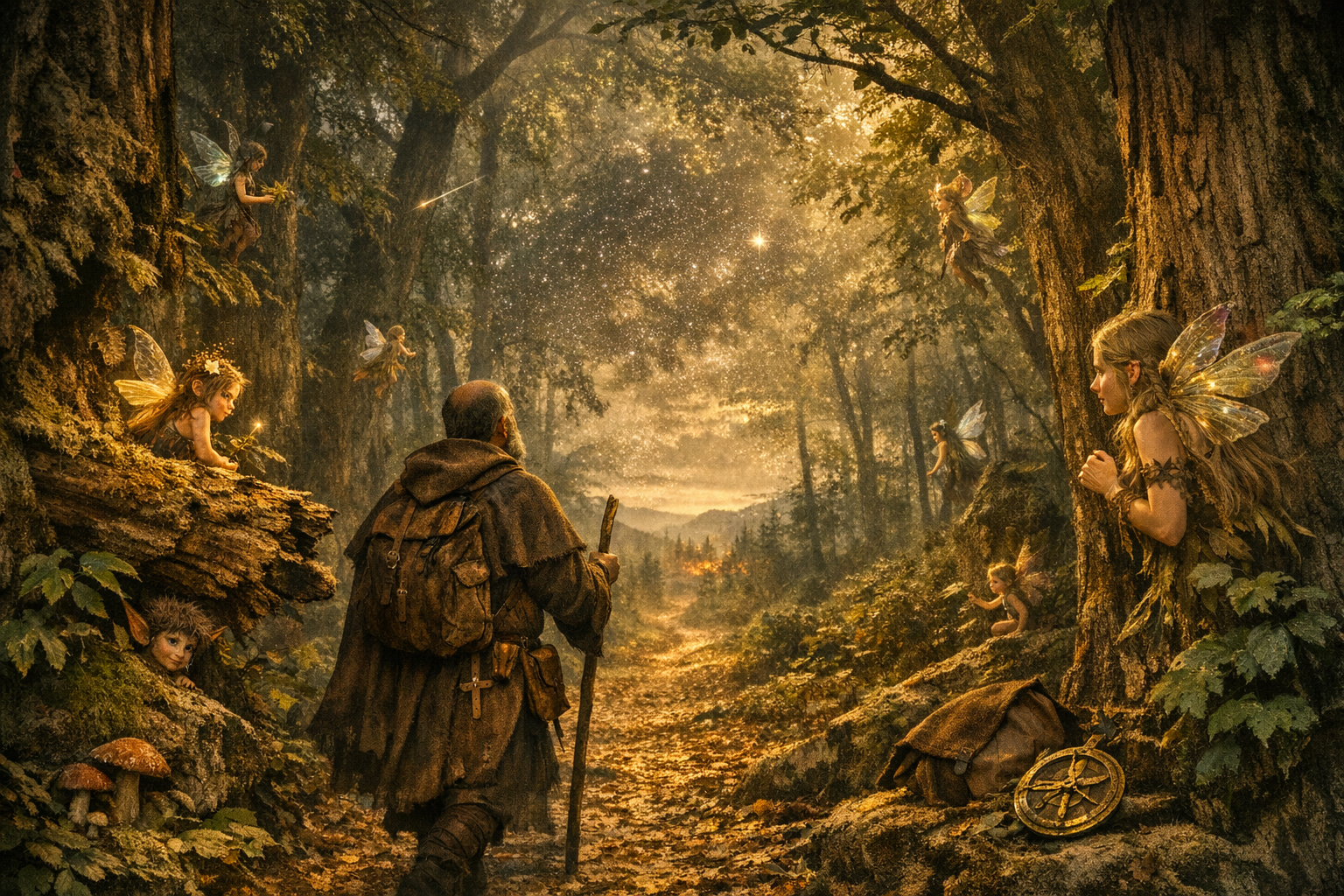
This lesson addresses a frequent misunderstanding:
“Why do early texts include magic if people were becoming Christian?”
Early English literature retains pagan folklore, charms, and magical beliefs, even after Christianisation. These older belief systems persist as sign systems, shaping meaning beneath later religious authority.
This lesson:
- Prevents “magic = fantasy” readings
- Reinforces substrata of meaning
- Shows how cultures absorb, not erase, beliefs
- Prepares students for Shakespeare, folklore, and mythic imagery
Today we are learning why magic and folklore appear in early literature. By the end of the lesson, you will understand that:
- Folklore and magic were meaningful belief systems
- These beliefs shaped how early texts created meaning
- Older beliefs continued beneath newer religions
These are the methodological facts students must retrieve later.
- Early English literature includes folklore and magical beliefs.
- Christianity absorbed rather than erased pagan sign systems.
- Magic and charms encoded beliefs about power, protection, and fate.
- These meanings persist beneath later literature.
Student‑friendly anchor:
“Old beliefs stay alive in stories.”
- Folklore – traditional beliefs and stories passed down
- Charm – words or actions believed to have power
- Magical power – belief in supernatural influence
- Pagan – pre‑Christian belief systems
- “This reflects folklore beliefs about…”
- “The charm encodes belief in…”
- “Magical power represents earlier ideas about…”
✅ Acceptable phrasing:
- “This reflects Early English traditions of…”
- “Though Christianity outlawed pagan ritual, it still exists in literature such as…”
🚫 Do not accept:
- “The use of fairies and magic is fantasy”
- “It’s just magic for fun”
“Folklore is not childish fantasy or roleplay.”
“It tells of early traditions and rituals that are mostly lost.”
🍀 A Lucky Charm
Ask:
- Do people still carry lucky objects?
- Do they always believe literally?
Establish:
- Beliefs persist even when science exists
- Symbols still feel powerful
Teacher line:
“Belief doesn’t disappear — it adapts.”
Although often taught as an elegy, this poem is built through folklore logic: curses, charms, the supernatural landscape, and the belief that words can shape fate. It contains
- Magical cursing practices
- Folkloric exile motifs (a woman banished to a liminal, possibly enchanted wood)
- Charm‑like imprecations (spoken words intended to enact suffering)
- Pagan ritual echoes (earth, burial‑mounds, spirits)
Extract from The Wife’s Lament (modernised for readability while keeping Early English tone)
“May he be sad‑minded forever;
let him be bound by sorrow.
May all his joy turn to longing.
Let him be outlawed in a far‑off land,
sit beneath stone cliffs,
cold in the storm, weary in spirit.
May he know grief,
and may he have no joy in life.”
Question: Why this is ideal for a lesson exploring how Folklore & Magic has been encoded into literature?
1. It contains a spoken curse — a real magical practice
2. It uses landscape as supernatural space
3. It preserves a pagan substratum beneath Christian England
4. It shows folklore + emotional suffering working as a sign system
The Wife’s Lament contains a spoken curse — a real magical practice. Early English culture believed that words could enact harm, not just describe it. The speaker invokes a curse that mirrors pagan charms. It uses landscape as supernatural space—Folklore often treats the natural world as spiritually charged: “stone cliffs” “storm” “far-off land” . These echo ritual landscapes like “barrows, “woods”, and “mounds”.
The poem preserves a pagan substratum beneath Christian England. Even though the manuscript is Christian, its worldview is older: we can interpret exile as doom, spoken curses as power, magical grief as fate-binding.
The speaker explores folklore and emotional suffering. The curse reads like an Early English charm reversed — not healing, but harming.
This is from Act 2, Scene 1, when Oberon instructs Puck to use a magical flower whose juice can enchant the eyes — a classic example of folkloric plant‑magic, spell‑casting, and fairy‑world power.
“Yet marked I where the bolt of Cupid fell:
It fell upon a little western flower,
Before milk‑white, now purple with love’s wound,
And maidens call it ‘love‑in‑idleness.’
Fetch me that flower; the herb I showed thee once.
The juice of it on sleeping eyelids laid
Will make or man or woman madly dote
Upon the next live creature that it sees.”
❌ Fantasy‑Only Reading
The fairies are included to make the play entertaining. It gives the play a fantasy genre which audiences like.
Why it fails:
- Reduces folklore to decoration
- Ignores cultural inheritance
✅ Folklore‑Based Reading
The fairies in A Midsummer Night’s Dream reflect Early English folklore beliefs about magical powers in nature. Shakespeare draws on pagan sign systems that existed before Christianity, showing how older beliefs about charms, enchantment, and unseen forces persist within later literature.
Why it succeeds:
- It recognises that authors inherit or adopt earlier signs
- It discusses texts within a historical sequence
Student Task
Choose one moment in our current text involving unusual power, belief, or symbolism.
- Identify the folklore belief behind it.
- Explain what meaning this belief adds.
Provide scaffold:
This moment reflects folklore beliefs about __________.
This adds meaning by showing __________.
Encourage focus on:
- power
- protection
- fear
- fate
- nature
Finish the sentence:
“Folklore and magic appear in early literature because __________.”
You are listening for:
- belief systems
- survival of pagan ideas
- meaning
- power and fate
a) Pre-reading of the next lesson – read through the knowledge so you can be ready to discuss in class.
b) Apply the learning of today’s lesson to your own private reading text. Write a paragraph explaining how today’s learning changes how you might conceive your text. Be sure to use the key vocabulary and sentence stems.
c) Write a paragraph about the discipline of Literature, explain how key words from today’s lesson impact the field overall.
d) Add today’s vocabulary and sentence stems to your own glossary. Highlight any that you are unsure about, but you must also research the meanings yourself and develop your glossary to include this differentiated support.
How did you do? Remember, this is the disciplinary knowledge for Literature – it needs combining with the text you are studying now. Can you use this knowledge to write differently about the text you are studying? When you are ready, access the next lesson in this series.