This lesson teaches students a key transition in English literary meaning:
Before the Reformation: belief authorised understanding.
After the Reformation: printed books authorised culture.
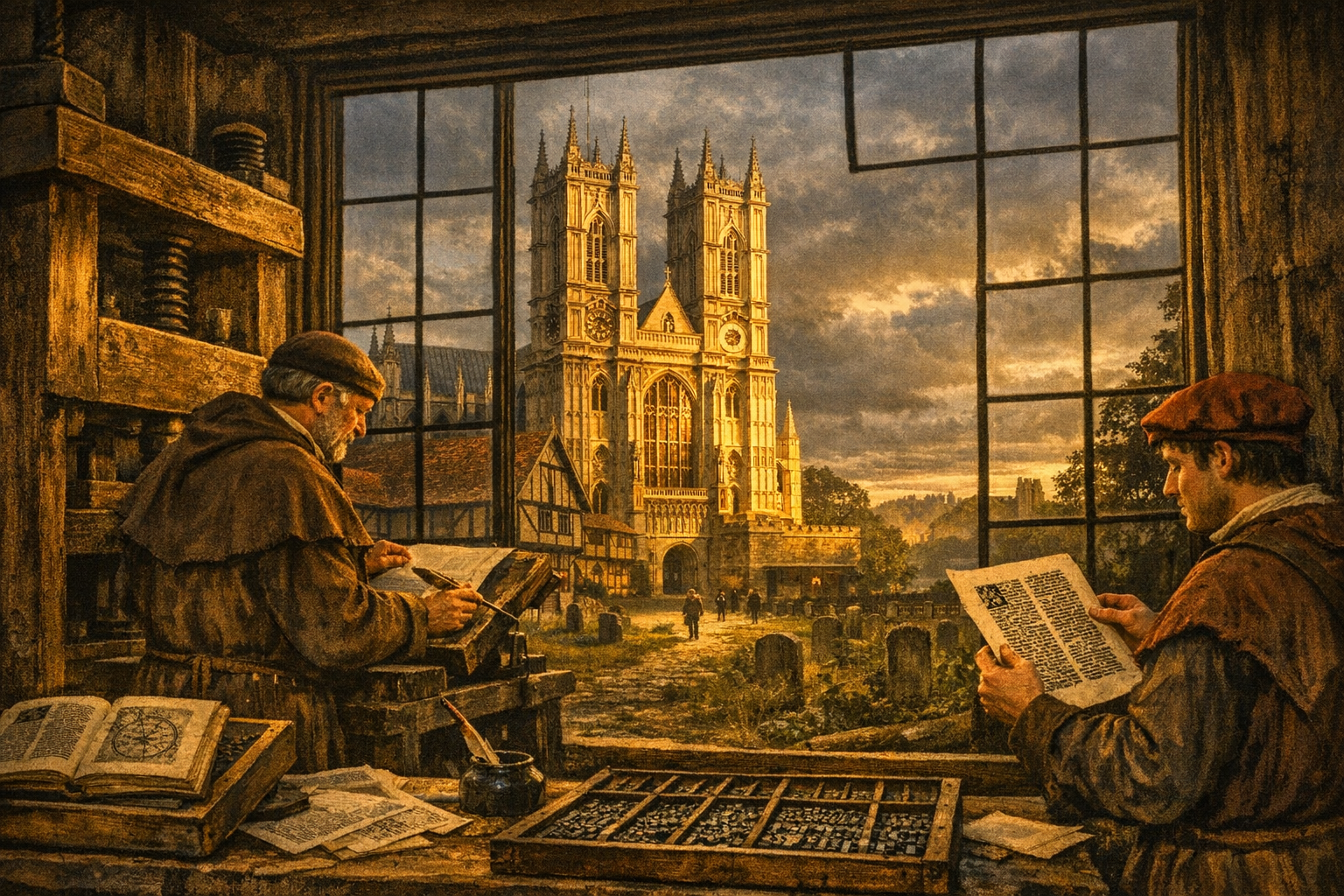
- The reformation period saw Henry VIII dissolve the church, shut down traditional literature structures of the scriptorium and replace them with the printing press – thus consolidating power through literature into the hands of the Crown.
- Print was now faster, wider, and more permanent than oral or manuscript culture.
- Control of print became control of what people believed.
- Three bodies gained enormous power:
the Church, the Crown, the Stationers’ Company. - Literature became a battlefield where ideas, doctrine, and authority were fought over.
This lesson shows students that print is not neutral — it shapes meaning by controlling what gets to exist.
Today we are learning how print became the main authority for culture during the Reformation from 1517 – 1648.
By the end of the lesson, you will understand that:
- Print allowed ideas to spread further and faster
- The Church, Crown, and Stationers’ Company controlled printed texts
- Print shaped what people believed, valued, and understood
- Print became the authority for culture during the Reformation.
- The Church, Crown, and Stationers’ Company controlled what could be printed.
- Literature became a tool in battles over religious and political ideas.
- Control of print meant control of belief and knowledge.
- Reformation – period when Christianity split into Protestant and Catholic
- Authority – power to decide what is true or acceptable
- Censorship – controlling or banning printed ideas
- Doctrine – official religious teaching
- Stationers’ Company – organisation controlling printing and publishing in London
- Printed texts become a powerful for authority to…
- Literature is now strongly associated with Protestantism or Catholicism, sand this text…
- The ideas of this text are undergoing censorship…
“Print did not make ideas free — it made them controlled.”
This counters the naive assumption that printing = liberation.
📱 App Store Approval
Ask:
- Can anyone publish an app?
- Who controls what is allowed?
Establish the parallel:
- Apps = ideas
- App store = printing press
- Rejection = censorship
- Approval = authorised culture
The Apple app store is highly controlled and it is argued ‘better’ for the end user because of the high degree of regulation placed upon apps by Apple. Android’s Play store allows private individuals to upload their own developed apps more easily, creating a wider and more active market, but also one that has less oversight by the manufacturer. Apple is like the Premodern, highly controlled market that excludes ‘oppositional’ or ‘subversive’ ideas. Android is more Modern allowing new ideas to come from anywhere, but they don’t all have the same high standard.
Teacher line:
“In the Reformation, print was the App Store — and only three groups had the password.”
William Shakespeare’s Macbeth tells the story of a man who kills a king to try and obtain power for himself. The events deny this however, and Macbeth is himself killed, and the throne is returned to the rightful heir. Literature in Premodernity, and even into Modernity for a while, must sustain existing power.
We will establish our estate upon
Our eldest, Malcolm, whom we name hereafter
The Prince of Cumberland; which honor must
Not unaccompanied invest him only,
But signs of nobleness, like stars, shall shine
On all deservers.—From hence to Inverness
And bind us further to you.
What does analysis look like when Macbeth has been synthesised with the methodologies of this lesson?
Macbeth reflects the Reformation era, when printed texts were controlled by the Crown and Church. Shakespeare’s company held a royal patent, meaning their work was approved by the King – literature including plays had to support the doctrine of divine right of kings and the faith held by the Monarch. It was Crown and Church which mostly held authority over literature. The play encodes the message that rebelling against the king leads to chaos and damnation because print was now a tool for protecting state authority. A text that promoted revolution would have been censored, so connecting kings to ‘nobleness’ is a sure way of ensuring publication.
In Mockingjay by Suzanne Collins, after the Capitol falls, Katniss confronts President Snow in his rose garden. Snow has been captured and is awaiting execution. The once all-powerful ruler is physically diminished—bloody from sores in his mouth, propped up in a chair—while Katniss stands over him, armed and in control.
During their conversation, Snow claims he did not order the final parachute bomb attack that killed many children and Prim. Instead, he suggests that President Coin orchestrated it to turn public opinion against him and solidify her own rise to power. Snow appeals to Katniss’s understanding of strategy and manipulation, insisting that he has no reason to lie now that he has lost.
The shift in power is stark. Earlier in the trilogy, Snow intimidates Katniss in her own home, threatening her loved ones and asserting absolute dominance. In this final meeting, he is the prisoner, dependent on her belief and judgment. Katniss, once a pawn in the Capitol’s Games, now holds moral and political leverage. The true transfer of power, however, is not simply from Snow to Katniss—it is from the old tyrannical regime to a contested future, with Katniss positioned as the moral arbiter. Her later decision to execute Coin instead of Snow confirms that she refuses to perpetuate the same cycle of authoritarian control.
Question: How does Mockingjay reflect changing ideologies in Literature studies?
Student Task
Choose one moment in our current text involving authority, belief, or power.
- Explain how control of print in the Reformation era might shape that meaning.
- Use the idea of print as cultural authority in your explanation.
Provide scaffold:
- This moment reflects print authority because __________.
- During the Reformation, printed texts were controlled by __________, which shaped meaning by __________.
- This text seems to exhibit a ‘permitted’ narrative, an oppositional narrative would be___.
Encourage focus on:
- obedience
- rebellion
- truth
- belief
- public ideas
Finish the sentence:
“Print became the authority for culture during the Reformation because __________.”
You are listening for:
- control
- spread
- regulation
- doctrine
- belief
a) Pre-reading of the next lesson – read through the knowledge so you can be ready to discuss in class.
b) Apply the learning of today’s lesson to your own private reading text. Write a paragraph explaining how today’s learning changes how you might conceive your text. Be sure to use the key vocabulary and sentence stems.
c) Write a paragraph about the discipline of Literature, explain how key words from today’s lesson impact the field overall.
d) Add today’s vocabulary and sentence stems to your own glossary. Highlight any that you are unsure about, but you must also research the meanings yourself and develop your glossary to include this differentiated support.
How did you do? Remember, this is the disciplinary knowledge for Literature – it needs combining with the text you are studying now. Can you use this knowledge to write differently about the text you are studying? When you are ready, access the next lesson in this series.