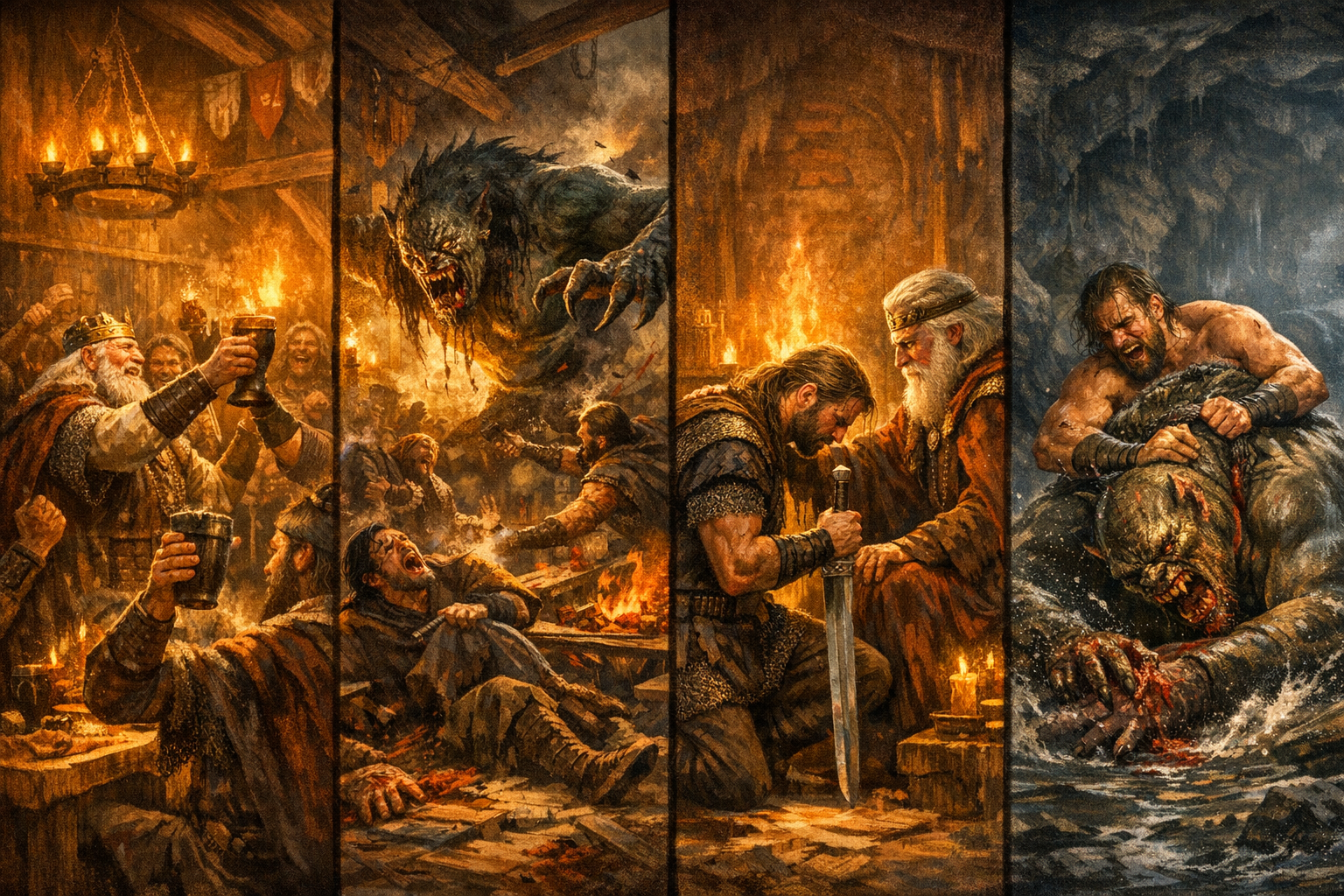
Four cells showing the narrative of Beowulf

Lit212 Todorov’s Narrative Structure

Accessibility options: Use your browsers translation, screen reader and AI summary tools to help your studies.

This lesson develops the concept of Literariness by introducing Tzvetan Todorov’s Narrative Theory as a disciplinary method for analysing how stories are structured to produce meaning and emotional impact. Drawing on Narratology, this lesson frames narrative as a designed experience, not a natural sequence of events. Todorov’s model (equilibrium → disruption → recognition → repair → new equilibrium) allows students to analyse how tension, pacing, and resolution are engineered.

This lesson builds on CECA’s assertion that literary analysis requires explicit methodological knowledge, moving students away from retelling plot and toward recognising structural intention.

By the end of the lesson, students will be able to:

  • Explain Todorov’s narrative stages using disciplinary vocabulary.
  • Identify how narrative structure creates tension and emotional engagement.
  • Analyse a text by linking its structure to its dramatic appeal.

Stories are not sequenced randomly. Writers carefully structure events to guide how readers feel at different points — calm, anxious, hopeful, shocked, or satisfied. Todorov’s theory explains that most narratives begin with balance, introduce a problem, demonstrate the emotional reaction to this, then move toward resolution and a new world. Understanding this structure helps students analyse why certain moments feel dramatic or powerful.

Student‑friendly anchor:

“Stories rarely tell unique sequences, and authors recycle the same total sequence that audiences have come to understand easily.”

  • Narrative equilibrium — a state of balance or normality at the start of a story.
  • Equilibrium – the world in balance and accepted as ordinary
  • Disruption — an event that breaks the equilibrium and creates tension.
  • Recognition — the moment characters realise a problem exists.
  • Repair — actions taken to resolve the disruption.
  • New equilibrium — a changed state of balance at the end of the narrative.
  • Tension — emotional pressure created by uncertainty or conflict.
  • Chronology — the order in which events are presented to the reader.
  • “The narrative initially establishes an equilibrium in which…”
  • “Tension is introduced through a disruption when…”
  • “The dramatic appeal of this moment lies in the delayed recognition that…”
  • “By structuring the narrative in this way, the writer encourages the reader to…”
  • “The new equilibrium suggests that the experience has permanently altered…”

🚫 Do not accept:

  • “First this happens, then this happens, then the story ends.”

What’s wrong with it:
This is sequencing, not analysis. It lists events without explaining how structure shapes emotional experience or meaning.

✅ Acceptable phrasing:

  • “Authors adopt a standard sequence of story telling that goes back to the very earliest tales of warriors and victory.”

This advert neatly presents Todorov’s Narrative theory. It opens in an equilibrium of guys playing football. This is disrupted by the realisation that a date has been neglected. We briefly see the man’s emotional reaction; panic, dismay and terror. The repair stage is aided by the Coke Zero team, who are encoded with military, police and tactical response sign systems. The repair stage reunites the couple and a new equilibrium is reached in which the world is changed, the man is with his date and not with his friends. The branding is positioning Coke Zero as the tools able to reach new equilibrium.

This appears at the top of the Goodreads YA Novels of 2026 list and is already highly rated by teen and young‑adult readers.

It’s contemporary, romantic, character‑driven, and structurally very clear — perfect for modelling Todorov’s narrative stages.

Below is a bullet‑point breakdown of Todorov’s Five Narrative Stages for this text.

Todorov’s Narrative Stages in I Could Give You the Moon

1. Equilibrium

  • Protagonist begins in a stable (though emotionally fragile) state.
  • Life is defined by predictable routines: school pressures, social expectations, and quiet personal ambitions.
  • Relationships are calm but brittle — tensions lie beneath a polished surface.

2. Disruption

  • A dramatic emotional or social event ruptures the stability (e.g., a confession, betrayal, or sudden revelation).
  • The protagonist is forced out of their comfort zone.
  • Existing friendships or romantic interests become complicated, producing narrative tension.
  • The disruption creates a problem the protagonist cannot ignore.

3. Recognition

  • The protagonist realises the full consequences of this disruption.
  • They confront uncomfortable truths about their desires, identity or relationships.
  • Secondary characters begin to reveal their own motives, widening the conflict.
  • This stage typically contains heightened emotional stakes and self‑reflection.

4. Attempt to Repair

  • The protagonist takes deliberate action to fix the disruption — often misguided at first.
  • Miscommunication, avoidance, or overcompensation complicate attempts at repair.
  • The narrative builds toward its emotional peak as the protagonist risks vulnerability.
  • Tension intensifies through near‑misses, reversals, or partial failures.

5. New Equilibrium

  • A new, changed balance is formed — emotionally, relationally, or socially.
  • The protagonist emerges with a clearer understanding of their relationships.
  • Former tensions resolve into a healthier, more honest dynamic.
  • The ending affirms personal growth and a shift in perspective.

Question:

“This part shows that the characters are having problems and feeling emotional. It means their relationship is getting complicated and things are going wrong.”

Why if fails

  • It paraphrases events without identifying Narrative stages or terminology.
  • It expresses content-level observations rather than structural analysis.
  • It focuses on feelings rather than narrative design.

Liang adopts the literary structure identified by Todorov, she doesn’t challenge the ordinary way of structuring stories. This moment marks the disruption of the narrative’s initial equilibrium, as the fragile stability between the protagonists collapses under a sudden emotional revelation. Liang delays recognition, allowing the characters — and the reader — to slowly understand the full weight of this change, which intensifies the tension. By structuring the scene so that the consequences unfold gradually, the novel heightens its dramatic appeal, creating a pivotal turning point that shifts the story from hope toward uncertainty and sets up the later attempt at repair.

Why it succeeds:

  • Correctly identifies Todorov’s stage (disruption) as something adopted by the author.
  • Uses disciplinary vocabulary (disruption, recognition, tension, dramatic appeal).
  • Synthesis methodological analysis, with plot recall.

Task 1: What do you think is the most important, longest, most developed stage in different genres?

  • New Equilibrium
  • Disruption
  • Recognition
  • Repair
  • New Equilibrium
  • Action
  • Romance
  • Horror
  • Gothic

The following are indicative and not ‘closed responses’. Authors adapt the narratives in different ways, but the following could be true in some circumstances:

  • Action might focus on the repair stage, giving plenty of narrative space to ‘action sequences’
  • Romance might focus on the recognition stage, where people realise their emotional connection and narrative space is given over to dealing with this emotion
  • Horror might focus on the disruption stage, and give plenty of narrative space to constant antagonism from some terrible device
  • Gothic might focus on the equilibrium, giving lots of character development and scene setting so that there is a lot to lose by the character; the character and the audience become nostalgic for all that world building done in the equilibrium when it is gone.

Student Task – apply Todorov’s narrative theory to a new section of the text:

Instructions to students

  1. Identify which stage of Todorov’s narrative the extract represents.
  2. Use at least two key vocabulary terms.
  3. Begin your response using a sentence stem.
  4. Explain how the structure creates tension or emotional impact.

Success Criteria

A successful response will:

  • Correctly identify a narrative stage
  • Link structure to dramatic appeal
  • Use disciplinary vocabulary accurately
  • Avoid plot summary

Optional Scaffold

“This moment functions as a disruption because…”
“The narrative structure here intensifies tension by…”

Put these literary structures into the right order:

  • Disruption
  • New equilibrium
  • Recognition
  • Repair
  • Equilibrium

a) Pre-reading of the next lesson – read through the knowledge so you can be ready to discuss in class.

b) Apply the learning of today’s lesson to your own private reading text. Write a paragraph explaining how today’s learning changes how you might conceive your text. Be sure to use the key vocabulary and sentence stems.

c) Write a paragraph about the discipline of Literature, explain how key words from today’s lesson impact the field overall.

d) Add today’s vocabulary and sentence stems to your own glossary. Highlight any that you are unsure about, but you must also research the meanings yourself and develop your glossary to include this differentiated support.

How did you do? Remember, this is the disciplinary knowledge for Literature – it needs combining with the text you are studying now. Can you use this knowledge to write differently about the text you are studying? When you are ready, access the next lesson in this series.