


In a football team, not every player scores goals. Some defend, some assist, and some organise play. Removing one role weakens the whole system. Similarly, characters in stories have different functions, and each contributes to the narrative’s effectiveness.
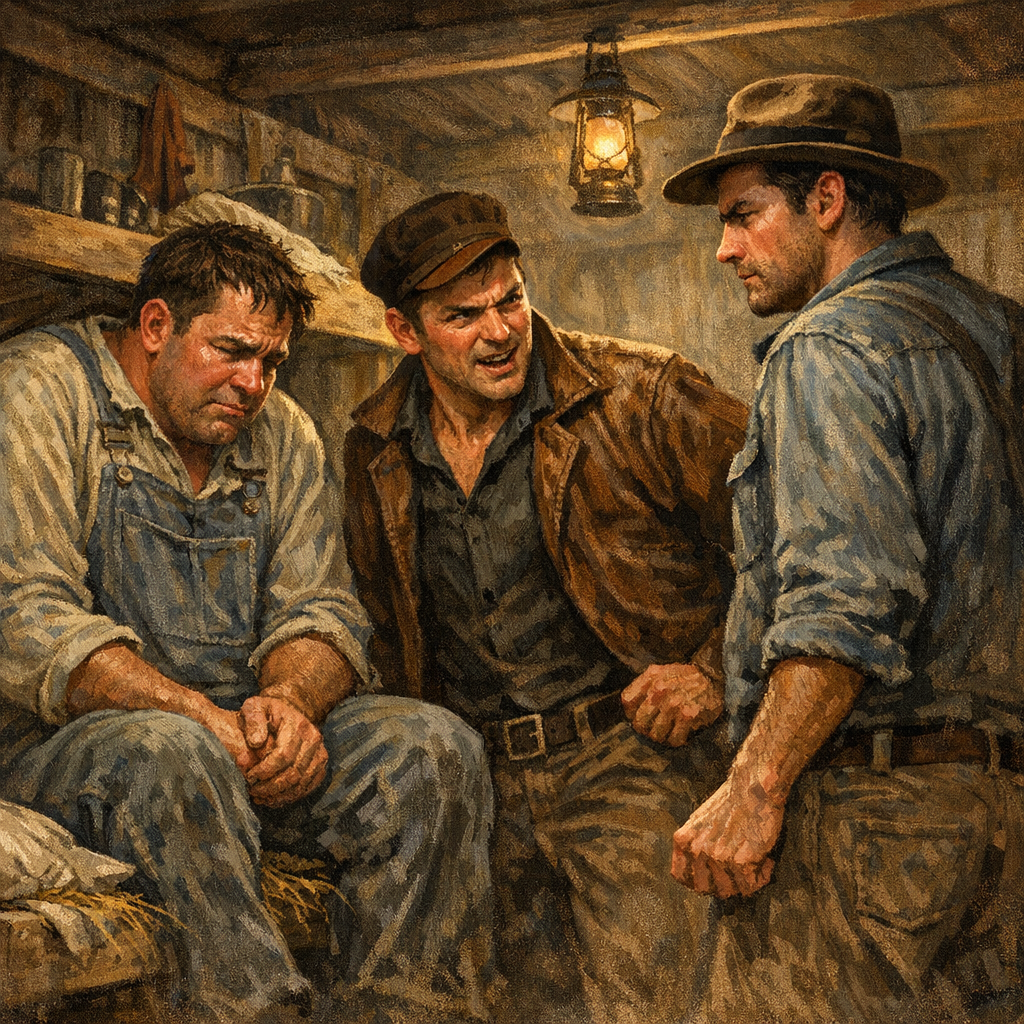
Of Mice and Men by John Steinbeck (1937) uses a small cast of characters to explore loneliness and responsibility. Each character performs a distinct narrative role that shapes the emotional impact of the story.
The old man came slowly into the room. He had his broom in his hand. And at his heels there walked a dragfooted sheepdog, gray of muzzle, and with pale, blind old eyes. The dog struggled lamely to the side of the room and lay down, grunting softly to himself and licking his grizzled, moth-eaten coat. The swamper watched him until he was settled. “I wasn’t listenin’. I was jus’ standin’ in the shade a minute scratchin’ my dog. I jus’ now finished swampin’ out the wash house.”
“You was pokin’ your big ears into our business,” George said. “I don’t like nobody to get nosey.”
The old man looked uneasily from George to Lennie, and then back. “I jus’ come there,” he said. “I didn’t hear nothing you guys was sayin’. I ain’t interested in nothing you was sayin’. A guy on a ranch don’t never listen nor he don’t ast no questions.”
“Damn right he don’t,” said George, slightly mollified, “not if he wants to stay workin’ long.” But he was reassured by the swamper’s defense. “Come on in and set down a minute,” he said. “That’s a hell of an old dog.”
“Yeah. I had ‘im ever since he was a pup. God, he was a good sheepdog when he was younger.” He stood his broom against the wall and he rubbed his white bristled cheek with his knuckles. “How’d you like the boss?” he asked.
“Pretty good. Seemed awright.”
“He’s a nice fella,” the swamper agreed. “You got to take him right.”
At that moment a young man came into the bunk house; a thin young man with a brown face, with brown eyes and a head of tightly curled hair. He wore a work glove on his left hand, and, like the boss, he wore high-heeled boots.
“Seen my old man?” he asked.
The swamper said, “He was here jus’ a minute ago, Curley. Went over to the cook house, I think.”
“I’ll try to catch him,” said Curley. His eyes passed over the new men and he stopped. He glanced coldly at George and then at Lennie. His arms gradually bent at the elbows and his hands closed into fists. He stiffened and went into a slight crouch. His glance was at once calculating and pugnacious. Lennie squirmed under the look and shifted his feet nervously. Curley stepped gingerly close to him. “You the new guys the old man was waitin’ for?”
“We just come in,” said George.
“Let the big guy talk.”
Lennie twisted with embarrassment.
Why this scene is suitable:
- Candy acts as a Raisonneur, giving George’s information about the scenario.
- George and Lennie are out protagonists.
- Curley is presented as an antagonist by being threatening toward Lennie.
- The scene intensifies dramatic appeal without advancing plot.
- Demonstrates how minor characters are structurally essential.
Question – how are the characters presented in this scene?
Question: Why is the use of these character conventions in your answer so important?
Students analyse a different character from the text using archetypal terminology.
Instructions to students
- Choose a character from the extract.
- Identify their archetypal role.
- Use at least two key vocabulary terms.
- Begin with a sentence stem.
- Explain how the character’s function contributes to dramatic appeal.
Success Criteria
A successful response will:
- Identify a character function accurately
- Use disciplinary vocabulary
- Explain narrative purpose
- Avoid moral judgement or description alone
Optional Scaffold
“This character functions as a ______ because…”
“Their role allows the writer to…”
Finish the sentence:
a) Pre-reading of the next lesson – read through the knowledge so you can be ready to discuss in class.
b) Apply the learning of today’s lesson to your own private reading text. Write a paragraph explaining how today’s learning changes how you might conceive your text. Be sure to use the key vocabulary and sentence stems.
c) Write a paragraph about the discipline of Literature, explain how key words from today’s lesson impact the field overall.
d) Add today’s vocabulary and sentence stems to your own glossary. Highlight any that you are unsure about, but you must also research the meanings yourself and develop your glossary to include this differentiated support.
How did you do? Remember, this is the disciplinary knowledge for Literature – it needs combining with the text you are studying now. Can you use this knowledge to write differently about the text you are studying? When you are ready, access the next lesson in this series.