
Imagine two approaches to running a cafeteria:
- Left‑wing approach: Everyone pays the same amount up front even people not eating from the canteen, and the school uses the money to make sure students who can’t afford can all access meals.
- Right‑wing approach: Students choose and pay only for their own food; eating comes to reflect the amount of money / work you do. Some students cannot afford to eat in the canteen.
Both systems have strengths and weaknesses — and both shape feelings of fairness, belonging, and motivation. Literature uses identical tensions.
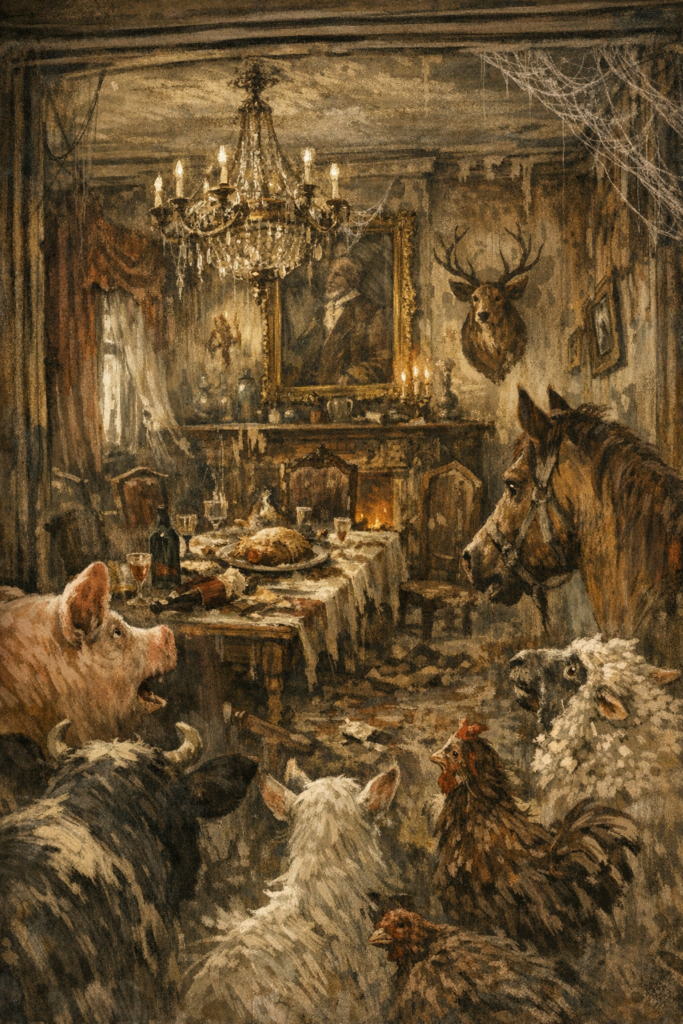
For this lesson, we will use Animal Farm (1945) by George Orwell. This allegorical novella explores political ideology through the rise and corruption of a revolutionary movement. Although set on a farm, the novel presents clear contrasts between collectivist left‑wing ideals and emerging right‑wing authoritarianism.
Then they filed back to the farm buildings and halted in silence outside the door of the farmhouse. That was theirs too, but they were frightened to go inside. After a moment, however, Snowball and Napoleon butted the door open with their shoulders and the animals entered in single file, walking with the utmost care for fear of disturbing anything. They tiptoed from room to room, afraid to speak above a whisper and gazing with a kind of awe at the unbelievable luxury, at the beds with their feather mattresses, the looking-glasses, the horsehair sofa, the Brussels carpet, the lithograph of Queen Victoria over the drawing-room mantelpiece. They were just coming down the stairs when Mollie was discovered to be missing. Going back, the others found that she had remained behind in the best bedroom. She had taken a piece of blue ribbon from Mrs. Jones’s dressing-table, and was holding it against her shoulder and admiring herself in the glass in a very foolish manner. The others reproached her sharply, and they went outside. Some hams hanging in the kitchen were taken out for burial, and the barrel of beer in the scullery was stove in with a kick from Boxer’s hoof, otherwise nothing in the house was touched. A unanimous resolution was passed on the spot that the farmhouse should be preserved as a museum. All were agreed that no animal must ever live there.
The animals had their breakfast, and then Snowball and Napoleon called them together again.
“Comrades,” said Snowball, “it is half-past six and we have a long day before us. Today we begin the hay harvest. But there is another matter that must be attended to first.”
The pigs now revealed that during the past three months they had taught themselves to read and write from an old spelling book which had belonged to Mr. Jones’s children and which had been thrown on the rubbish heap. Napoleon sent for pots of black and white paint and led the way down to the five-barred gate that gave on to the main road. Then Snowball (for it was Snowball who was best at writing) took a brush between the two knuckles of his trotter, painted out MANOR FARM from the top bar of the gate and in its place painted ANIMAL FARM. This was to be the name of the farm from now onwards.
Why this suits the learning objectives:
- Shows left‑wing collectivist ideals (shared labour, equality).
- Shows gradual shift to right‑wing authoritarianism (hierarchy, privilege).
- Reveals ideological containment (pigs controlling the narrative).
- Highlights how political values shape power and exploitation.
Question: Orwell is demonstrating differences in class – to what extent do you agree?
Question: What do you think should be the priority of a Government, who should it focus on helping to succeed?
Students apply today’s ideological vocabulary to an extract from the class text.
Instructions
- Identify whether the text expresses left‑wing, right‑wing, or conflicting ideologies.
- Use at least two vocabulary terms.
- Begin with one sentence stem.
- Analyse how ideology influences behaviour, conflict, or power.
Success Criteria
- Provides analysis, not description.
- Uses terminology accurately.
- Identifies ideological structure.
- Explains effects on characters or society.
Finish the sentence:
“Authors often include political ideology in their work to show _____.”
Indicative content:
- Who is in a position of power, or who lacks power
- How power is obtained and held
- What power is used to achieve
- How ideology can come to reduce or harm some groups
a) Pre-reading of the next lesson – read through the knowledge so you can be ready to discuss in class.
b) Apply the learning of today’s lesson to your own private reading text. Write a paragraph explaining how today’s learning changes how you might conceive your text. Be sure to use the key vocabulary and sentence stems.
c) Write a paragraph about the discipline of Literature, explain how key words from today’s lesson impact the field overall.
d) Add today’s vocabulary and sentence stems to your own glossary. Highlight any that you are unsure about, but you must also research the meanings yourself and develop your glossary to include this differentiated support.
How did you do? Remember, this is the disciplinary knowledge for Literature – it needs combining with the text you are studying now. Can you use this knowledge to write differently about the text you are studying? When you are ready, access the next lesson in this series.