

A man faces a choice between virtue and vice

Lit231 Human Nature — Desire, Motivation, and Choice

Accessibility options: Use your browsers translation, screen reader and AI summary tools to help your studies.

This lesson operationalises CECA’s Human Nature concept using Freud’s tripartite psyche (id/ego/superego) and repression, and Lacan’s mechanisms displacement and condensation as analytic language for desire and motivation in texts. Students will treat characters as constructed sites of conflict between impulse, conscience, and social reality.

Students will be able to:

  • Define id/ego/superego and repression; explain displacement/condensation in simple terms.
  • Identify how a scene in Lord of the Flies dramatises conflicts of desire.
  • Write one analytical paragraph using two of the key terms.

Characters are designed to act in human ways, but why do humans behave in as they do? We are controlled by inner forces that are unconscious to us. Psychanalysists have tried to identify these inner, unconscious forces to explore why we behave the way we do – particularly why we behave in dysfunctional ways. They give us a language to help understand where disfunction from, and this same language is a really good way of describing the behaviours of literary characters too.

  • Id / Ego / Superego — impulse / mediator / inner rule‑voice.
  • Repression — pushing unacceptable wishes out of awareness.
  • Displacement — emotion diverted from its true object to a safer one.
  • Condensation — multiple meanings/desires fused into a single image or act.
  • “This moment externalises the id because …”
  • “The ego negotiates risk/approval here by …”
  • “This image condenses several desires, including …”
  • “Anger is displaced onto … which reveals …”

✅ Acceptable phrasing:

Characters are designed to act and respond like humans would in these situations, so the reader gets to experience a reality according to the author.

🚫 Do not accept:

Characters just act the way the author wants them to.

Imagine craving reactions on social media, so you behave in compulsive ways (id), knowing homework is due and there is a deadline set by your teacher encouraging you to act responsibly (superego), and compromising by writing a social media post after you finish (ego). If anxious about a the deadline, you snap at a sibling (displacement).
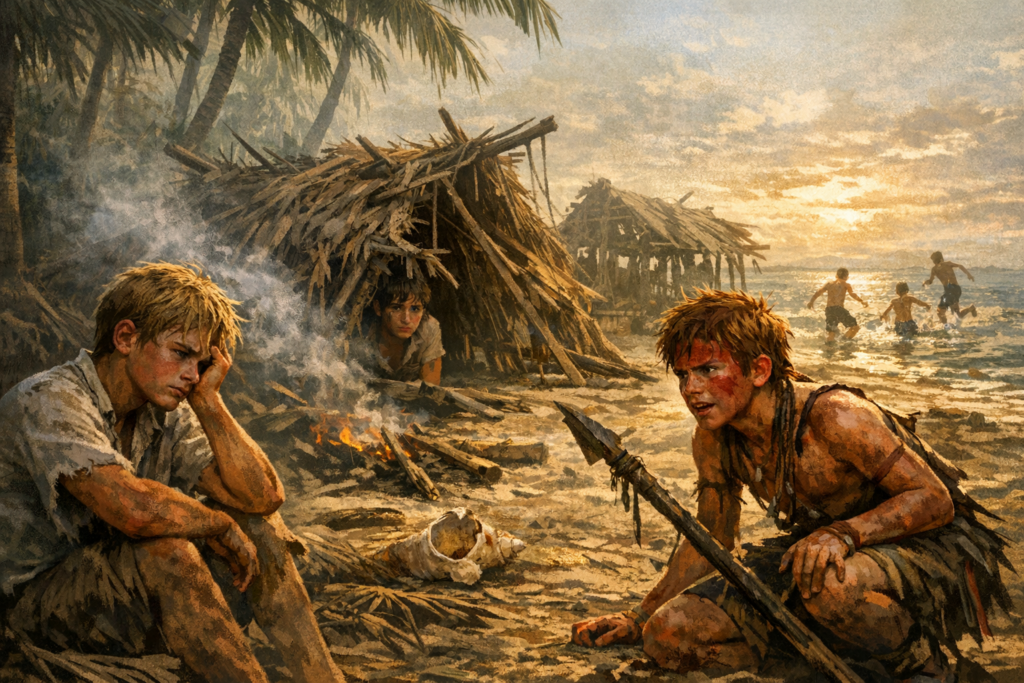
Ralph struggling with people's nature as children and jack satisfy their inner desires and not the civic good

Golding’s 1954 novel stages competing human drives on a lawless island. Jack channels raw id (thrill, dominance), while Piggy voices superego (order, rules). The group’s shifting allegiance lets us see desire, repression, and misdirected anger as social forces.

Two shelters were in position, but shaky. This one was a ruin. “And they keep running off. You remember the meeting? How everyone was going to work hard until the shelters were finished?”

“Except me and my hunters―”

“Except the hunters. Well, the littluns are―” He gesticulated, sought for a word. “They’re hopeless. The older ones aren’t much better. D’you see? All day I’ve been working with Simon. No one else. They’re off bathing, or eating, or playing.”

Simon poked his head out carefully. “You’re chief. You tell ’em off.”

Ralph lay flat and looked up at the palm trees and the sky. “Meetings. Don’t we love meetings? Every day. Twice a day. We talk.” He got on one elbow. “I bet if I blew the conch this minute, they’d come running. Then we’d be, you know, very solemn, and someone would say we ought to build a jet, or a submarine, or a TV set. When the meeting was over they’d work for five minutes, then wander off or go hunting.”

Jack flushed. “We want meat.”

“Well, we haven’t got any yet. And we want shelters. Besides, the rest of your hunters came back hours ago. They’ve been swimming.”

“I went on,” said Jack. “I let them go. I had to go on. I―” He tried to convey the compulsion to track down and kill that was swallowing him up. “I went on. I thought, by myself―” The madness came into his eyes again.

Why this extract fits:

  • The mask works as condensation (courage, anonymity, permission to act).
  • Chanting and hunting show displacement of fear/shame into group violence.
  • Piggy’s appeals mark superego pressure; Jack mobilises id.

Question: How does Golding present people?

Ralph and Simon are trying to build shelters but the others keep running off to play, swim, or hunt. Jack says he and his hunters were going after meat and he becomes annoyed because Ralph reminds him that they still haven’t caught anything. Ralph complains that the boys only listen during meetings and then wander off again. Simon watches them both quietly. Jack gets frustrated and talks about how he kept going by himself because he really wanted to kill something. The argument continues as they both realise the group isn’t helping.

Why if fails

  • It simply retells events from the extract.
  • It does not mention desire, repression, id/ego/superego, or displacement/condensation.
  • It does not use any sentence stems.
  • It treats characters as if they were “just doing things,” not as constructed sites of psychological conflict.

Golding presents the children as in conflict between id‑driven desire and attempts at the social need understood by the Super-ego. When Jack insists “We want meat,” the scene externalises his inner id because his impulse is for simple gratification of food and the glory of hunting and killing. Ralph understands the social need for shelter and though “Two shelters were in position, but shaky. This one was a ruin”. Ralph’s ego prioritises the need for shelter; “All day I’ve been working with Simon. No one else” but few other children are willing to put aside their need for self-fulfillment and act in the greater good.

Jack’s claim that he “had to go on,” even when the others abandoned the hunt, reveals his id, which is a motivation for the self-fulfillment that is driving him on more than anyone else. When Jack says “we want meat” and “I had to go on”, this is the inner impulse of his id talking. The “compulsion to track down and kill” signals an instinctive id‑impulse overriding the superego’s civic duty. They need to establish shelters and rescue more than food right now.

We can see other aspects of human nature in this scene too; Ralph talks plenty about the need for shelters, but he jokes “we ought to build a jet, or a submarine, or a TV set”, which might reveal his desire for many aspects of civilisation and not just shelter – the shelters are a condensation of the many things he desires. The shelters are important to him because they carry the weight of many desires, but the shelters aren’t important to the other children because the shelters have not come to represent greater meaning.

Why it succeeds:

  • It recognises that fictional characters are built from non-fiction realities
  • It uses accepted technical terminology to talk about the texts
  • This terminology is universal to all literature and not simply a paraphrase of this text

What inner force drives the following actions:

  • Getting out of bed early instead of lying in
  • Buying fast food instead of making a healthy lunch
  • Taking pocket money to the shops, but coming home with something for yourself and your little brother
  • Having a very minor difference with a friend, which suddenly and unexpectedly blows out of proportion
  • Getting out of bed early instead of lying in – the super ego motives the ‘right’ choice
  • Buying fast food instead of making a healthy lunch – The id motivates an immediate gratification that is not healthy
  • Taking pocket money to the shops, but coming home with something for yourself and your little brother – the ego balances two decisions, one from the super ego and one form the id
  • Having a very minor difference with a friend, which suddenly and unexpectedly blows out of proportion – this could be a condensation of many issues all coming out against the one person, or a displacement in which a problem somewhere else is taken out on the friend here and now

Analyse a short passage chosen in class. Use two terms (e.g., repression + displacement). Start with:

“This image condenses …” / “The anger is displaced onto …”

Success criteria: accurate terms; link to behaviour; not plot summary.

“Where do you see repression operating in this scene, and what leaks out when it fails?”

a) Pre-reading of the next lesson – read through the knowledge so you can be ready to discuss in class.

b) Apply the learning of today’s lesson to your own private reading text. Write a paragraph explaining how today’s learning changes how you might conceive your text. Be sure to use the key vocabulary and sentence stems.

c) Write a paragraph about the discipline of Literature, explain how key words from today’s lesson impact the field overall.

d) Add today’s vocabulary and sentence stems to your own glossary. Highlight any that you are unsure about, but you must also research the meanings yourself and develop your glossary to include this differentiated support.

How did you do? Remember, this is the disciplinary knowledge for Literature – it needs combining with the text you are studying now. Can you use this knowledge to write differently about the text you are studying? When you are ready, access the next lesson in this series.