
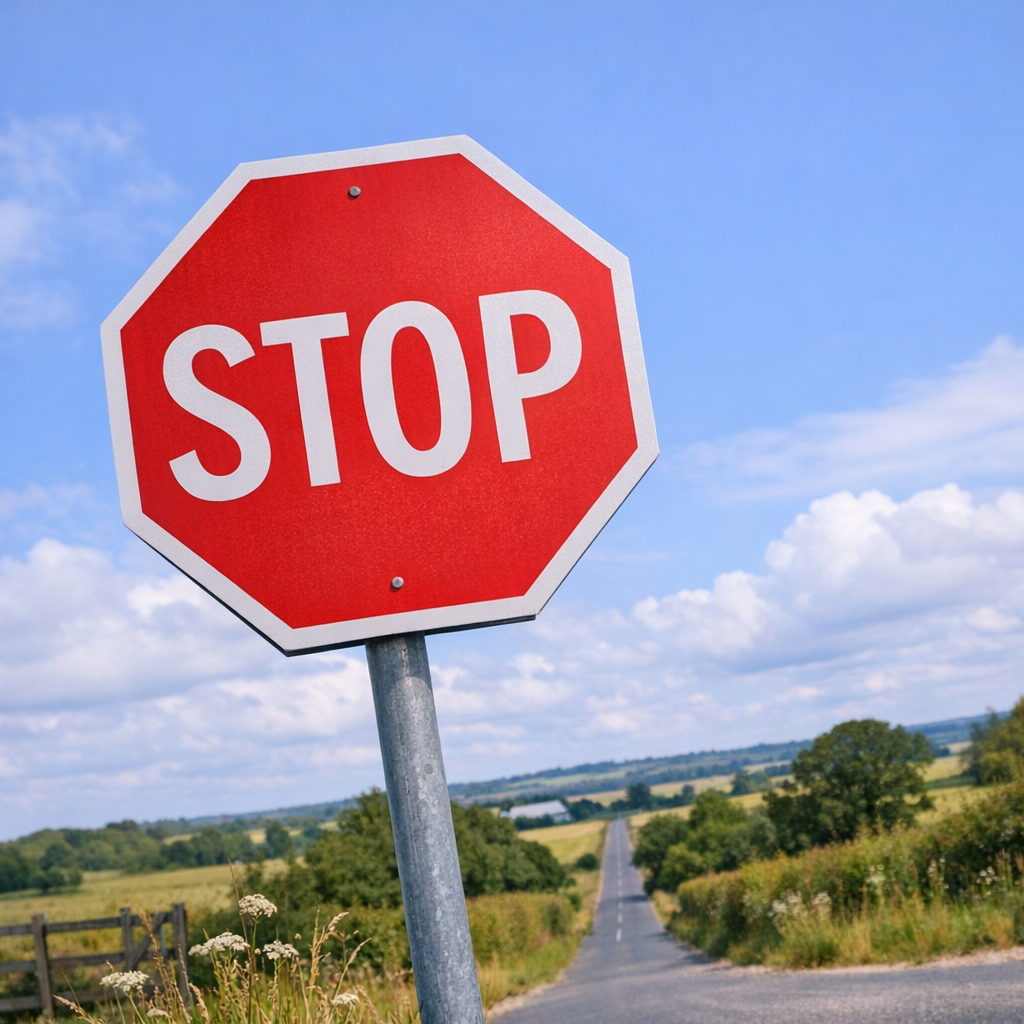
Octagonal ‘stop signs’ are the only road sign that is this shape. All other instructions or warnings are in rectangles or triangles. The shape gets its meaning not from a relationship with other signs but externally, from the Highway code (where all road signs get their meaning).
The Highway code gets this meaning from statistical data about accidents. Accidents data gets its meaning from people’s experience and the weather: Snow or dirt can hide the image on road signs, drivers failing to stop at junctions are a significant risk, the highway code needs a surefire way of always meaning ‘stop’ even when the sign is covered by snow or dirt, the stop sign is the only sign that can be an octagon. Octagonal road signs mean stop – but only by referencing out and away to other meaning structures. Stop is not inherent within the shape, but given to it by external structures. Structures of human experience, structures of crash data, structures of road signs in general (ie, it can’t be triangular as this shape is already encoded).
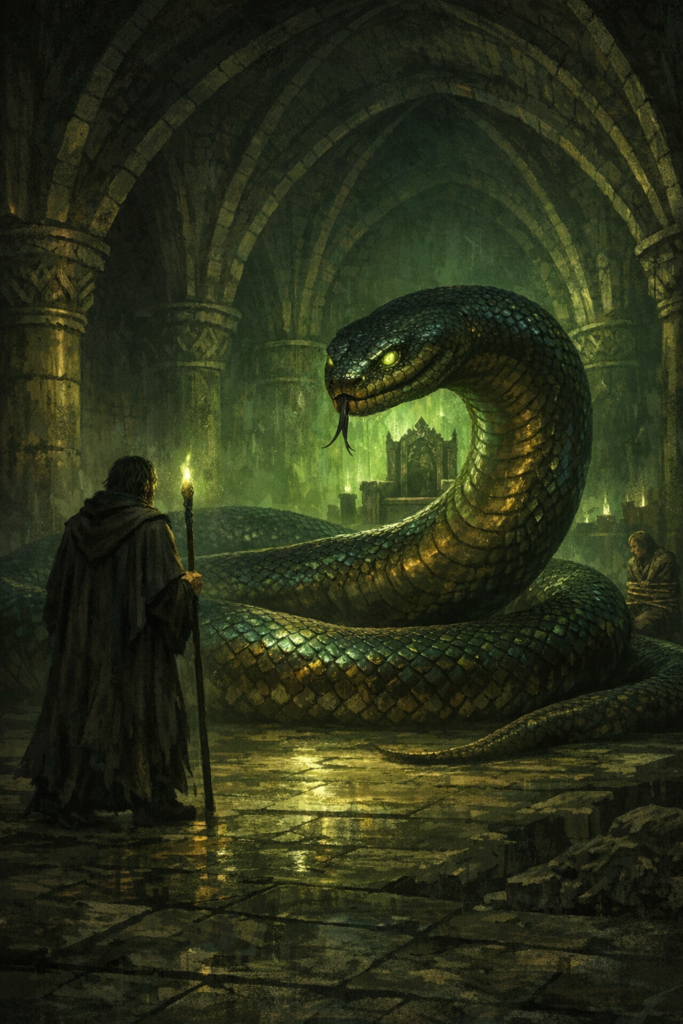
Across many cultures, snakes have long been associated with danger, temptation, and evil—ideas that come from ancient human experience with poisonous snakes and from religious stories like the serpent in the Garden of Eden. The story draws on these shared cultural ideas so that even a new reader instinctively understands that Nagini represents something threatening and morally corrupt.
The chamber was lit only by a wavering green glow, throwing long, shifting shadows across the stone floor. At the centre of the room, a great serpent lay coiled beside her master’s throne, her scales catching the light with an oily shimmer. Nagini lifted her head the moment Voldemort spoke, as though the sound of his voice travelled along a thread only she could sense. With a slow, deliberate movement, she uncurled her massive body and slid forward, the scrape of her scales echoing softly against the cold walls.
Her tongue flickered, tasting the fear that thickened the air. The captive wizard bound at the far end of the room tried to pull himself backwards, but there was nowhere to go. Nagini circled him with a kind of ceremonial grace, each loop tightening the ring around him. Though she made no sound beyond a low hiss, her presence alone seemed to communicate Voldemort’s intentions more clearly than words.
When she paused before him, raising her head so her gleaming eyes were level with his, the room fell silent. She waited, perfectly still, as if listening for her master’s unspoken command — an extension of his power, his will, and his malice made flesh.
Why this scene suits the lesson objectives:
J.K. Rowling did not encode snakes as dangerous or evil,
- The snake has been used many times in literature as a representation of evil, going back at least to the Bible,
- Monstrous forms that endanger humans goes back even earlier to Early English and stories of warriors, such as Beowulf fighting Grendal,
- The need for mankind to overcome evil goes back even earlier than literature, to our ancestors who struggled to survive amongst predatory creatures,
- This goes as far back as the very earliest of stories, about binary opposition, that has been encoded into human experience since the dawn of humanity.
Question: How has the snake Nagini been represented?
Have the following symbols been encoded by today’s authors, or does their meaning extended back in time to earlier structures?
- Stars encoded with fate and destiny
- Men encoded as warriors
- Potions and witchcraft encoded as evil
- 6-7 encoded as a farcical response
Students explore how the extract relies on cultural codes, myths, or wider structures beyond the text.
Instructions to Students
- Identify one cultural code, social convention, or mythic structure shaping meaning in the extract.
- Use at least two key vocabulary terms (cultural code, system of relations, convention, mythic structure).
- Begin with a sentence stem:
- “This behaviour makes sense because the cultural code of ___ expects…”
- “The story fits a broader structure of…”
- Explain how meaning depends on the reader recognising this external system.
Success Criteria
A strong response will:
- Identify a relevant cultural or mythic structure
- Link it clearly to meaning within the extract
- Use vocabulary precisely
- Avoid personal opinion or psychological interpretation
Why do authors rely on using the signs and meanings established in earlier traditions, and not just invent their own?
Students might talk about:
- How difficult it is to establish new meaning within a text
- How un-likely it is that this new meaning will stick, making the text quickly irrelevant
- Social conditions don’t change much and so old signs are still relevant today
- Using signs that readers already know makes engagement much easier
a) Pre-reading of the next lesson – read through the knowledge so you can be ready to discuss in class.
b) Apply the learning of today’s lesson to your own private reading text. Write a paragraph explaining how today’s learning changes how you might conceive your text. Be sure to use the key vocabulary and sentence stems.
c) Write a paragraph about the discipline of Literature, explain how key words from today’s lesson impact the field overall.
d) Add today’s vocabulary and sentence stems to your own glossary. Highlight any that you are unsure about, but you must also research the meanings yourself and develop your glossary to include this differentiated support.
How did you do? Remember, this is the disciplinary knowledge for Literature – it needs combining with the text you are studying now. Can you use this knowledge to write differently about the text you are studying? When you are ready, access the next lesson in this series.