
The interconnectedness of meanings

Lit304 Poststructuralist Procedure for Literature

Accessibility options: Use your browsers translation, screen reader and AI summary tools to help your studies.

Post-structuralism begets the Structuralism that came before it, and readers of this article would do well to begin with some familiarity of that earlier school of thought. Neither critical perspective fits particularly well into simple statements or themes, but doing so would help to draw a distinction between Structuralism and Poststructuralism.

Structuralism, as its name suggests, is focused on structures from which meaning can be transferred between interlocutors. The transference of meaning requires that both speaker and recipient are operating with the same definitions of words. An older generation hearing a younger speaker refer to an artist as ‘sick’ causes issues for Structuralists because of the drift in meaning (or as Roland Barthes would refer to the cultural code – the older generation is outside of the cultural usage of sick being an positive and not a pejorative). Meaning is more than just definitions though, and an entire grammar of signs is also required. “The cat in the hat” cannot be reconstructed in any other order and still convey meaning, so rules are as important as meanings. Those rules are always learned from outside the text or the speaker; we come to understand the meanings not from within usage but from outside the usage. Structuralism is the study of these rules, where they are formed and how speakers come to understand them.

[Structuralism’s] emphasis on the static (synchronous) language system was felt to neglect process and change. The explanation of linguistic change through time is a major theoretical problem for the Saussurean theory of language (p112)… meaning is not anchored in the ‘real world’ but is a product of the particular language or discursive structure of which its units are a part. One consequence of ths is that meaning becomes insecure: there are no stable ‘truths’ i knowledge of belief; all is relational. thus some structuralist-influence theories encourage a sceptical view of the world, and Poststructuralist thought became adept at demonstrating how received, apparently ‘natural’ and taken-for-granted beliefs were in fact culturally produced effects of the governing structure.

Poststructuralism however deconstructs this theory that grammar and meanings can in fact be known with any degree of certainty at all. And the vernacular “sick” works well here; meaning is transcendental. Language and grammar is not fixed, nor can we know that readers are operating with the same signifier-signified relationships as the speaker.

Structuralism famously trends away from the text upwards and outwards to where the grammar was formed. Structuralism is exophoric in discovering where meaning comes from, and it is certain that it is able to find some root sign that forms the genesis of meaning. To some extent them, Structuralism generates some degree of certainty about where meaning comes from – that there is some actualization of meaning, some first domino, some origin of source, from which all meaning is derived. Poststructuralism however says that meaning is not so orderly and cannot be traced backwards genealogically. Poststructuralism is defined well by Jean Francois-Lyotard’s assertion that Modernity is incredulous towards grand-narratives; any all encompassing, totalitarian form of authority is not to be trusted and is ultimately superseded by the concept that meaning is formed through plurality. Poststructuralism’s argument that meaning is ultimately unknowable is highly abstract and conceptual, but there is actually a very neat modern analogy.

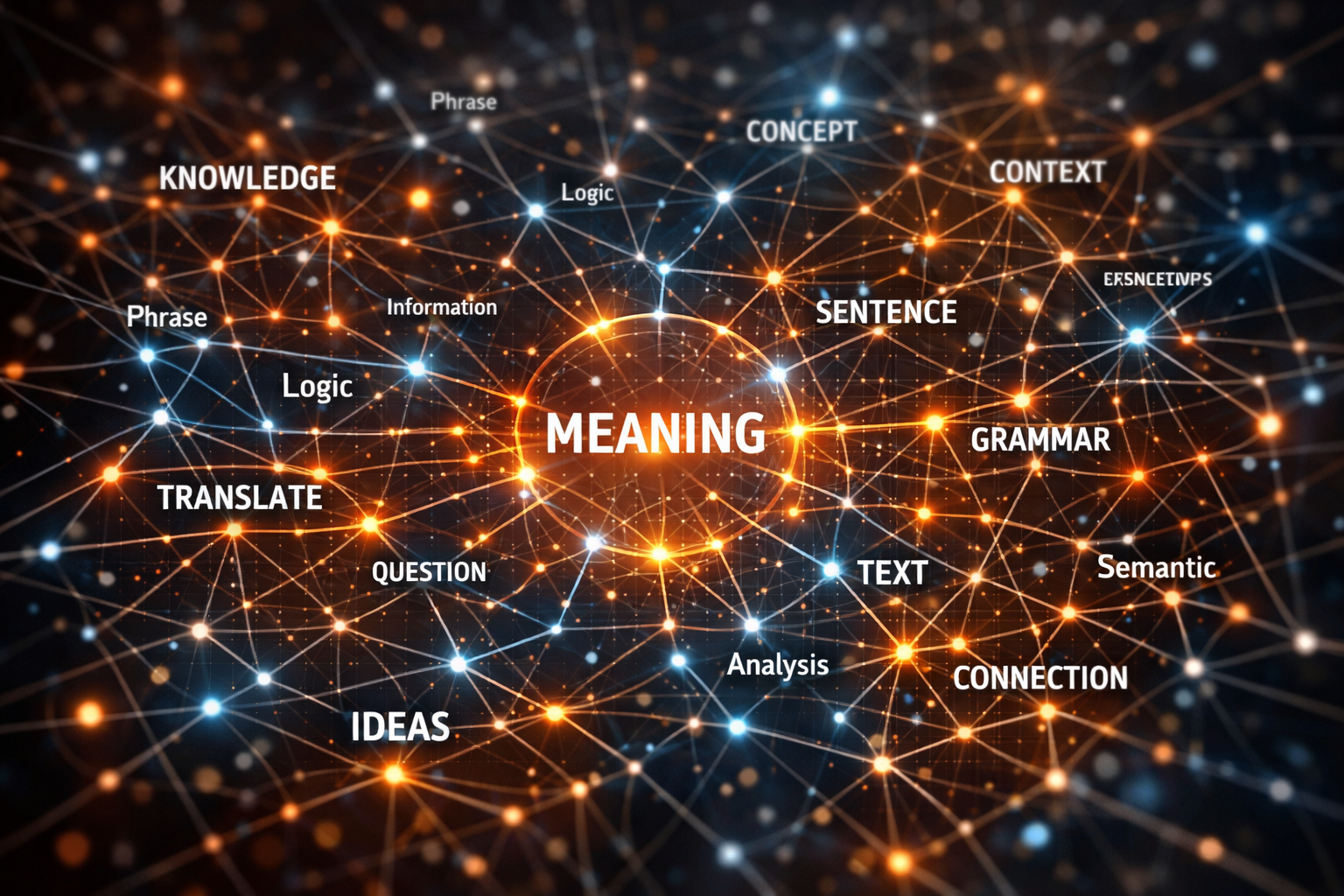
The argument against a taxonomy of sign systems is that we cannot take a word such as ‘blue’ and assume some agreed upon universal definition; what is being referred to by the author is not necessarily the same as what the reader decodes as being signified. ‘Blue’ requires knowledge of other colours, colour spectrum, and boundaries that define the limits of blue-ness. It also needs some concrete body upon which to ‘paint’ blue, as the actual referent is merely an electromagnetic wave that we conceive upon physical bodies. And there are cultural values to the colour as well: coldness? isolation? grief? When we decode the sign, we are not merely obtained some singular definition but sampling together a wide range of associations. Words do not simply have meanings. They are part of a vast web interconnecting words, opposites, feelings, experiences and literary usage that operate together in defining what the sign signifies.

This is how AI systems build their Large Language Models. Meaning in AI models is not built like dictionaries, but vast webs of interconnectedness. You cannot trace a word, a sign or a grammar backwards to earlier rules. We cannot know for certain exactly what meaning is being intended. The web of networked meanings implies an infinite possibility of meaning.

What a Poststructuralist does is to show that we cannot know for certain what has been meant within a text, and that meaning is constructed by the reader and their unique experiences. Reading creates more meaning than the author can control.

This has some rather unsettling consequences however, and Poststructuralist’s messiah suffered at the crucifix of his own religion. Jacques Derrida was one of the key philosophers of the Poststructuralist movements and a Jewish man living through World War II. In 1987, a Belgian scholar discovered that Derrida’s colleague, Paul de Man, had written over 180 articles for a pro-Nazi newspaper, at least one being explicitly antisemitic. Derrida was approached for comment, and was compelled to respond in the famous, poignant and heartbreaking article, Like the Sound of the Sea Deep Within a Shell (1988), which Marci Shore calls the obituary for Poststructuralism. Many readers have noted the elegiac, defensive, and conflicted tone of Derrida’s essay. Derrida writes “for almost twenty years, I never had the least reason to suspect my friend to be the author of such articles”. Derrida goes on to attempt to salvage some of de Man’s dignity, despite the clear conflict between the one’s identity and the other’s ideology. Derrida uses the Poststructuralist approach to show that de Man subvert himself, and that no determinate moral centre can be possible. Language always says something other than what it wants, something contradictory, some double bind of ‘however / on the other hand’. Derrida does not deny the antisemitism present in de Man’s articles. But he does warn against “moralising” readings that ignore the complexity of the texts and the human writing them. Derrida asks that we, contextualise it, analyse its rhetorical structure, and discover that the article’s logic is internally unstable. Derrida claimed that de Man’s later work implicitly repudiates such positions… Maybe de Man’s work can be deconstructed to pull the rug from beneath the feet of meaning and destabilize the entire text… and so destabilize the accusation of antisemitism… maybe de Man is the victim of decontextualised readings and not simply an anti-semite…

Derrida is expert at turning texts against themselves in this way, and exploring the contradictions in pieces of writing so as to deconstruct their foundations (p114).

But to do so would be to exonerate any crime, and no insult could ever be taken at face value. What crime cannot be turned into a dialectical argument? What virtue cannot be twisted into cruelty? When signs cannot be taken at face value and have no central, mandatory, definable meaning, how can any judgement ever be made? This moment created a crisis in literary theory and Poststructuralist procedures continues to do great good in the world that we stand to lose if we don’t ensure some safe grounds upon which to be critical.

Let’s reflect upon Derrida’s paradox a moment and see it through the mirror of pop culture today, and almost every cinema-goer has had the very same debate destabilizing meaning in the post film debate. Let’s turn ourselves to the Marvel Cinematic Universe and its de Man, and the MCUs Derrida. Structuralism is able to determine that Thanos is the great antagonist of the series through the roles and function he fulfils; he is in binary opposition to the Avengers who have already been defined as heroes in earlier films; his narrative places him in the disruption sequence, unsettling the equilibrium; he is killed so that a new equilibrium can be obtained. We can investigate outwards to literary tradition and see how such structures persist in defining the ‘bad guy’, where “elements from one text are offered to legitimate elements of another” (p112). And yet… Thanos is attempting to bring ‘balance to the universe’; he has no prejudice and kills half of all living creatures at random; it seems that his own family, friends and even himself are not safe from the randomness (Thanos survives only as a function of the plot and not some nepotism or merit). At the start of the final film, we see some new equilibrium in which Earth is healing, there seems to be no wars, and even Tony Stark is cynical of trying to reverse the ‘snap’ that successfully fulfilled Thanos’ goals. Genocide or no, the universe post-snap is serene in a way that complicates the moral binary. Poststructuralists’ readings of Thanos, like Derrida’s reading of de Man, do not reject the crimes of Thanos. Marvellers (a term I just invented as the collective noun for those who imbibe the MCU) accept Thanos’ act as genocide, they accept genocide is a bad thing – but the function behind it is aligned with many of today’s very real concerns about survival and resources. Poststructuralism is capable of taking the accepted meaning of the Structuralist and undermine binary readings of good and bad, so that the extenuating circumstances surrounding any truth-claims make us question the certainty that the Structuralist feels.

We can apply this same Poststructuralist logic to literary texts too. We can argue that Priestley’s Mr Birling is not well defined as the antagonist of An Inspector Calls as a Structuralist would do; that his wages meet the industry average; he gave Eva Smith opportunity to progress and lead; there is an actual economic argument that running a business with higher operating costs (through labour rates) harms employees when the business fails due to being economically uncompetitive. Mr Birling functions as the Structural antagonist, but he is not the moral antagonist Priestley sets him up to be. Inspector Goole, however is deconstructed into a possible antagonist through his narrative which breaks the very principles of judicial procedures, ignoring legal rights and representation. Goole engages in entrapment and fails to abide by the code of ‘innocent until proven guilty’. The Structuralist reading lives on in how we understand the characters, but the validity of its assertion is undermined by the Poststructuralist who double-takes at the text and points to contradictions.

So what have the Romans done for us then? Apart from questioning the grand-narratives of religious scripture and paving the way for both religious and scientific freedom; advancing the rights of citizens through legislation; questioning the hegemony of patriachy and creating the emancipation of women; questioning the founding of relationships as between man and woman, creating the freedom for same sex relationships; questioning the very identity of people to create space for gender and sexuality; questioning the role of the citizen to its government and corporations, promoting freedom from servitude and labour; questioning euro-centrism and recognising the value of culture and art in colonised communities… What has Poststructuralism actually done for us? It has freed us from assumptions that became dominant narratives – grand narratives, that ruled with an iron fist. Examining accepted dogma is the function of Poststructuralism critique to create space for alternative, subversive narratives.

What grand narratives are left to question and provoke through the Poststructural lens? What is the human? Do we have to be bound to life on Earth? Is intelligence something within the brain or can it be computed? Is death final (and by that I’m not insinuating a heaven or hell afterlife)? Are humans superior to animals? Poststructuralism doesn’t assume that the grandnarratives are wrong – it is simply questioning the longstanding beliefs so that truth can be validated.

To learn how to read a text like a Poststructuralist by spotting contradictions, unstable meanings, and broken binaries, and using these to build a more complex interpretation.

Poststructuralism is a way of reading texts that questions fixed meanings. Structuralists believe that meaning comes from stable rules, shared definitions, and clear oppositions (like hero/villain or good/bad). Poststructuralists challenge this. They argue that:

  • Meanings are not fixed — words carry many associations, emotions, and cultural links.
  • Readers help create meaning — your experiences shape how you interpret a text.
  • Texts contradict themselves — characters, ideas, and symbols often pull in different directions.
  • Binaries break down — the “good” character may do bad things, and the “villain” may have understandable motives.
  • No single interpretation is final — meaning is unstable and open to debate.

Poststructuralist reading is not about finding the answer. It is about noticing where meaning becomes uncertain, where the text hesitates or contradicts itself, and how different readers might understand it differently.

This approach helps us read more deeply, question assumptions, and explore the complexity inside every text.

  • Structuralism: A way of reading that looks for fixed rules, patterns, and oppositions (like good/evil) to explain meaning.
  • Poststructuralism: A way of reading that questions fixed meanings and looks for contradictions, gaps, and multiple interpretations.
  • Binary: A pair of opposite ideas (e.g., hero/villain, rich/poor) that a text often relies on — and sometimes breaks.
  • Instability of meaning: The idea that words don’t have one clear meaning; they shift depending on context, culture, and the reader.
  • Contradiction: When a text says or suggests two things that don’t fully fit together, creating tension or uncertainty.
  • Interpretation: A reader’s explanation of what a text means — Poststructuralists argue there can be many valid ones.
  • Deconstruction: A method of reading (linked to Derrida) that looks for the moments where a text undermines its own message.
  • Sign: A word, image, or symbol that carries meaning — but that meaning is never fully stable.
  • “One place where the text begins to undermine its own message is when…”
  • “Although the text seems to present a clear binary between ___ and ___, this breaks down when…”
  • “A contradiction emerges in the way the writer describes ___, suggesting that meaning here is less stable than it first appears because…”
  • “This moment creates multiple possible meanings; a reader might interpret it as ___, but it could also suggest…”
  • “The author wants to present a message about ___ however…”

✅ Acceptable phrasing:

  • Poststructuralism helps us read more deeply by showing how meaning can become unstable, contradictory, or open to multiple interpretations. It doesn’t reject meaning — it examines how meaning is made, how it shifts, and where texts undermine their own apparent messages. It gives readers tools to notice complexity.

🚫 Do not accept:

  • Poststructuralism is not “anything goes” or “all interpretations are equally valid.” It does not mean that texts have no meaning or that readers can invent whatever they like. Instead, it demands careful attention to language, patterns, contradictions, and evidence in the text.

When we first meet Thanos in the Marvel films, the story seems to give us a simple binary: Hero (Avengers) vs Villain (Thanos) Good vs Evil. Save the universe vs Destroy half of it. A Structuralist reading would stop there: Thanos is the villain because he kills people and must be defeated. But a Poststructuralist reading looks for the moments where this simple meaning becomes unstable.

1. Thanos thinks he’s doing the right thing

He believes he is saving the universe by preventing overpopulation. This doesn’t make him “good,” but it complicates the binary. The villain sees himself as a hero.

2. The Avengers also cause destruction

To stop Thanos, the Avengers destroy cities, break laws, and risk innocent lives. So the “heroes” also do harmful things.

3. The binary breaks down

The neat opposition of hero/villain becomes messy:

  • Thanos does terrible things for what he sees as a moral reason.
  • The Avengers do morally questionable things for what they see as a good reason.

This is exactly what Poststructuralists look for: the moment when a text (or film) contradicts itself and the meaning becomes unstable.

4. Multiple interpretations become possible

A Poststructuralist reader might say:

  • Thanos is a villain with a strangely logical motive.
  • The Avengers are heroes who sometimes act like villains.
  • The story doesn’t give us one stable meaning — it invites debate.

An Inspector Calls is typically read through Structuralist terms. The author uses a fairly normal, traditional structure of meanings to build the Birlings as wrong-doers and Goole as holding them to account. But Poststructuralism challenges this dominant reading by recognising the instability within the text.

Priestly builds a play in which there is a clear binary opposition between the Birling class and the Smith class, with Inspector Goole firmly on the side of workers and their rights. But Priestly doesn’t follow the typical narrative structure created within the literary tradition. The protagonists are introduced to us in the opening equilibrium of the play and ordinarily, our protagonists become the heroes whose lives are undermined by the antagonistic disruptor – Inspector Goole. But the roles are reversed, so normal Structuralist identification does not apply here.

Further, Priestly expects us to follow Inspector Goole’s logic and identify Mr Birling as a cause of social harm and injustice. But if we deconstruct Birling, this perspective becomes less stable. Birling argues that his workers earn at least the industry average – he isn’t exploiting them any more than is culturally normal at the time. Accepting the worker’s request would add twelve percent to costs. A company that is not competitive in operating costs is doomed to failure, which Birling feels is his responsibility to avoid.

There is no central meaning in this which asserts his case to be immoral, and to evaluate Birling as the antagonist is purely on subjective terms.

Furthermore, Goole fails in his duty to follow procedures of due process and seems to be engaging in entrapment and not judicial rigor. The binary between vice and virtue is broken, and an investigation of the characters destabilizes the traditional view of the Birlings as the antagonists. This is not to exonerate them of their crimes, but merely reminds us that there is no explicit core of meaning here upon which vice and virtue can be locked.

Which of the following best describes what Poststructuralism argues about meaning in a text?

  • A. Texts have no meaning, so any interpretation is acceptable.
  • B. Texts have one fixed meaning that readers should try to uncover.
  • C. Texts can contain contradictions and unstable meanings, so readers must look closely at how meaning shifts.
  • D. Texts only gain meaning when the writer explains what they intended.

C. Texts can contain contradictions and unstable meanings, so readers must look closely at how meaning shifts. D. Texts only gain meaning when the writer explains what they intended.

1. Identify the text’s apparent meaning

  • What does the text seem to claim on a first reading?
  • What is the “stable” or “obvious” interpretation a Structuralist would give?
  • Which binaries, roles, or conventions appear to organise meaning?

(This gives you the surface against which instability can be measured.)

2. Locate contradictions, tensions, or slippages

  • Where does the text say one thing but imply another?
  • Where do characters, narrators, or arguments undermine themselves?
  • Where does tone conflict with content?
  • Where does the text hesitate, reverse, or contradict its own claims?

(Poststructuralism begins wherever the text stops agreeing with itself.)

3. Examine unstable or overloaded signs

  • Choose key words, images, or symbols.
  • Ask: What else could this mean? What associations cluster around it?
  • Identify ambiguities, double meanings, metaphors, or culturally shifting terms.
  • Consider how different readers might decode the same sign differently.

(Meaning is not fixed; it is a network of associations.)

4. Analyse binary oppositions

  • Identify the binaries the text relies on (e.g., hero/villain, male/female, civilised/uncivilised).
  • Ask how the text depends on these binaries.
  • Then ask how the text destabilises them.
  • Look for moments where the “inferior” term becomes necessary, powerful, or central.

(Poststructuralism shows that binaries are never stable.)

5. Look for the “absent centre”

  • What does the text rely on but never fully defines?
  • What assumptions does it take for granted?
  • What “truths” does it gesture toward but never secure?

(Every text depends on something it cannot fully explain.)

6. Read against the grain

  • What interpretation emerges if you take the text’s contradictions seriously?
  • How might a marginalised or alternative perspective read this differently?
  • What meanings appear when you refuse to accept the text’s authority?

(Reading becomes an act of questioning, not confirming.)

7. Consider the role of the reader

  • How do your experiences shape your interpretation?
  • How might another reader construct a different meaning?
  • What does this tell you about the instability of meaning itself?

(Meaning is co‑created, not delivered.)

8. Reflect on what the text cannot control

  • What meanings escape the author’s intention?
  • What cultural, historical, or linguistic forces shape the text beyond its control?
  • What readings does the text accidentally invite?

(Texts always say more than they intend.)

9. Formulate your Poststructuralist interpretation

Your final reading should:

  • argue that no single, authoritative interpretation can be secured
  • acknowledge the surface meaning
  • show how that meaning destabilises itself
  • demonstrate how signs, binaries, and contradictions multiply meaning

What assumption have you been able to challenge when investigating texts?

a) Pre-reading of the next lesson – read through the knowledge so you can be ready to discuss in class.

b) Apply the learning of today’s lesson to your own private reading text. Write a paragraph explaining how today’s learning changes how you might conceive your text. Be sure to use the key vocabulary and sentence stems.

c) Write a paragraph about the discipline of Literature, explain how key words from today’s lesson impact the field overall.

d) Add today’s vocabulary and sentence stems to your own glossary. Highlight any that you are unsure about, but you must also research the meanings yourself and develop your glossary to include this differentiated support.

How did you do? Remember, this is the disciplinary knowledge for Literature – it needs combining with the text you are studying now. Can you use this knowledge to write differently about the text you are studying? When you are ready, access the next lesson in this series.