
Discipline Of English is continuing to build a comprehensive set of lessons following in the principles of Anderson and Krathwohl, who tell us that cognitive domains need knowledge of facts, concepts, procedures and metacognitions. There are now swathes of lessons drawing from writers such as Peter Barry, Rick Rylance, Adrian Johns, Elizabeth Eisenstein, and a dozen theorists fulfilling facts, concepts and procedures. The lessons constituting the metacognition are the final lesson group to be written and possibly one of the most challenging.
A metacognition of Literature will give to students a whole-view of the subject, like looking down at a map, improving their ability to put the pieces of knowledge together. Metacognition might be at the top of the taxonomy, but actually all stages need to be developed together and not sequentially. Roland Case argues that Bloom’s hierarchy is “one of the most destructive theories in education” because it misrepresents thinking as a sequence of levels rather than an integrated cognitive act. He shows that higher‑order thinking presupposes lower‑order knowledge and that the hierarchy is a distortion of Bloom’s original assessment framework.
Anderson and Krathwohl continue in the work of Bloom, but may not go far enough to contest that the levels are not like locks along a canal rising one at a time, but a tidal estuary rising along its entire length simultaneously. And so too for Literature, the metacognition is an equal contributor to progress as the basic facts are.
For this reason, I try to teach metacognitions of Literature regularly in class, saying to students ‘think of it like this...’. One particular expression for metacognition came to me this week that has been a lightbulb moment for students.
It started with explaining a difference between the texts of Language with the texts of Literature. The former is generally concerned with the way meanings are conveyed grammatically, and grammar is used as a mechanism for clarity and the transfer of meaning. Language texts rely upon grammar as a shared decoding strategy, a stable cultural code that connects speakers. Conformity and prescription is key to the accuracy of both encoding and decoding of meaning. Language usage might sometimes be figurative, similes draw comparisons to aid understanding by alluding to familiar, anchoring difficult concepts, but this is not the same function as Literary imagery. Language is used in transactional articles to increase the speed of perception.
Literature studies can be thought of as the inverse of Language studies. Literary authors attempt to extend the time taken for perception. Literature decreases clarity and put barriers between reception and perception. Literature is intentionally ambiguous whilst Language is functionally informative. Literature is not governed by the expectations of grammar with poetry being especially subversive. Ultimately, this ambiguity is an intentional act of making texts harder to access, not simpler.
If a Literary author has a significant message to convey, why not aim for clarity? Why not write grammatically? Why doesn’t the author open with some headline statement, provide a brief summary at the beginning, and develop details in the order which makes best sense? Because then it would be more like a news article. The intention is not to convey meaning in the same way as reality unlike Language articles, but to defamiliarise the world and make it seem strange – which would be incredibly disingenuous for learners of the language.
Understanding this is key to accessing Literature. Once this is understood, it is a metacognition that maps how we perceive the text but it’s highly abstract and seemingly self-defeating. So how do we present this to students? Jokes actually make the point in a really simple manner;
A man and his wife are sitting together when she suddenly asks:
“If I died, would you remarry?”
He hesitates, then responds that he probably would, he has many years of life ahead of him.
She presses on.
“Would you let her live in this house?”
He says yes — it’s a good house, a good family home that would be silly to leave.
“Would she sleep in our bed?”
He admits she probably would, it’s a good bed that was an investment and there’s no point in replacing it.
She narrows her eyes.
“Would you let her use my golf clubs?”
He replies, without thinking:
“No. She’s left‑handed.”
The joke extends the period of perception by adding layers of questions from the wife, and we could even extend this further if we wanted to (with some risk of boring the listener if the reward is too distant) adding layers of questions and responses so that the audience continues to wonder where the story will end. The joke simply wouldn’t work if it was written in the manner of Language articles; the pun appearing at the start of the narrative for clarity of meaning – a man who is having an affair with a woman (who happens to be left handed) sits with his wife. The wife (right handed by the way) doesn’t know of the affair but the man accidentally let’s it slip whilst having a casual conversation.
The joke played its magic upon the class; a few students laughed immediately, a few laughed when some cognition had been undertaken, and a few needed it explaining to them. This affective response is the point of Literature; to feel something because of the ambiguity of the structure rather than the grammatical cultural encoding of the language. The greatest impact is had when we have to engage in some computation over the narrative before it makes sense. Literature isn’t striving for clarity (unlike Language texts), they are striving for impact.
And what were the student’s laughing at? The man who let slip his affair? The coldness of the man to his wife’s fears of replacement? The very existence of ‘lefties’? The connection being felt between the audience and comedian? It doesn’t really matter why we find the joke funny, only that we are impacted by it.
This is the true nature of ambiguity, that texts themselves might intend for some authorised meaning but the audience might not be reacting to it. The reader comes to find their own pleasure in the joke, their own understanding or their own meanings based on their perception of the text.
The next step in understanding ambiguity is to connect it to Literature; who is the ‘bad guy’ in Macbeth: Is it the titular character himself? Is it his wife? Is it the witches? Is Duncan himself to blame? Shakespeare doesn’t make it clear who is the true antagonist, the meaning is ultimately ambiguous and we the audience feel certain elements of the play more strongly – some lines or passages strike us more cordately than others and the selection of significance is entirely subjective. We each have a unique and individual experience of reading. Who we choose as the functional role of the ‘bad guy’ says more about us as individuals than it does of the text. The reader who blames Lady Macbeth might by a person who readily blames women in life. The reader who blames the witches might be a person who readily sees supernatural powers in the world around them.
Discussions of ambiguity recognise the variety of ways in which a reader will respond and might even account for the type of person most likely to make that conclusion. A critic is not making their own unique reading, a critic is above those readings, looking down at how others could perceive the text.
And there might be an even better joke for making this point, in which the very pun is about the order of the telling and the problem of ambiguity:
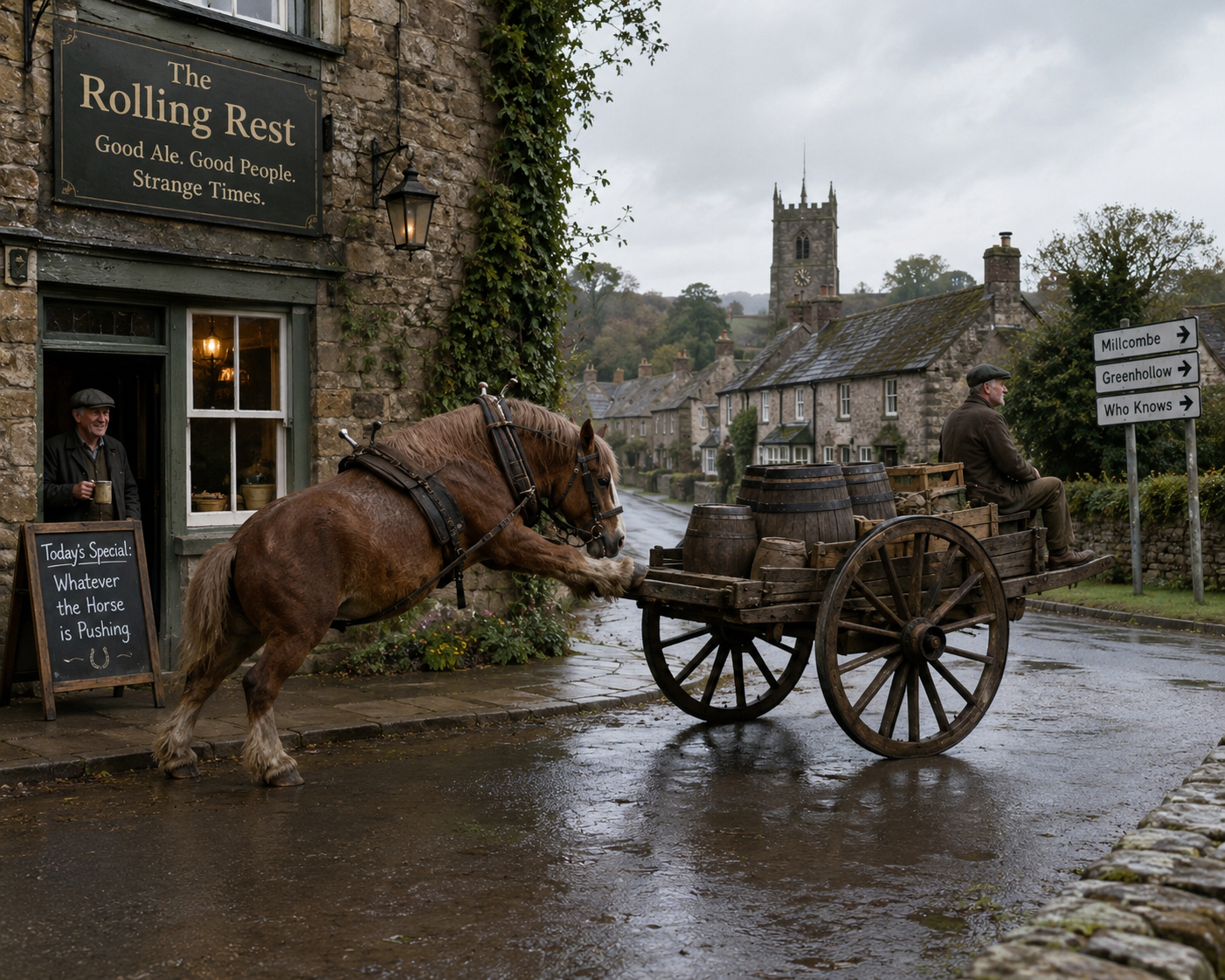
A horse walks into a bar for the eleventh time in a week.
The bartender looks concerned and asks the horse;
“You’re in here pretty often fella, do you think you might be an alcoholic?”
To which the horse replies;
“I don’t think I am.”
Then POOF! The horse disappears.
To this image, any philosophy student begins to giggle, as they are familiar with the philosophical proposition of cogito ergo sum, or roughly, “I think, therefore I am.”
But to explain that concept beforehand would be putting Descartes before the horse.
The very joke plays on the structure of narratives, that puns only work at the end and not the beginning, whilst also playing on homophones, and playing on the issue of ostracising audiences with ambiguity.
Literature works best when the message is felt like the pun of a joke, something that happens by the end and not in the duration, something that might feel strange and confusing during the reading (a horse frequenting a bar!?) but is clearer by the end. This is the Russian Formalist concept of defamiliarisation which posits that Literature intends to take a world which we know well and reshape it into something new and strange. The Descartes jokes make a better demonstration of defamiliarisation than the left handed golf clubs, but it is also less likely to be understood by students who may not be familiar with ‘I think therefore I am’.
So both jokes work to demonstrate the way we analyse Literature, as an act of slow perception, of purposeful ambiguity, of subjective experience, and a pay off at the end after some cognition has occurred. This is the inverse of the Language texts. Literature’s ambiguity – those steps we need to walk to get to the final meaning – is what we are attempting to identify and classify as critics.
- Literature is the study of symbolic and interpretive ambiguity
- Language is the study of grammatical and transactional certainty
Jokes make a neat little packet of thought that helps students to conceive the wider discipline, and have within them a metacognition that helps to navigate the facts, concepts and procedures that make up the field of Literature.
Leave a Reply