
There has been a gap in my knowledge. I hold my hands up and announce; my degree was in English (not Literature), with a minor in Journalism. I was not trained academically in the procedures of Literature analysis. This has led in the past to what I now see as deficiencies in my delivery of teaching Literature. My delivery was driven and directed by the pedagogy of the department and like all freshly qualified teachers, I required the structure of the department to guide my delivery. What we taught was always to read a book, track the characterisation, the change in mood, the significant plot points. Afterwards, we would focus on reducing the text down to its significant quotations, ‘exploding’ those into degrees of meaning, labelling the quote as a ‘device’. We would ‘contextualise’ the quote and identify what part of the author’s society was visible through the quote. Is it wrong to proceed through a text in this way?
Today I would feel this procedure not to be one of Literature, but one of Literacy. Much of this is about reading for meaning, reading fluently, building in recall, and building reading stamina. These procedures establish a good baseline of reading skill or reading quality, and so they are not without value. They are arguably, the baseline for the study of Literature, but they are not the given procedure of Literature. Literature requires a text and clear knowledge of the text, but Literature is also a set of methodological principles that is independent of the text. The literacy is a personal skill and not ‘powerful knowledge’ as Michael Young would prioritise. Schools have a responsibility to give to students a specialised, systematic form of knowledge that comes from within a discipline, and the skill of reading does not quality as academic knowledge. Literature contains powerful knowledge, and powerful procedures that can be used to access any given text and is a transferable skill, which needs to be explicitly taught to students, it cannot be developed through discovery learning as argued by Barak Rosenshine.
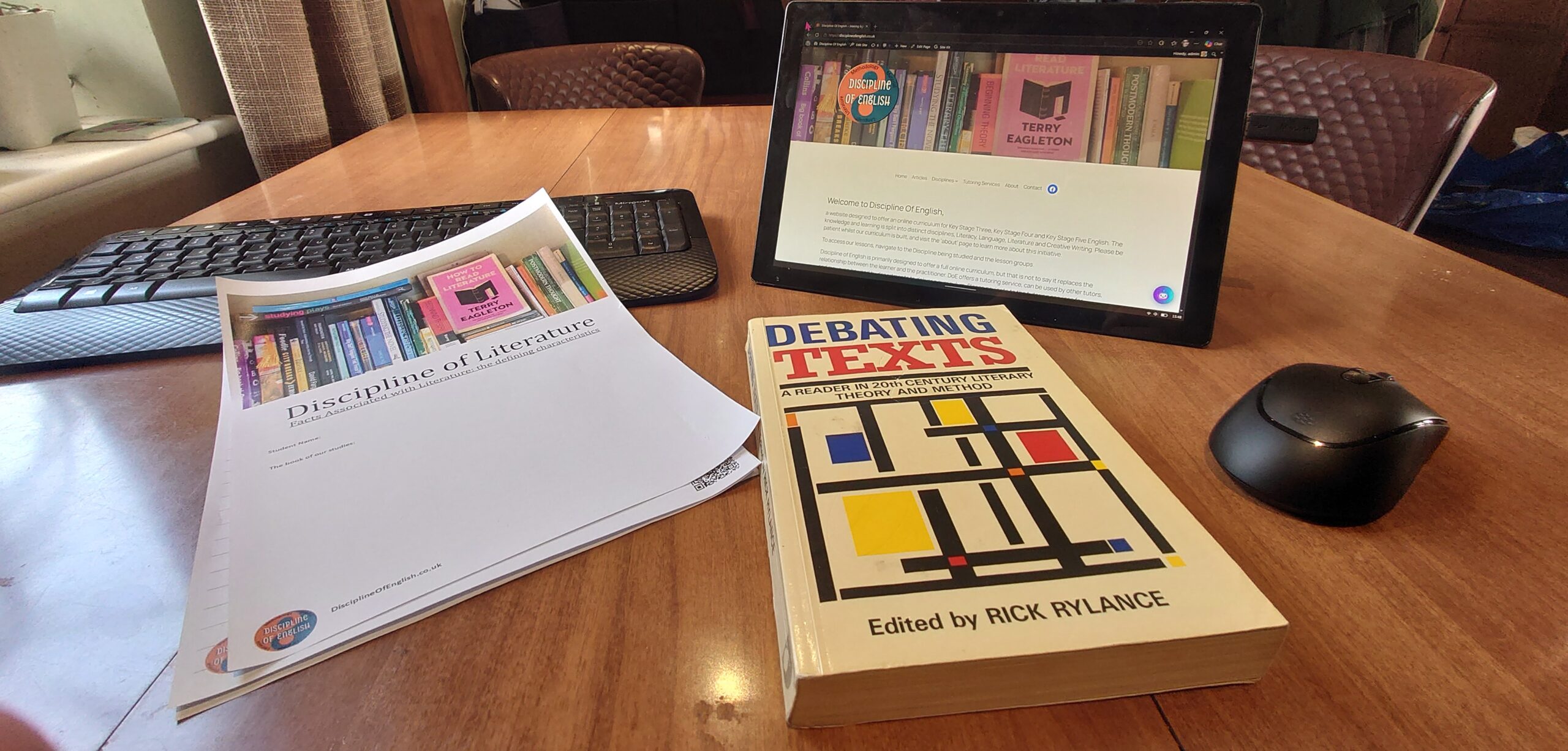
This is where Rick Rylance’s Debating Texts comes in. His introduction lands on this very problem;
These contexts are intellectual and methodological, for the choices we make about which works to study, which critical methods we bring to bear, and what aims and purposes we have in view for such an activity, must have a determining impact on the conclusions we form about our reading. At all events, it is certainly the case that at different times, and for different reasons, critics have urged attention on particular critical procedures, and that in turn these have had effects on the institutional study of literature. When critics or educational policy makers propose such procedures they are engaging in activities of a theoretical kind.
It is through Debating Texts that we can come to some procedure undertaken by critics and done upon the material text, what Thomas Dale calls the ‘object’ of study. Rylance notes that the range of critical methods available to Literature is very large, and each itself highly sophisticated, and so it becomes crucial that we make selections. With selections of course comes subjectivity and bias and I myself will be taking a ‘reading’ of Debating Texts. The aim is to produce some Secondary education appropriate procedures for the study of Literature.
One thing that the procedures must achieve is to reflect the conceptual language being taught, the characteristics and the theories. These areas have already been written up and were heavily influenced by Peter Barry, Michael Alexander, Adrian Johns, Elizabeth Eisenstein, Jeremy Hawthorn and Terry Eagleton to name a few. But thankfully, they all draw from similar literary traditions of Structuralism, Formalism, Poetics, Marxism etc.
The Force of Tradition
In the early C20th, F.R. Leavis promotes what becomes known as ‘practical criticism’. This procedure nots the importance of the ‘tradition’ of Literature, the singular noun being important here, in which historical experiences and values permeate throughout. Leavis promotes also the objective, impersonal reading of texts. This ‘historicism’ is possibly one of the least developed elements of a literature curriculum, and though other texts are included in the wider curriculum, the intertextual nature, the dialogic nature or the genealogy of meaning is not well developed. Rylance puts it very clearly;
No poet, no artist of any art, has his complete meaning alone. His significance, his appreciation is the appreciation of his relation to the dead poets and artists. You cannot value him alone; You must set him, for contrast and comparison, among the dead. I mean this as a principle of aesthetic, not merely historical criticism. The necessity that he shall conform is not one sided; What happens when a new work of art is created is something that happens simultaneously to all the works of art which preceded it. The existing monuments form an ideal order among themselves, which is modified by the introduction of the new work of art among them (p7).
Rylance uses the syntax of ‘refinement’ done upon Literature by the addition of new works, not improvement or development. I would add to this, ‘vectoring’; that a small shift in pace or direction is done upon the tradition by new works. It is not repairing, nor is it correcting. Adjusting, but only in incremental ways. What was the rudder to the Titanic? Too small to make a meaningful alteration in such small unit of space and time. Authors are small rudders added to large vessels of tradition. This analogy however fails to depict the importance of speaking back to previous works and continuing the discourse that was started eons ago, and so maybe ‘Chinese Whispers’ brings to mind that we receive something from the person before us, and we pass it along with our own inflection to the next person, contaminated by mishearings or selection bias. Or maybe a chain in a link; no author can simply design their own gauge of wire in the chain link and it must conform to the gauge of the link before it. There can be no ur-form, np truly original piece of work. It must be designed to fit within the link before it, it must be designed to continue the conversation passed to it, it must can only be a small influencer on the direction taken by a vast and weighty heritage.
And what of spontaneity? What of a readers personal and subjective experience? What of our own internal and immediate reactions? Rylance draws from Wordsworth;
Spontaneity, that is, as Wordsworth seeks it, involves no cult of the instinctive and primitive at the expense of the rationalised and civilised; it is the spontaneity supervening upon complex development, a spontaneity engaging an advanced and delicate organisation (p15).
Authors themselves are not necessarily writing unique and un-prompted works, they are not abandoning the path being worn in. And neither should the critical reader, whose aim is to map the path being taken by literary tradition by becoming well trained, ‘ideal readers’.
Q.D. Leavis (Queenie Dorothy), wife of Frank Raymond Leavis, closes this section of the significance of literary tradition;
To learn anything of this novel’s true nature we must put it into the category of novels it belongs to – I have specified Women In Love and Jules et Jim Might and might add Anna Karenina and Great Expectations – Ignite its relation to the social or literary history of its own time (p29).
These categories are ultimately taxonomical branches, genealogy within literature, through which authors continue to talk backwards to one another. And to know the true nature, the discussion being had, we must account for these related texts.
From Rylance then we obtain our first procedure of academic literary studies; we must be able to trace the history of related texts and know the conversation being had by these authors. There is the potential to trace this conversation right back to the very beginning of story telling; to the oral tradition of folk lore and tales. But Queenie clarifies, of its own time is sufficient.
Before reading a text, we should come at it with some awareness of the preceding dialogue:
- What is the conversation about,
- which authors are advancing the conversation,
- what is the ideological perspective being delivered by each text,
- how does this compare or contrast to each succeeding text?
Then, students can take the text to read. Instead of mapping characters, plots, tone and reducing the text into key quotations, a critical reader is looking for the author’s use of the text as a response to the discussion. Is the author comparable to previous authors, or contrasting with them? We can see the ‘powerful knowledge’ now as knowledge of texts, authors and perspectives and not as a powerful reading, the skill of reading, or the perseverance of reading. Literature is not even the enjoyment of literary texts. But it could be an enjoyment of the debate being had between authors. This is the nature of Literature and becoming a critical reader, one that is aware of the discourse. It is an entirely different approach to Secondary education, which I fear is often limited to literacy skills rather than Academic knowledge.
This will become the first lesson on procedures of Literature, and further posts reflecting on Rylance are planned.
Leave a Reply