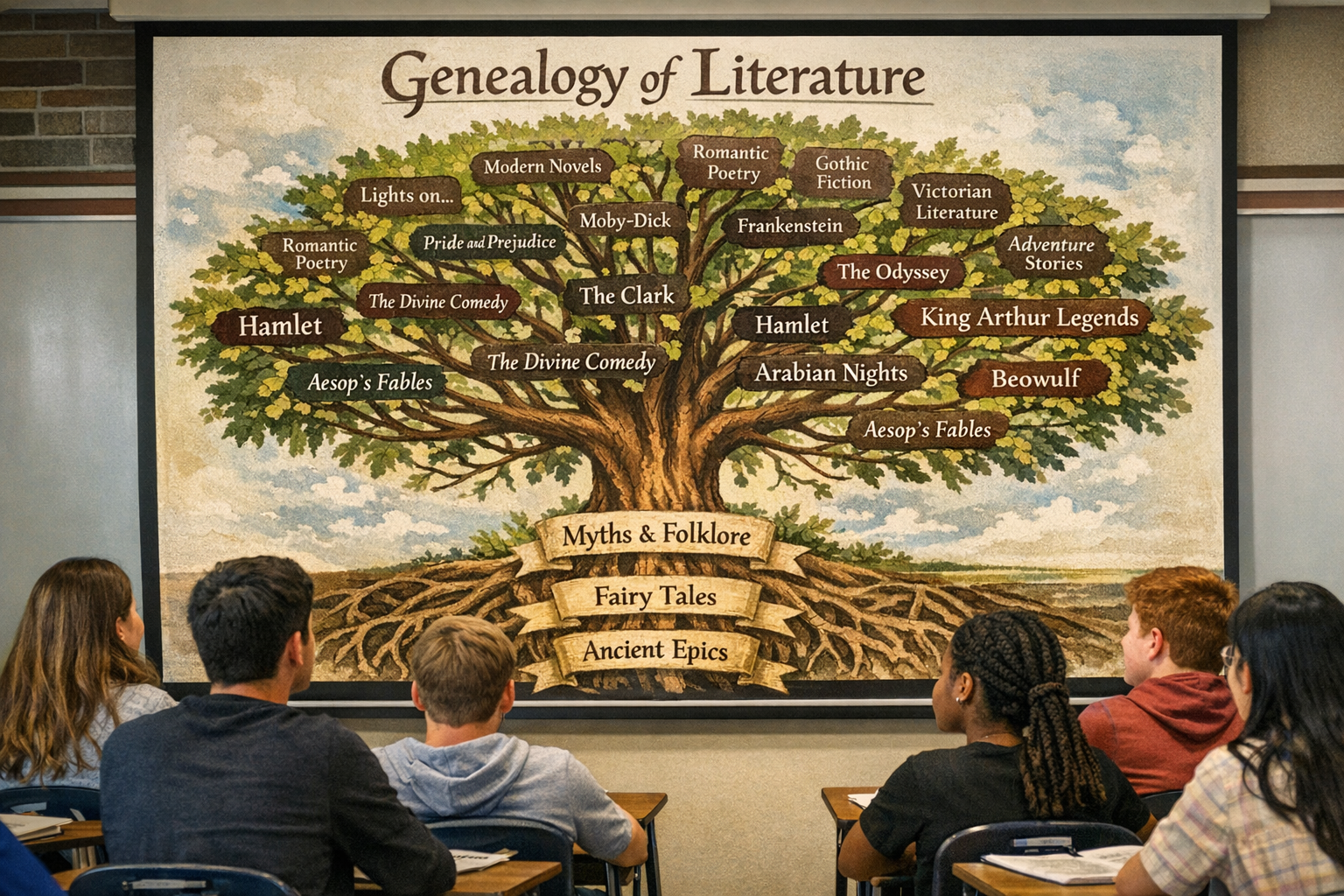

The curriculum structure being used by Discipline Of English was established by Lorin Anderson and David Krathwohl in their work on the Cognitive Domain. Their proposal is that cognitive domains require facts, concepts, procedures and metacognitions to fulfil their knowledge requirement.
The facts (defining characteristics, measurable qualities, or stable attributes) and the concepts (terminology, patterns and trends, theories and hypothesis) are well established in various textbooks. But as we progress toward the procedures undertaken when investigating a new text, there is increasing difficulty in locating and interpreting the actions of the critic (‘critic’ being to Literature, as sociologist is to Sociology, or historian is to History). But it is a difficulty that needs resolving as the procedure of English Literature at secondary schools is not well defined, and possibly contaminated through conflation of procedures from other disciplines.
One of the early literary critics who championed a rigorous analytical procedure of literary texts was F.R. Leavis. Leavis repeatedly insisted on “searching critical intelligence” and paying close attention to the text, rejecting biographical or historical approaches. Critics have long noted that Leavis did not particularly spell out his ‘systematic procedure’ however, leaving critics in the dark. René Wellek, for instance, argued that Leavis’s criteria were narrow, moralistic, and insufficiently theorised — meaning the grounds of his judgments were often implicit rather than methodologically explicit. It has created a sense of the critic as someone who has a sixth sense for credibility in literature. Leavis’s style is famously assertive, even dogmatic. J. B. Priestley and George Steiner both criticised the authoritarian tone of his judgments and the sense that his evaluations rested on cultivated taste rather than articulated procedure. Leavis was criticised ultimately that his authority was performative, an enacted judgement and not a transparent teachable procedure. This performative, moralistic authority persists today, in which the methods being followed by the teacher seem unteachable.
What is the current procedure for Literature in the classroom?
One procedure undertaken when reading literature in class is tracking the characters, exploring the way they have been characterised, identifying plot points and settings. This procedure is quite material centric; these points are paraphrases of the text and show that it has been read but are not yet grounded in academic language. For this reason, it is not a procedure of Literature, but rather a procedure of Literacy. Handbooks of critical Literature do not use this level of comprehension as the starting point of a procedure for analysis and whilst we might argue that a student cannot analyse what they have no understood, it is important that we place into the hands of students a book they can understand, so that it can be analysed. This is how students will learn the procedures of analysis. So what are the current practises of analysis in a Literature curriculum?
Secondary Literature procedures prioritise the selection of some evidence, to then create ‘word explosions’, and define ‘layers of meaning’. The criteria for the quote is usually in the linguistic quality. Where an author has used a nameable linguistic technique, usually a metaphor, simile or dramatic irony, a criteria for selection is checked. The procedure then is in explaining the ‘hidden meaning’ behind the language which often amounts to no more than paraphrasing the implicit as explicit. The procedure is to identify and name a form, then to explain its function; here is a metaphor, its purpose is to mean x. Students operate like dictionaries. This type of analysis does appear in critical handbooks, but it is arguably only a very small part of what the critic is doing. This continues to be a problem with the learning of Literature studies in Secondary education. Teachers often take an authoritative, moralistic and performative procedure when selecting evidence that is often unclear to students, who cope by having to learn quotes by wrote and deploy quotation banks of ‘correctness’. They aren’t taught why those quotes are more valuable than an alternative.
Other procedures given by teachers are to identify common trends in meaning referred to as ‘themes’. Once identified, a student is able to ‘analyse’ a larger portion of the text by recognising repeating functions, but it is still ultimately an act of paraphrase.
We teachers implicitly know that this type of paraphrase is not true analysis, that simply decoding the linguistic into its implied meaning is not a Literature academic procedure. We see that it caps students to the C/D 4/5 grade boundary. This paraphrase fails to grasp the deeper purpose of literary analysis and so limits grades to the ‘literacy’ level – we acknowledge the student has read and understood the material for its inner content. Higher grades require some external academic agent being deployed upon the text. Literature studies is not simply reading and knowing a book for its content; Literature places books into a much larger pattern and it is the external that is more relevant to analysis.
The problem of context
Another procedure undertaken is that of context – explaining how the world of the author can be witnessed within the text. This isn’t a paradox with my earlier statement that secondary literature analysis is text focused and inward looking. Context is limited to localised events that become part of the narrative. For example, King James I wrote a book about witches, therefore Macbeth contains witches. There was an assassination plot against James, therefore Macbeth contains an assassination plot. Whilst these localised events are relevant to the narrative, we only select those events because of the narrative within the story. Students have still not been taught of the lasting literary legacy.
The problem with how secondary schools treat ‘context’ is complex. Literature is fundamentally not thousands of individual, unrelated texts that can be studied in isolation. Literature is not an archapeligo of islands. Literature is one long continuous story and each new book merely a chapter in the continuation of a tradition. Like chapters in any book, the ‘latest’ can be best understood if the prior chapters were read first, and in sequence. Like a soap opera, if we come in as a fresh reader with no knowledge of earlier episodes, we can begin to grasp the overall theme and direction of the tradition in just a few episodes but there will be many references to earlier episodes that don’t make sense.
Literary theorists across have consistently challenged the notion of the autonomous text, instead positioning literature as a historically layered taxonomy whose meanings emerge through relations with prior works. Mikhail Bakhtin’s account of dialogism establishes the foundational principle that every utterance is shaped by earlier utterances, where literary texts are part of an ongoing cultural conversation rather than discrete artefacts. Julia Kristeva develops this insight into a theory of intertextuality, arguing that each text is a “mosaic of quotations” in which earlier discourses are reactivated and transformed. Roland Barthes similarly dissolves textual boundaries by emphasising the circulation of cultural codes that precede and exceed any individual work. Gérard Genette formalises these relational dynamics through his taxonomy of transtextuality, demonstrating that genres, allusions, adaptations, and commentaries constitute the structural conditions under which texts acquire meaning. Even Harold Bloom’s more psychological model of influence presupposes a genealogical tradition in which new works emerge through acts of revision, misreading, and inheritance. Taken together, these theorists present literature not as a sequence of isolated events but as a cumulative, backward‑looking system in which each new text extends, reframes, or contests the branches of an evolving tradition.
Next steps for a procedure in Literature
So, procedures at Secondary school usually:
- Track characters and plot.
- Select quotes, often based on labeling, and engaging in quote ‘explosions’ that explore meaning.
- Use the narrative to identify events or issues surrounding the author.
The solution needs to recognise that:
- Mere knowledge of the text is not the academic, transferable discipline
- Extrapolating meanings and labels is more aligned with Language analysis
- Texts are often treated in isolation of the literary tradition.
- Whilst texts do observe the world around the author, examiners often ask that we don’t treat context like a history lesson.
- The genealogy of literature is poorly developed.
How do we resolve this deficiency in procedural analysis? For this, I am reading Rick Rylance’s Debating Texts. Here we can find some guidance as to what the academic discipline of Literature does with a text and why, to what end. The aim of the ‘Procedure’ pages of this curriculum is to present some lessons that can be delivered at Secondary level to impart some notion of academic procedures in Literature. It intends to outline in basic terms a good starting point for reading, what to look out for, and what to do with a text. It intends to reduce the procedure into something that is academically rigorous and still suitable for secondary education. It intends to ‘level-up’ the quote, label, explode, contextualise approach.
Glossary:
- Literary heritage / Literary Tradition – the way literature is not seen as many unrelated, isolated texts, but as one continuous text in which many authors advance further with new books. Therefore, understanding of a new book relies on knowledge of prior books. Texts as independent and closed systems should be rejected.
- Geanalogy – new works only emerge through relationships of texts in the past, or confrontations between texts.
- Taxonomy – texts only exist through their relations with other texts.
- Intertextuality – texts are part of a network, referring to one another.
- Dialogism – Authors talk to one another, responding by new texts which counter or advance the claims that went before it. Literature tradition is an unbroken chain of conversation.
Sentence stems:
- “The author seems to be in dialogue with a previous work, and they are challenging the idea that…
- “This work seems to have emerged from the existence of previous texts…
- “This work directly follows on from an earlier work…
Literary example:
Priestley’s 1945 play An Inspector Calls is part of a Literary tradition in which it is not a individual, self-determining text, but part of a taxonomy of texts in which one leads to another. An Inspector Calls traces its moral and structural genealogy through nineteenth‑century realist drama and Edwardian social critique. Its roots trace back to Ibsen’s A Doll’s House and Shaw’s Mrs Warren’s Profession, both of which expose bourgeois hypocrisy through domestic settings. Without these earlier texts, it is unlikely that Priestly could have written his own, because there would have been no prior statement or social critique for him to be in dialogue with. Priestly continues a dialogue regarding collective responsibility and moral awakening, which comes from these earlier branches of literature, positioning Priestley as a descendant of the realist tradition that uses the family home as a microcosm of society.
Leave a Reply