
How is power presented in the play Macbeth? Asked the examiner.
How? Asked the student…How? Through words… as a play… How? Well as something desirable to Macbeth and Lady Macbeth. They desire it so much they are willing to kill a King for it. And They must plot carefully for it. And they must continue to kill others like Banquo, Fleance and Macduff for it, though, not always successfully. Power is something they want, but not something that is psychologically good for them and both descend into a kind of depression, guilt and nihilism. By the end of the play, power is presented as something not belonging to Macbeth because power is inherited, ordained. Power is a social order and one cannot simply change the degree of power that one is born with – your power is some fixed part of your identity and a birthright, thus we get the great chain of being. Power in Macbeth, is very different to today’s power. And seeing power back then might make us thankful of the democratic power that citizens have today.
How! Said that assessor… How was it presented? You have done a fantastic job of telling back the story to me and you’ve extended it with some correct context, but I’ve not discovered much about the story that couldn’t be known by simply reading the text. What I can see here is your literacy level, I can see you have a sophisticated ability to read a text, recall details of the text and make selections from this. I can see you have responded to the ‘power’ bit of the question, and the ‘Macbeth’ bit but what about the ‘How’ bit? I’m assessing a paraphrase of the story… not some learning that can only have been gained through teaching and learning, through the relationship you have with a subject expert.
This imagined conversation is influenced by a wide range of comments and examiner feedback I read; that there often seems to be an expectation to do more than simply retell the story. And whilst my student response above is a concentration of an answer, hydrating this back into a full response with more and more textual detail doesn’t change the domain of knowledge the respondent is using.
Students can often exhibit a full and sophisticated review of a text and the paragraph above be fleshed out to pages and pages of textual detail. But, has the extended version really done something different to some much reduced response? Does saying 10 words where one will do make there response more sophisticated? Has the full essay really said anything more meaningful than the reduced version here?
Play a mindgame with me. Or better yet, grab a student response and try the following. Take two highlighters. Create a colour code
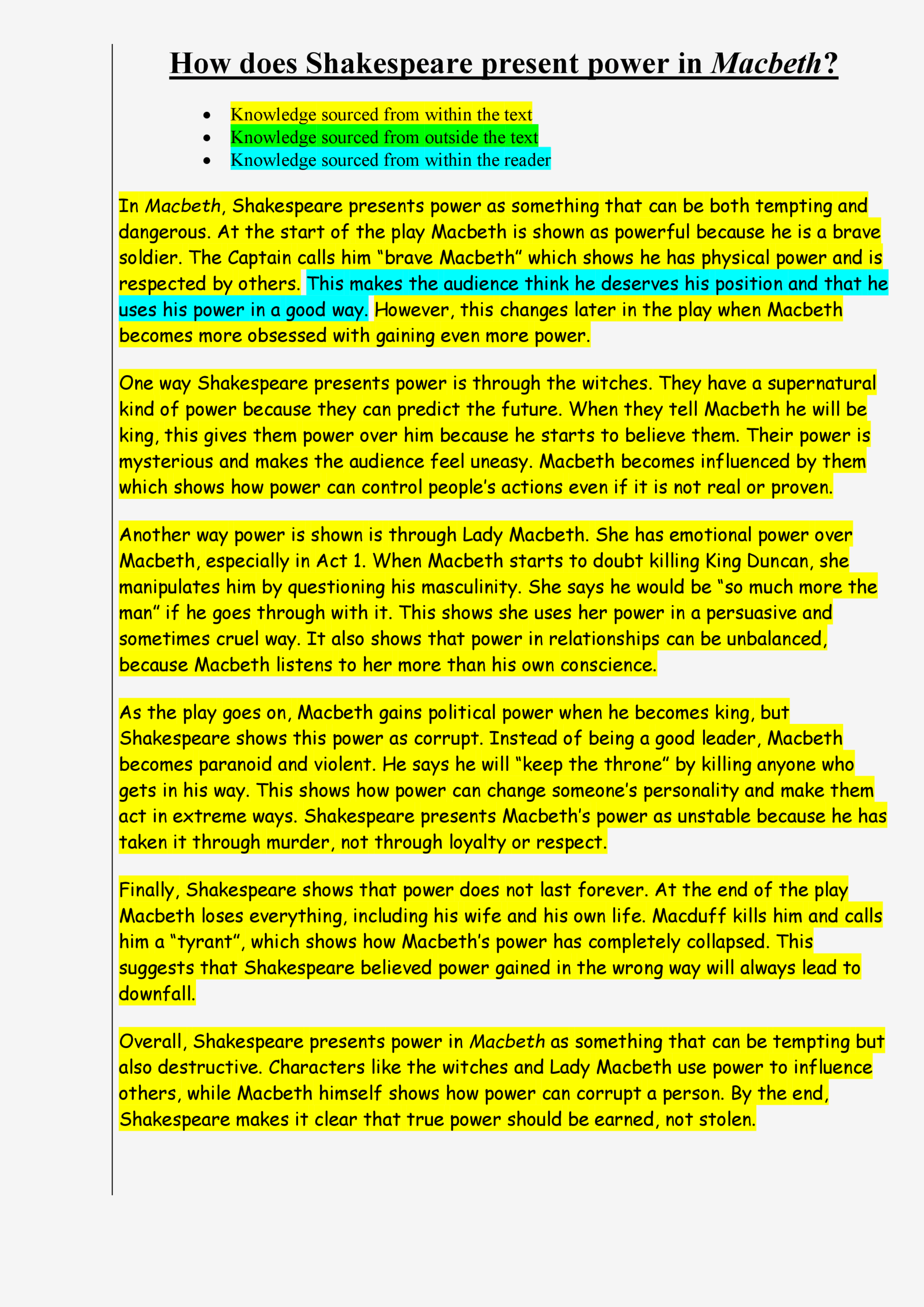
Read closely everything highlighted in yellow. It it something that reasonably could have been understood by a student with a high enough literacy skill? If a student lacks the ability to read, know and report back this knowledge, is the student progressed through new knowledge or advance in their reading skill?
What knowledge could only have been known from the teaching and learning with a subject specialist? What knowledge could not have been gained from reading the text Macbeth? It’s really hard to find any actually. There is language from the student such as ‘conscience’, ‘corrupt’, ‘mysterious’, and ‘supernatural’. But these are not terms outside of the bounds of literacy skill.
It’s not an exact model of what many students are doing. Many are also applying category labels such as ‘metaphor’, ‘genre’ and ‘theme’. But Literature begins at year 7 and ends at year 11; five years of Literature study culminating in a small number of labels. Are students doing more; ‘foreshadowing’, ‘dramatic irony’ or maybe even ‘symbolism’ maybe? If this model were to use those terms, really all we are highlighting is single words here and there. An essay is still predominating in recalling textual reading, a literacy skill, and lacking in actual knowledge of Literature principles, a knowledge domain.
This for me is the biggest downfall of Literature teaching. Its focus on reading, recall and labelling of language features inside the text leaves students bereft of actual Literature analytical facts, concepts or procedures that form true analysis. Discipline Of English intends to reverse this curriculum and focuses on the academic identity of Literature. This knowledge is what is applied to texts to create a true analysis; the synthesis of academic knowledge with cultural material. That is the Literature curriculum we should be working towards to teach students how to read from a critical perspective, and not just how to read through a Literacy skill.
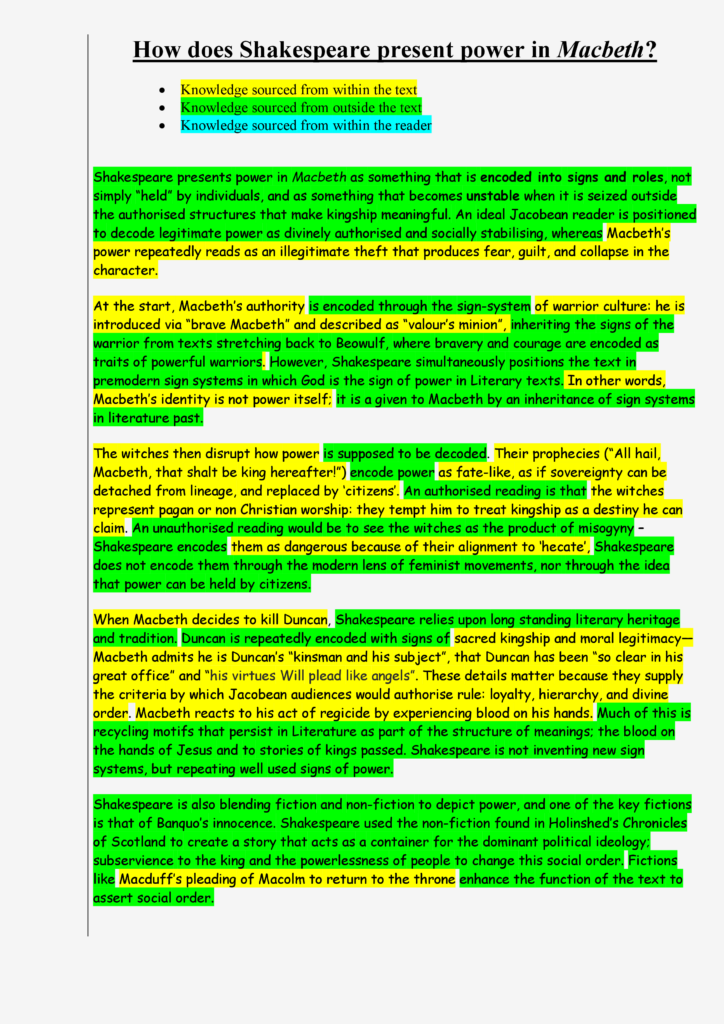
This essay is now annotated with a very high content of academic literature. Everything in green is something that would reasonably only be known by a student who has had some tuition in Literature. It consistently talks about Literature as a system of signs, that are not original to the text but inherited from earlier texts. It understands that texts have function, political motivation. It understands that Literature is written with an ideal reader in mind, who is able to understand an authorised meaning. The response recognises that modern interpretations are not the reading authorised by the author.
These statements are effectively approved statements, and can be synthesised with any text. They are solid ‘right answers’, that are based on tutelage and recall, not subjective interpretation.
This is how I perceive the truest analysis of Literature; it is the synthesis between a set of academic language and a text. When students are told not to simply paraphrase the text, it is this academic language that is lacking.
Leave a Reply